

Key takeaways
- The best outdoor storage sheds depend less on brand than on matching the shed’s footprint, material, foundation, ventilation, and door layout to the way you use your yard. For most homeowners, a resin shed is the easiest low-maintenance choice; a…
The best outdoor storage sheds depend less on brand than on matching the shed’s footprint, material, foundation, ventilation, and door layout to the way you use your yard. For most homeowners, a resin shed is the easiest low-maintenance choice; a metal shed suits a tighter budget and basic tool storage; and a wood shed is the most adaptable option when appearance, insulation, or custom shelving matters.
Our top picks


As an Amazon Associate we earn from qualifying purchases at no extra cost to you. Ratings are shown as listed on Amazon.
Quick comparison: which shed fits your yard?
| Shed type | Useful sizes | Typical empty weight | Foundation requirement | Assembly time | Best for |
|---|---|---|---|---|---|
| Resin or plastic | 5 × 3 to 15 × 8 ft | 80–700 lb | Level base; a floor kit or platform is often recommended | 3–10 hours | Low-maintenance storage, bikes, lawn equipment |
| Galvanized steel | 6 × 3 to 12 × 10 ft | 70–500 lb | Firm, level platform; anchoring is essential | 4–12 hours | Budget tool storage and narrow side yards |
| Wood | 6 × 8 to 16 × 24 ft | 500–3,000+ lb | Raised, level foundation or concrete slab | 1–3 days for a kit | Custom layouts, attractive garden studios, heavier equipment |
| Metal-framed resin | 8 × 6 to 15 × 8 ft | 250–900 lb | Rigid level base, usually with anchoring points | 6–14 hours | Large storage with less maintenance than wood |
These figures are planning ranges rather than specifications for one particular model. Wall thickness, roof design, included flooring, and packaging can change the final dimensions and weight. Always compare the assembled exterior footprint—not just the advertised nominal size—with your available space.
Best outdoor storage sheds by situation
Best for small yards and side passages: narrow resin or steel
A 5 × 3 ft or 6 × 3 ft shed can hold long-handled tools, a mower with a compact deck, hoses, folding chairs, and seasonal supplies without consuming the whole yard. Resin models from established manufacturers such as Suncast, Rubbermaid, and Keter are generally easier to clean and less vulnerable to surface rust than steel. A narrow galvanized-steel shed can cost less and may offer more usable wall height, but its panels can dent and its edges require careful assembly.
For a side passage, check three measurements: the shed’s maximum width, the clearance needed to carry panels into position, and the door swing or sliding-door track. Leave approximately 24–36 inches of walking clearance where possible. A shed that technically fits but blocks a gate or downspout is a poor purchase.
Best for lawn equipment: medium resin or metal-framed resin
For a push mower, trimmer, leaf blower, bags of soil, and hand tools, a 6 × 8 ft shed is a practical starting point. Choose double doors or an opening at least 48 inches wide if you will roll equipment in and out regularly. A single 30–36 inch door may be adequate for shelves and tools but becomes frustrating when the mower must be tilted or partially disassembled.
Brands such as Lifetime, Keter, and Suncast offer resin designs in this general category, although features vary considerably by model. Look for a reinforced roof, a floor designed for the shed, lockable handles, skylights or windows only if you want daylight, and ventilation openings positioned high and low. A vent near the roof allows hot air to escape, while a lower vent helps reduce stagnant moisture.
Best for maximum value: galvanized steel
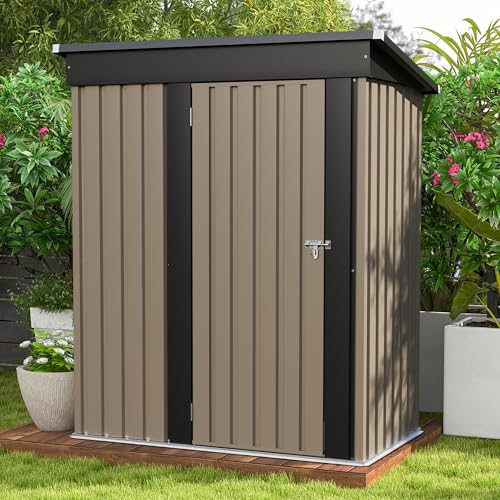
Steel sheds from brands such as Arrow are often attractive when the goal is secure, inexpensive storage rather than a backyard focal point. They can provide good volume for the money and are unaffected by wood rot. Their weaknesses are equally important: thin panels may flex, interior temperatures can rise quickly in direct sun, and condensation may form when warm humid air meets a cool metal roof.
Use a steel shed for tools, empty containers, ladders, and outdoor equipment. Add a raised floor, wall shelving, and ventilation where the design permits. Do not assume a padlock alone makes a light steel shed theft-proof; anchoring the structure to its foundation is more important.
Best-looking and most adaptable: wood
Wood sheds are the strongest choice when you want windows, custom shelving, a workbench, or a finish that complements the house. They are also the most demanding. A wood structure needs a properly drained foundation, exterior paint or stain, periodic inspections, and prompt repair of damaged trim or roofing.
Wood kits commonly arrive unfinished or primed rather than fully weatherproofed. Budget for roofing underlayment, shingles or another roof covering, paint, hardware, and foundation materials. In return, you can add standard wall studs, pegboard, shelves, insulation, or electrical work more easily than with thin resin or steel panels.
How much shed space do you really need?
Estimate storage by grouping possessions rather than guessing from the floor area. A compact mower needs roughly 12–20 square feet including maneuvering space. A bicycle requires about 6–8 square feet when stored against a wall, but two bikes need an access path. Shelving can hold small items vertically, while bags of soil and wheelbarrows consume floor area.
Here is a useful sizing calculation. Suppose you have a 22-inch-wide mower, a 24-inch-wide wheelbarrow, and two bicycles requiring 28 inches of wall length each. A 6 × 8 ft shed has 48 square feet of floor area, but reserve a 30-inch-wide route from the door. That leaves approximately 28 square feet for equipment. It may work if the bicycles hang on wall hooks and the mower parks nose-in; it will feel crowded if everything remains on the floor. Moving up to 8 × 8 ft adds 16 square feet—about one-third more floor area—which can be more valuable than adding shelves to the smaller shed.
Foundation, ventilation, and access essentials
Foundation
Every shed needs a level, stable base, even when the manufacturer supplies a floor. Options include a concrete slab, pressure-treated timber skids over compacted gravel, or a purpose-built plastic or resin foundation system. Gravel improves drainage, while concrete offers the flattest surface for doors and heavier loads. Keep wood components away from standing water and confirm local rules before pouring a permanent slab.
A foundation that is only slightly out of level can cause doors to bind, roof panels to misalign, and water to pool along one wall. Check level in both directions before anchoring, then recheck after the walls are assembled.
Ventilation
Ventilation is especially important in humid climates and in unheated steel sheds. Choose cross-ventilation—openings on opposite walls or a vent plus a ridge or gable vent—rather than relying on a window that is usually kept closed. Keep cardboard, fabric, and rust-prone tools off the floor. A small gap around stored equipment is more useful than packing every corner tightly.
Door access
Measure the widest object you plan to store and add clearance. A 36-inch opening may handle a mower, but a 60-inch double door is more convenient for wheelbarrows, snow blowers, and bulky patio furniture. Sliding doors save front clearance; hinged doors can seal more tightly and are usually simpler to repair. Look for adjustable hinges, a sturdy threshold, and a lock point that cannot be easily flexed away from the frame.
Decision matrix for a faster choice
| Your priority | Recommended type | Target size | Important feature |
|---|---|---|---|
| Lowest initial cost | Galvanized steel | 6 × 3 to 8 × 6 ft | Anchoring kit and ventilation |
| Minimal maintenance | Resin | 6 × 5 to 8 × 8 ft | UV-resistant panels and an integrated floor |
| Frequent daily access | Resin or wood | 8 × 8 ft or larger | Double doors, clear aisle, interior lighting |
| Custom workshop use | Wood | 10 × 12 ft or larger | Rigid foundation, windows, electrical planning |
| Very limited footprint | Narrow resin or steel | 5 × 3 or 6 × 3 ft | Vertical shelving and sliding or outward-opening doors |
Assembly and ownership realities
Plan on a full day for a medium resin or steel shed if two people are available, and longer if the foundation must be built first. Wood kits often take one to three days because roofing, painting, and trim are separate tasks. Do not rush panel alignment: forcing screws into misaligned holes can strip threads, distort doors, and create leaks.
The parts that wear first are usually door hinges, sliding-door rollers, roof seals, floor edges, and exposed fasteners. Lubricate moving hardware according to the manufacturer’s instructions, clear leaves from the roof and base, and inspect after severe wind. Tighten loose anchors rather than merely straightening the shed. Replace cracked seals before water reaches stored tools.
For a 2026 purchase, compare the delivered cost of the shed, foundation, anchors, shelves, and assembly—not only the panel price. A less expensive steel unit can become the costlier option if it needs a separate floor, extensive anchoring, and replacement shelving. Conversely, a resin shed with an included floor may offer better value for a homeowner who wants quick setup and little annual maintenance.
Final recommendation
Choose a narrow resin or steel shed for a small yard, a 6 × 8 ft resin shed for everyday lawn equipment, galvanized steel for economical basic storage, and a wood shed when appearance or customization justifies ongoing maintenance. Whichever material you select, prioritize a genuinely level foundation, adequate door width, cross-ventilation, and at least 20–30 percent spare capacity. That extra room is what keeps a storage shed usable after the first season rather than immediately turning it into an overfilled closet.





Write Your Review
No reviews yet. Be the first to share your experience!