

Key takeaways
- Stud-mounted hooks: The preferred option for drywall-covered walls. Use structural wood screws long enough to penetrate the stud by roughly 1 1/2 inches after passing through the bracket and drywall.
- Masonry-mounted brackets: Suitable for concrete or brick when paired with the correct masonry anchors. Do not assume a general-purpose plastic plug is appropriate for a heavy ladder.
- Drywall-only anchors: Acceptable only for very light decorative ladders or display use within the anchor’s stated capacity. They are a poor choice for full-size extension ladders.
- Ceiling hooks and lift systems: Useful in garages, but they must be attached to ceiling joists or a properly engineered support frame. Never rely on the ceiling finish alone.
- Freestanding ladder racks: A good alternative when you cannot drill into the wall. Look for a broad base, anti-tip feet, and a stated capacity exceeding the combined weight of all stored ladders.
The best ladder storage hooks are heavy-duty steel hooks rated well above your ladder’s weight, mounted into structural framing, and padded wherever the hook touches painted aluminum, fiberglass, or finished wood.
Our top picks


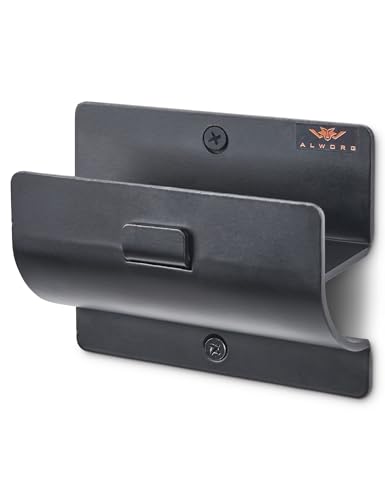
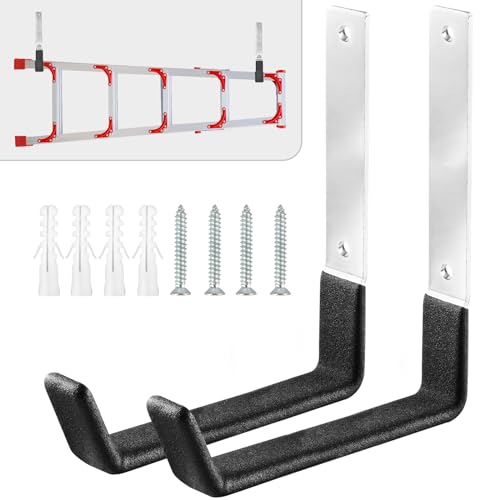
As an Amazon Associate we earn from qualifying purchases at no extra cost to you. Ratings are shown as listed on Amazon.
Best ladder storage hooks by situation
| Storage situation | Best hook style | Recommended working load | Minimum clearance | Why it fits |
|---|---|---|---|---|
| Occasional household step ladder | Single or pair of utility J-hooks | At least 25 lb per hook | 4–6 inches from the wall | Compact and inexpensive for a light, short ladder |
| Frequent-use extension ladder | Wide, padded double hooks or ladder rack brackets | At least 50 lb per hook | 8–12 inches from the wall | Provides better rail support and easier lifting |
| Heavy fiberglass extension ladder | Steel brackets fixed to studs or masonry anchors | 75–100 lb per hook | 10–14 inches from the wall | Handles greater weight without concentrated rail damage |
| Decorative ladder used as a blanket rack | Small padded utility hooks or concealed brackets | At least 15 lb per hook | 3–5 inches from the wall | Protects the finish and keeps the display close to the wall |
| Garage ceiling or overhead storage | Ceiling-mounted ladder lift or paired support hooks | At least 1.5 times the ladder’s weight | Clear the garage-door travel path | Uses unused overhead space, but needs careful anchoring |
These are practical starting points, not substitutes for the manufacturer’s load rating. A hook rated for 50 pounds should not routinely carry a 50-pound ladder; aim for a safety margin of at least 50 percent, especially when the ladder is lifted, bumped, or placed onto the hooks unevenly.
What makes the best ladder storage hooks?
Weight capacity and load distribution
Check the ladder’s actual weight on its label or manual rather than estimating from its length. A lightweight aluminum step ladder may weigh 15–25 pounds, while a tall fiberglass extension ladder can weigh 40–75 pounds or more. Add anything stored with it, such as a stabilizer, leveler, or detachable tool tray.
Divide the total weight between the supporting hooks, then add a margin. For example, a 52-pound ladder supported by two hooks places approximately 26 pounds on each hook. With a 50 percent margin, each hook should be rated for at least 39 pounds, so a pair rated at 50 pounds per hook would be a sensible minimum.
Load ratings apply only when the hook is installed as specified. A high-capacity hook screwed into drywall alone is not a high-capacity storage system. The wall connection, fasteners, substrate, hook shape, and ladder position all limit the result.
Mounting style
- Stud-mounted hooks: The preferred option for drywall-covered walls. Use structural wood screws long enough to penetrate the stud by roughly 1 1/2 inches after passing through the bracket and drywall.
- Masonry-mounted brackets: Suitable for concrete or brick when paired with the correct masonry anchors. Do not assume a general-purpose plastic plug is appropriate for a heavy ladder.
- Drywall-only anchors: Acceptable only for very light decorative ladders or display use within the anchor’s stated capacity. They are a poor choice for full-size extension ladders.
- Ceiling hooks and lift systems: Useful in garages, but they must be attached to ceiling joists or a properly engineered support frame. Never rely on the ceiling finish alone.
- Freestanding ladder racks: A good alternative when you cannot drill into the wall. Look for a broad base, anti-tip feet, and a stated capacity exceeding the combined weight of all stored ladders.
For a wide extension ladder, a pair of hooks is usually safer and easier to handle than one central hook. Position the supports so they carry the ladder’s side rails rather than thin rungs. Two supports also reduce twisting when the ladder is removed.
Clearance: the measurement people miss
Hook depth is not the same as usable storage clearance. Measure from the wall to the furthest part of the mounted ladder, including the hook’s back plate, padding, rails, and any protruding rung hardware.
A step ladder often needs only 4–6 inches of clearance. An extension ladder may need 8–12 inches, and a ladder with wide stabilizer feet may require more. Leave enough room to grasp the rails with both hands. If the ladder is difficult to lift off the hooks, users tend to drag it sideways, which can loosen fasteners and damage the wall.
Also check nearby doors, vehicles, shelving, light switches, garage-door tracks, and walkways. A ladder stored at shoulder height should not project into a route where someone can strike it. For vertical storage, use a lower retaining point or strap so the ladder cannot tip outward.
Padding and surface protection
Padding is more than a cosmetic extra. Bare metal can scratch aluminum rails, chip painted steel, and create point pressure on fiberglass. Look for hooks with thick rubber, vinyl, or closed-cell foam sleeves. A sleeve around 1/8 to 1/4 inch thick is generally adequate for household storage if it is firmly attached.
Choose padding that is tight and continuous rather than a loose piece that can slide off when the ladder is removed. Inspect it periodically for compression, tearing, or exposed metal. Replace worn sleeves before the ladder rests directly on the hook.
For a decorative wood ladder, use soft, non-marking padding and avoid rough textured coatings. If the ladder has a delicate painted or waxed finish, add a thin felt or rubber contact layer, but ensure it cannot bunch up and make the ladder unstable.
Head-to-head: common hook designs
Open J-hooks versus enclosed ladder brackets
Open J-hooks are inexpensive, easy to install, and convenient for a step ladder used often. Their drawback is that a bumped ladder can shift or roll out, particularly when the hooks are shallow. They work best when the ladder is light and the storage location is protected.
Enclosed or deep ladder brackets hold the rails more securely and distribute contact over a larger area. They are preferable for heavy extension ladders, high-traffic garages, and locations where vibration or accidental contact is likely. They occupy more wall space and may require lifting the ladder slightly higher to clear the bracket.
Single hooks versus paired supports
A single hook can hold a small decorative ladder, but it concentrates force at one point and allows the ladder to rotate. Use two hooks for any ladder that is long, heavy, frequently moved, or valuable. For a very long extension ladder, three support points may be appropriate if the bracket manufacturer permits that arrangement and all supports are aligned in the same plane.
Installation steps that prevent failure
- Weigh and measure the ladder. Record its weight, rail width, maximum depth, and the distance it will project from the wall.
- Choose the mounting surface. Locate studs with a stud finder and confirm their position with a small pilot hole. For masonry, identify solid material rather than a hollow section or mortar edge.
- Mark level support points. Place the hooks beneath strong rail sections, not where a flexible accessory or thin rung will carry the load.
- Pre-drill correctly. Use a pilot bit suited to the fastener and substrate. Oversized holes reduce holding power; undersized holes can split wood or distort the mounting hardware.
- Tighten without crushing the bracket. The hook should sit firmly against the wall, but over-tightening can bend thin metal or compress drywall.
- Test gradually. First press down by hand, then hang the ladder carefully. Watch for wall movement, fastener pullout, hook bending, or contact with nearby objects.
- Add a restraint where needed. A strap, retaining lip, or second lower hook helps prevent a vertically stored ladder from tipping.
Do not hang a ladder from its top rung unless the storage hardware is specifically designed for that load. Do not use adhesive strips, ordinary picture hooks, or a single drywall anchor for a full-size extension ladder.
Ownership realities and maintenance
The first component to wear is often the padding, followed by loose fasteners and wall material around the mounting holes. Inspect the hooks every few months and after the ladder has been dropped onto them. Tighten loose screws only after checking whether the hole or substrate has enlarged; tightening a stripped hole does not restore its holding power.
Clean hooks with a damp cloth and mild detergent. Remove grit because abrasive dust trapped between a hook and ladder rail can scratch the finish. Keep wet ladders from being stored against uncoated steel, and allow them to dry before hanging them in a closed space. Corrosion, cracked welds, bent metal, and peeling protective coating are reasons to replace the hook rather than straighten and reuse it.
Bottom line
For most homes, the best ladder storage hooks are a pair of padded steel brackets mounted into studs or solid masonry, with a capacity at least 1.5 times the ladder’s total weight and enough depth to clear the rails and accessories. Choose compact J-hooks for a light step or decorative ladder, but move up to deep, enclosed brackets or a dedicated rack for a heavy extension ladder. The right capacity matters, but secure anchoring, generous clearance, and intact padding matter just as much.






Write Your Review
No reviews yet. Be the first to share your experience!