

Key takeaways
- Air: Oxygen gradually dulls aroma and flavor. A silicone or rubber gasket should form a continuous seal around the lid.
- Light: Clear glass looks attractive but allows light to reach the beans. Stainless steel, ceramic, or opaque plastic is safer for a counter exposed to daylight.
- Moisture: Coffee beans should stay dry. Avoid storing them beside a kettle, dishwasher, sink, or steamy espresso machine.
- Carbon dioxide: Freshly roasted beans release gas. A one-way valve lets carbon dioxide escape while limiting outside air from entering, which is why the valve is useful in the original bag.
The best coffee bean storage containers for freshness are opaque, airtight canisters sized for your normal buying cycle, with a reliable seal and either a one-way valve or a vacuum mechanism that limits oxygen without making daily use cumbersome.
For most households, a 0.7- to 1.2-liter stainless-steel or opaque canister is the practical sweet spot. Choose a vacuum canister such as the Fellow Atmos if you want to actively remove air, an opaque inner-lid canister such as the Airscape Classic if you want easy everyday access, or a simple gasket-sealed container if low cost matters more than maximum protection.
Our top picks


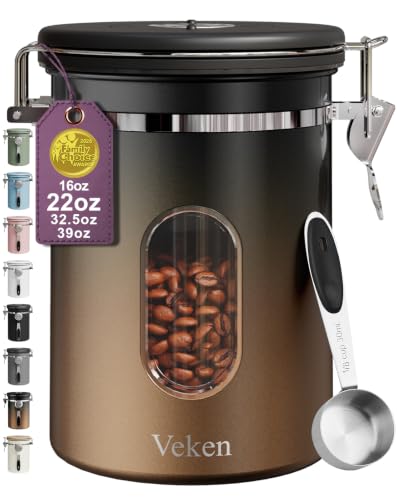

As an Amazon Associate we earn from qualifying purchases at no extra cost to you. Ratings are shown as listed on Amazon.
What actually keeps coffee beans fresh?
Roasted coffee deteriorates mainly through exposure to oxygen, light, heat, moisture, and repeated handling. A good container does not make old coffee new again; it slows the process after opening the bag.
- Air: Oxygen gradually dulls aroma and flavor. A silicone or rubber gasket should form a continuous seal around the lid.
- Light: Clear glass looks attractive but allows light to reach the beans. Stainless steel, ceramic, or opaque plastic is safer for a counter exposed to daylight.
- Moisture: Coffee beans should stay dry. Avoid storing them beside a kettle, dishwasher, sink, or steamy espresso machine.
- Carbon dioxide: Freshly roasted beans release gas. A one-way valve lets carbon dioxide escape while limiting outside air from entering, which is why the valve is useful in the original bag.
A one-way valve is not the same as an airtight storage lid. The valve is valuable when beans are degassing, but the container still needs a strong lid seal for long-term storage.
Head-to-head comparison of the main container designs
| Container type | Typical capacity | Freshness protection | Best feature | Main drawback |
|---|---|---|---|---|
| Vacuum canister | 0.4–1.2 L; about 170–500 g of beans | Very good against oxygen when the vacuum is refreshed | Actively removes air | Seal or pump mechanism may need replacement or more careful cleaning |
| Inner-lid displacement canister | 1.0–1.9 L; about 340–800 g of beans | Very good because the inner lid reduces headspace | Simple, fast daily access | Usually needs a mostly full container for the best fit |
| Gasket-sealed stainless or ceramic jar | 0.5–1.5 L; about 170–630 g of beans | Good if the gasket remains supple | Few parts and easy cleaning | Does not remove oxygen already inside |
| Opaque screw-top plastic container | 0.5–2.0 L; about 170–850 g of beans | Fair to good, depending on the thread and gasket | Low price and light weight | Plastic can retain odors or become scratched |
| Glass jar with clamp lid | 0.5–1.5 L; about 170–630 g of beans | Good against air, weak against light unless stored in a cupboard | Visible contents and inexpensive replacement jars | Heavy, breakable, and often too transparent for a sunny counter |
Capacity varies with bean size and roast level. A rough planning figure is 340–400 grams of whole beans per liter, but a very light roast can occupy more space than a dense dark roast.
Best picks by coffee routine
Best for everyday simplicity: an inner-lid displacement canister
The Airscape Classic is a strong choice for people who open their container several times a day. Its movable inner lid presses down toward the beans, reducing the air space above them. The outer lid protects the inner seal and gives the container a clean countertop appearance. Airscape containers are available in metal and other finishes, and the design is more forgiving than a vacuum system when you frequently scoop or pour beans.
Choose the smaller size for roughly 225–340 grams and the larger size for a standard 450-gram bag. If you usually have only a few days of beans in the container, do not buy an oversized model: a large empty chamber leaves more air around the coffee.
Best for active air removal: a vacuum canister
The Fellow Atmos is designed to remove air by twisting the lid rather than using an electric pump. It is useful for households that buy enough beans to keep them for a week or two and want more oxygen reduction than a conventional jar provides.
The vacuum must be refreshed after opening. If the lid no longer holds pressure, inspect the silicone seal and valve area rather than assuming the beans are the problem. Vacuum storage is also less convenient if multiple people repeatedly open the lid throughout the day.
Best for a tight budget: an opaque gasket-sealed container
A well-made opaque container with a silicone gasket can preserve beans effectively without specialized parts. Look for a lid that closes evenly, a gasket that can be removed for washing, and a body that does not flex enough to break the seal. General market prices range from about $10 to $25 for basic containers and approximately $25 to $50 for better stainless-steel models.
Do not pay extra for a one-way valve built into the lid unless it is designed for storage rather than decorative appearance. A valve does not compensate for a loose lid or a transparent body left in sunlight.
Decision matrix: which container fits your situation?
| Your situation | Recommended design | Useful capacity | Why |
|---|---|---|---|
| One coffee drinker, fresh beans every week | Opaque gasket jar or small vacuum canister | 0.4–0.7 L | Less headspace and a compact footprint |
| Two drinkers, one 340–450 g bag at a time | Inner-lid canister | 1.0–1.5 L | Fits a normal bag while remaining easy to scoop |
| Limited counter space | Tall, narrow stainless canister | 0.7–1.0 L | Uses less depth; measure cabinet clearance first |
| Occasional coffee drinker | Small airtight canister plus original bag valve | 0.4–0.7 L | Reduces the amount of coffee exposed after each opening |
| Several coffees in rotation | Multiple labeled 0.4–0.7 L containers | One per coffee | Prevents repeatedly opening one large container |
| Lowest ownership cost | Replaceable-gasket jar or simple opaque container | 0.7–1.2 L | Fewer proprietary parts and inexpensive replacement seals |
How much capacity do you need?
Start with your normal purchase size, not the maximum amount the container can hold. For example, assume you buy 340 grams of beans and your container holds approximately 380 grams per liter. The minimum volume is:
340 ÷ 380 = 0.89 liters
In practice, choose a 1.0- to 1.2-liter container so the beans are not packed against the lid and can be poured without spilling. If you buy 1 kilogram at once, a single 1-liter container is unsuitable; divide the coffee into two or three smaller containers, keeping one in daily use and the rest sealed in a cool, dark cupboard.
Dispensing design matters more than it seems
A wide-mouth canister is easiest for scooping and cleaning, while a narrow opening reduces accidental exposure when pouring. A hinged lid is convenient but can interfere with a countertop grinder or scale. A fully removable lid is usually better for washing and for checking the gasket.
For espresso, a wide opening helps when weighing beans directly into a dosing cup. For filter coffee, a controlled pour can be useful, but avoid complicated spring-loaded spouts that trap grounds and moisture. A separate scoop is fine if it is dry and stored outside the beans between uses.
Maintenance and common mistakes
- Empty the container before refilling. Mixing fresh beans with stale fragments leaves old oils and grounds in contact with the new batch.
- Wash the body and lid according to the manufacturer’s instructions. Mild dish soap and warm water are usually sufficient; abrasive pads can damage finishes and seals.
- Dry every part completely. Even a small amount of trapped water is more damaging than ordinary air exposure.
- Inspect the gasket monthly. Replace it if it is cracked, flattened, sticky, or unable to maintain a seal.
- Keep the container away from heat. A dark canister beside a hot grinder or espresso machine is still a poor storage location.
- Do not refrigerate or freeze the daily-use container. Temperature changes can cause condensation. If you freeze coffee for long-term storage, divide it into genuinely airtight portions and let each sealed portion reach room temperature before opening.
The parts most likely to wear first are silicone gaskets, vacuum valves, and hinges. A container with replaceable seals can cost less over several years than a cheaper model that must be discarded after the lid loses its seal. Stainless steel generally resists odor and staining better than plastic, while ceramic offers good light protection but is heavier and more vulnerable to chips.
Final buying recommendation
Choose a 1.0- to 1.2-liter opaque inner-lid canister for a typical 340- to 450-gram weekly bag. Choose a 0.7-liter vacuum canister if you prioritize oxygen reduction and do not mind refreshing the seal. Choose a smaller opaque gasket-sealed container if you use coffee slowly or want the lowest cost. Whichever design you select, correct sizing, darkness, dryness, and a sound seal will matter more than a decorative finish or a built-in valve.



Write Your Review
No reviews yet. Be the first to share your experience!