

Key takeaways
- Seat comfort: Check the seat height and depth, and whether the top is flat enough to sit on comfortably. A cushion improves comfort but needs somewhere dry to go when not in use.
- Weight limit: Confirm the listed limit is for sitting, not merely the lid’s supported load. If more than one adult will sit on it, make sure the manufacturer explicitly permits that use.
- Drainage: Look for drainage holes or channels at the base and avoid designs that trap water under the storage compartment. Keep drainage openings clear of leaves and dirt.
- Lid safety: A heavy lid can slam shut. Hinges, lid stays, or gas-assisted supports are useful, especially where children may use the bench; no lid mechanism replaces supervision.
- Assembly and stability: Thin panels and poorly aligned fasteners can loosen with repeated opening. Assemble on a level surface, tighten fittings as instructed, and check them after the first few weeks.
The best patio storage benches are the ones that stay comfortable and dry in your climate, fit the items you actually need to store, and can be opened without blocking a walkway. For a small balcony, a compact resin bench is usually the practical choice; for cushions or frequent seating, prioritize a longer bench with a reinforced seat, gas-assisted lid, and rain-shedding design.
Our top picks
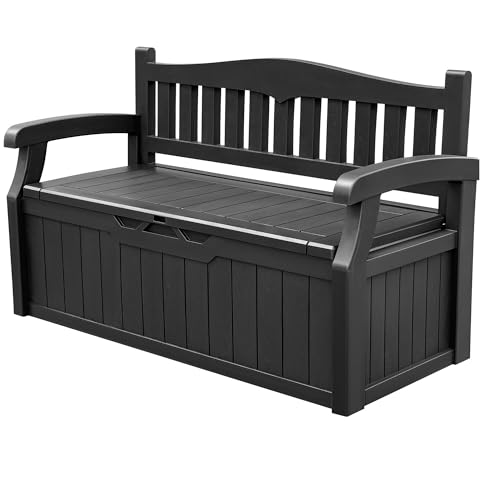
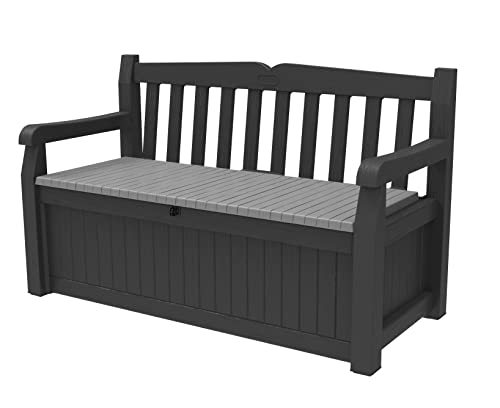


As an Amazon Associate we earn from qualifying purchases at no extra cost to you. Ratings are shown as listed on Amazon.
Patio storage benches compared by use
The figures below are representative dimensions and capacities for common bench styles, not specifications for every model. Check the exact manufacturer’s listing before buying: capacities, weight limits, and weather-resistance claims vary by product.
| Bench style | Typical outside size | Typical storage | Typical seat limit | Best suited to |
|---|---|---|---|---|
| Compact resin deck box bench | Approximately 22–25 in. deep × 45–50 in. wide × 22–25 in. high | Approximately 50–80 gal. | Approximately 300–450 lb. | Small patios, balcony cushions, and lightweight accessories |
| Long resin storage bench | Approximately 24–27 in. deep × 55–60 in. wide × 23–26 in. high | Approximately 90–130 gal. | Approximately 450–600 lb. | Two-person seating and several seat cushions |
| Wooden storage bench | Approximately 20–25 in. deep × 45–55 in. wide × 18–22 in. high | Approximately 15–30 cu. ft. | Often 400–600 lb.; verify the model | A furniture-like look and a spot under a roof or cover |
| Metal-frame bench with storage compartment | Approximately 22–26 in. deep × 48–60 in. wide × 20–25 in. high | Varies; often less than a deck-box design | Model-dependent; confirm before use | Design-led seating where storage is secondary |
Gallons and cubic feet are not directly interchangeable in practice: interior shape, supports, and lid hinges reduce usable space. A stated 100-gallon capacity also does not mean a bench can safely hold 100 gallons of heavy material. Treat the seat’s weight limit and the storage volume as separate specifications.
Choose by patio, weather, and what you’ll store
For a narrow balcony: choose compact resin
A bench around 45–50 inches wide can provide a seat without dominating a small outdoor area. Measure the space with the lid open, not just with the bench closed. A hinged top may need several extra inches of clearance behind it, while a front-opening or removable-lid design can work better against a wall.
Compact resin benches tend to be light and easy to clean, but light construction can shift in strong wind. Look for a secure lid and a manufacturer-approved way to anchor the unit if exposure is a concern. Avoid placing it where the open lid blocks a door, stair, or path.
For outdoor cushions: prioritize capacity and water management
Measure the largest cushion first, then compare it with the bench’s interior dimensions. A long cushion may not fit through a narrow opening even if the listed volume seems adequate. For a typical stack of four seat cushions measuring about 24 × 24 × 4 inches each, the uncompressed volume is roughly 6.7 cubic feet: 24 × 24 × 4 × 4 ÷ 1,728. Allow extra room so cushions are not forced against the lid or packed while damp.
“Water-resistant” does not always mean watertight. Rain can enter around a lid seam, and warm, trapped moisture can lead to mildew. Choose a box with a sloped or overlapping lid, good drainage paths, and ventilation where appropriate. Store cushions dry, and use breathable storage bags rather than sealing damp fabric in plastic.
For a covered porch: consider wood or a furniture-style frame
Wood offers a warmer, more traditional appearance and can be refinished, but it needs more upkeep than molded resin. Sun and moisture can fade finishes, open joints, or encourage rot if water sits on the surface. Keep a wooden bench off standing water, inspect the finish seasonally, and recoat it as the manufacturer directs.
Metal-frame designs can look less like a storage box, but check what the compartment is made from and how it drains. A durable-looking frame does not guarantee a weatherproof interior. For exposed patios, inspect joints, fasteners, and any fabric panels for corrosion or water-trapping seams.
What matters beyond the capacity number
- Seat comfort: Check the seat height and depth, and whether the top is flat enough to sit on comfortably. A cushion improves comfort but needs somewhere dry to go when not in use.
- Weight limit: Confirm the listed limit is for sitting, not merely the lid’s supported load. If more than one adult will sit on it, make sure the manufacturer explicitly permits that use.
- Drainage: Look for drainage holes or channels at the base and avoid designs that trap water under the storage compartment. Keep drainage openings clear of leaves and dirt.
- Lid safety: A heavy lid can slam shut. Hinges, lid stays, or gas-assisted supports are useful, especially where children may use the bench; no lid mechanism replaces supervision.
- Assembly and stability: Thin panels and poorly aligned fasteners can loosen with repeated opening. Assemble on a level surface, tighten fittings as instructed, and check them after the first few weeks.
Quick decision matrix
| Your situation | Best fit | Trade-off to accept |
|---|---|---|
| Tight space; occasional seating | Compact resin, about 50–80 gal. | Less room for bulky cushions; check lid clearance |
| Two adults sit regularly; cushions need storage | Long reinforced resin bench, roughly 90–130 gal. | Greater footprint and a larger lid to manage |
| Covered patio; appearance matters most | Wooden or metal-frame furniture-style bench | More maintenance or less weather-protected storage |
| Frequent rain; storage must stay reliably dry | Weather-rated resin box with a close-fitting lid, plus dry inner bags | No outdoor bench should be assumed fully waterproof |
Ownership realities: what wears first
On resin benches, hinges, lid stays, and snap-fit joints usually deserve more attention than the broad molded panels. Repeatedly overloading the lid, sitting on a model not rated for seating, or dragging a full box across rough paving can strain those points. On wood, finish and joints are the maintenance priorities; on metal, check coatings and fasteners for rust, particularly near the ground.
Clean resin with mild soap and water rather than abrasive pads that can dull the surface. Remove debris from drains, and let the interior dry before storing fabric. In windy areas, follow the maker’s anchoring guidance instead of adding improvised weights that exceed the product’s limits. A general market range is about $70–$180 for basic resin benches, $180–$450 for larger or more furniture-like options, and $250–$700 or more for many substantial hardwood designs; size, construction, and finish drive the difference.
Bottom line
For most exposed patios, a resin bench with a documented sitting limit, useful interior dimensions, a secure lid, and drainage is the easiest balance of seating and storage. Choose the smallest size that fits your largest stored item with room to spare. If the bench will sit in full sun or frequent rain, treat weather protection as a system—good lid design, clear drainage, dry contents, and occasional maintenance—not as a guarantee printed on the product label.


Write Your Review
No reviews yet. Be the first to share your experience!