

Key takeaways
- Width: Measure at the front, middle, and rear. Use the narrowest measurement.
- Depth: Leave at least 0.25 inch of clearance front and back so the organizer does not scrape.
- Height: Subtract around 0.5 inch from the measured clearance, especially for a frequently opened drawer.
- Usable depth: A deep bin should be shorter than the drawer interior. A 20-inch drawer usually works better with an 18- or 19-inch organizer than one that exactly matches the measurement.
Best Deep Drawer Organizers for More Storage
The best deep drawer organizers are modular, stackable or expandable bins with a usable depth of at least 3.5 inches, enough clearance for the drawer, and compartments sized around the items you actually store.
Deep drawers can hold far more than shallow trays, but they also create a common problem: small objects disappear underneath larger ones. The right organizer should divide the drawer vertically without wasting too much space on thick walls, awkward gaps, or compartments that are too shallow. For most kitchens, bedrooms, bathrooms, and home offices, look for low-friction plastic or coated-metal organizers that are easy to lift out and clean.
Our top picks


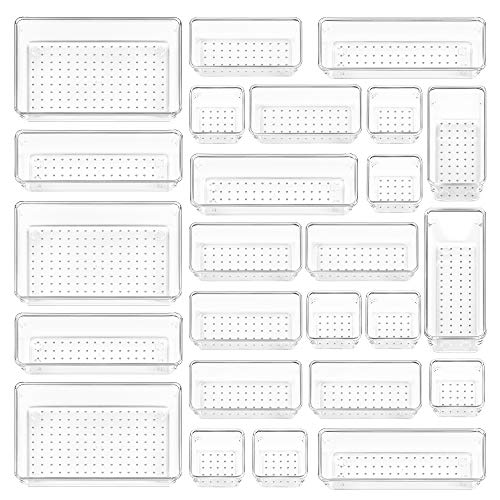
As an Amazon Associate we earn from qualifying purchases at no extra cost to you. Ratings are shown as listed on Amazon.
Quick Picks by Drawer Situation
| Drawer situation | Best organizer type | Recommended dimensions | Typical price range |
|---|---|---|---|
| Kitchen utensils in a 4- to 6-inch drawer | Expandable utensil tray with long compartments | 17–23 inches wide, 2–3 inches high | $20–$45 |
| Deep pantry or kitchen drawer | Removable bins with front labels | 10–12 inches deep, 4–6 inches high | $8–$20 per bin |
| Bedroom clothing or accessory drawer | Fabric cubes or adjustable dividers | 10–14 inches wide, 4–6 inches deep | $15–$35 per set |
| Bathroom vanity drawer | Water-resistant clear bins with rounded corners | 6–12 inches wide, 3–5 inches high | $12–$30 per set |
| Office supply drawer | Small compartment tray or modular bins | 2–4 inch compartments, 2–3 inches high | $10–$30 |
What to Measure Before Buying
Measure the drawer’s interior, not the cabinet opening. Record the usable width from side to side, the front-to-back depth, and the vertical clearance from the drawer bottom to the lowest obstruction. Drawer slides, hinges, and uneven cabinet walls can reduce the practical space.
- Width: Measure at the front, middle, and rear. Use the narrowest measurement.
- Depth: Leave at least 0.25 inch of clearance front and back so the organizer does not scrape.
- Height: Subtract around 0.5 inch from the measured clearance, especially for a frequently opened drawer.
- Usable depth: A deep bin should be shorter than the drawer interior. A 20-inch drawer usually works better with an 18- or 19-inch organizer than one that exactly matches the measurement.
For a practical fit calculation, suppose the drawer measures 28 inches wide by 21 inches deep. Two 10.5-inch-wide bins appear to use the full width, but their outside walls may add a small amount to each measurement. Choosing two bins no wider than 10 inches each leaves 8 inches for a third narrow bin or a hand-access gap. That extra space is often more useful than forcing a wall-to-wall fit.
Best Expandable Organizers for Kitchen Drawers
An expandable tray is usually the best choice for cutlery and cooking tools because it adapts to several drawer widths. Look for a main tray with a stated closed and extended width, not simply “fits most drawers.” A useful range is approximately 17 to 23 inches wide, 15 to 18 inches deep, and 2 to 3 inches high.
Choose long compartments for spatulas, tongs, and serving spoons. Short compartments work better for measuring spoons and peelers. A removable side section is valuable because it can be lifted out when cleaning or when the drawer needs to hold unusually wide tools.
Expandable trays are less effective in very deep drawers when the tray only covers the front half. In that case, combine the tray with two or three rear bins. Keep rarely used tools in the rear rather than stacking them on top of everyday utensils.
Best Deep Bins for Pantry and Kitchen Storage
For deep food-storage drawers, open-front bins are easier to use than a grid of fixed compartments. Choose bins with integrated handles or a broad front lip. A 10- to 12-inch depth is usually deep enough to add capacity while remaining easy to remove.
Clear plastic makes contents visible, but opaque plastic or coated wire can be more forgiving of scratches and fingerprints. Avoid bins taller than the items they contain. A 5-inch bin is suitable for packets, snack bars, and small jars; a 7- to 9-inch bin may hide contents and require rummaging.
Do not place loose produce directly in a deep organizer unless the bin can be removed and washed. Crumbs and moisture collect underneath, particularly in drawers near a cooking surface.
Best Organizers for Bedroom Drawers
Bedroom drawers benefit from adjustable dividers or soft-sided bins rather than rigid trays with many tiny sections. Use 4- to 6-inch compartments for folded underwear, belts, scarves, or accessories. For socks and smaller garments, compartments around 3 to 4 inches wide prevent the contents from spreading.
Spring-loaded dividers are convenient in wide drawers, but they can shift when overloaded. A divider with silicone or rubber contact pads is less likely to mark finished wood and usually holds better than bare plastic. For delicate clothing, fabric bins with reinforced sides reduce snagging; choose washable or wipe-clean fabric if the drawer is used often.
Best Organizers for Bathroom Drawers
Bathroom organizers should prioritize cleanability over maximum compartment count. Clear polypropylene or acrylic-style bins with rounded inside corners are easier to wipe than deep woven baskets. A height of 3 to 5 inches keeps bottles and grooming tools visible without interfering with the drawer front.
Use separate bins for hair accessories, cosmetics, dental items, and first-aid supplies. Keep liquids upright in a leak-resistant container rather than placing them directly beside paper products. Do not store products in a way that prevents you from reading expiration dates or package instructions.
For a vanity drawer with 18 inches of usable depth, two 8-inch-deep bins placed front to back leave approximately 2 inches for clearance and finger access. Two 9-inch bins may technically fit, but they can be difficult to remove once the drawer is full.
Best Organizers for Office Drawers
Office drawers need more small compartments than kitchen drawers. Choose modular trays with sections between 2 and 4 inches wide for clips, erasers, adapters, pens, and charging accessories. A 2- to 3-inch organizer height is enough for most supplies and leaves room above the compartments for easy retrieval.
For cables, use one larger 5- to 7-inch compartment rather than several narrow ones. Coil each cable loosely and label both the cable and its power adapter. This prevents a deep drawer from becoming a collection of unidentified cords.
Material and Construction Comparison
| Material | Strengths | Weaknesses | Best use |
|---|---|---|---|
| Polypropylene plastic | Light, washable, resistant to ordinary household moisture | Can flex or crack if overloaded | Kitchen, bathroom, pantry |
| Acrylic-style clear plastic | Excellent visibility, rigid walls, polished appearance | Shows scratches and fingerprints | Vanity and accessory drawers |
| Coated steel or wire | Strong, ventilated, suitable for heavier items | Coating may chip; small items can fall through gaps | Tools, pantry supplies, office equipment |
| Fabric or felt | Soft for clothing, lightweight, often collapsible | Collects dust and may lose shape | Bedroom drawers |
| Bamboo or wood | Rigid, attractive, often long-lasting | Heavier and less tolerant of standing moisture | Dry kitchen and bedroom storage |
How to Set Up a Deep Drawer Without Losing Capacity
- Empty the entire drawer. Sorting around existing clutter usually creates redundant compartments.
- Group items by use. Keep daily items in front and occasional items in the rear.
- Match compartment depth to the item. The contents should be visible from above; avoid bins that are more than about 1.5 times taller than what they hold.
- Leave removal space. A 0.5- to 1-inch gap around a bin makes it easier to lift out for cleaning.
- Use non-slip pads selectively. Pads help with sliding trays, but placing them under every bin can make cleaning and rearranging harder.
- Recheck the drawer after one week. If an item repeatedly ends up on top of the organizer, its compartment is probably too small or in the wrong position.
Durability and Maintenance
The parts that usually wear first are expandable rails, thin divider clips, fabric seams, and rubber feet. Do not force an expandable tray beyond its published range, and avoid loading a shallow compartment with heavy metal tools. For plastic and coated metal, remove the organizer and wash it with mild soap before drying completely. Wood and bamboo should be wiped rather than soaked.
Common mistakes include buying based on exterior dimensions, filling every compartment immediately, and placing deep bins at the rear where their contents cannot be reached. The most useful deep-drawer system is not the one with the greatest number of sections; it is the one that keeps every category visible and removable.
Final Buying Advice
Choose an expandable tray for a wide utensil drawer, removable bins for deep pantry storage, adjustable dividers or fabric cubes for clothing, clear washable bins for bathrooms, and small modular compartments for office supplies. Before ordering, compare the organizer’s outside dimensions with the drawer’s narrowest interior measurement, then allow room for clearance and hand access. That combination of exact sizing, appropriate compartment depth, and easy cleaning will deliver more usable storage than simply choosing the organizer with the most sections.






Write Your Review
No reviews yet. Be the first to share your experience!