

Key takeaways
- Measure the door thickness: Common interior doors are about 1 3/8 inches thick; exterior and fire-rated doors may be thicker.
- Measure the top clearance: A hook rail usually needs room to pass over the door without forcing the door downward or lifting it from the hinges.
- Check the frame: Deep casing or a tight stop can prevent the door from closing even when the hook technically fits.
- Account for loaded depth: A rack advertised as 3 inches deep may project farther once bottles, shoes, or folded towels are inside.
- Inspect the hinges and latch: A heavy rack can make a lightly mounted door sag, causing the latch to misalign.
The best over the door organizers for most homes are slim, fabric-backed pocket racks for light everyday items, while metal baskets or reinforced pantry racks are better for heavier loads and frequent access. The right choice depends less on the number of pockets than on your door clearance, pocket dimensions, total load, and whether the door can still close without rubbing.
Our top picks

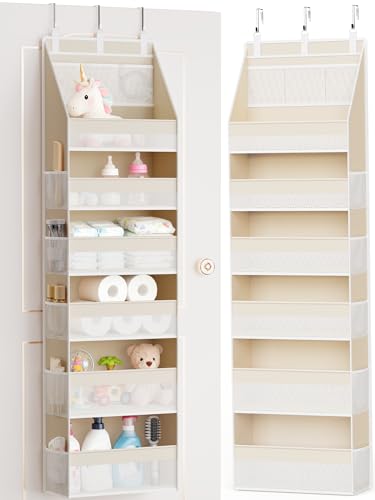
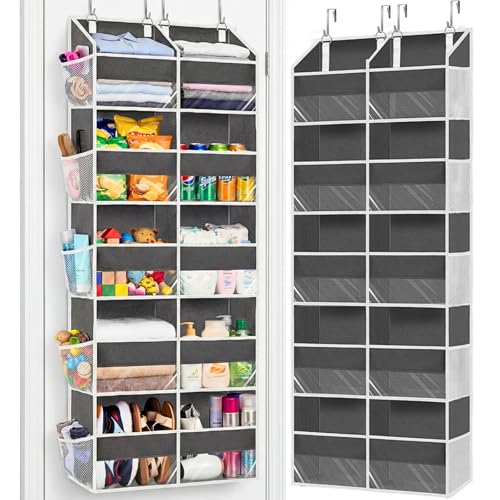
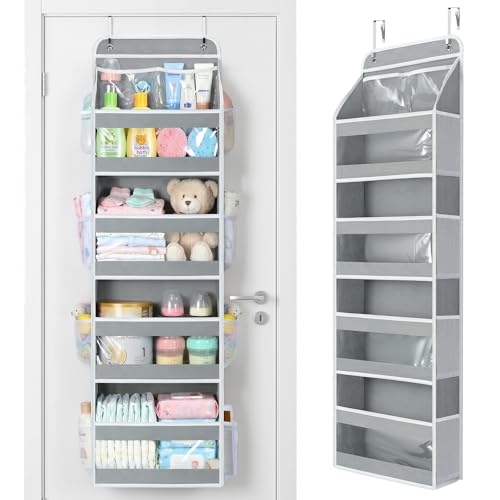
As an Amazon Associate we earn from qualifying purchases at no extra cost to you. Ratings are shown as listed on Amazon.
Quick picks by room and situation
| Best for | Recommended organizer type | Useful target specifications | Why it fits |
|---|---|---|---|
| Bedroom or nursery | Soft hanging pockets | 5–8 pockets; 10–15 lb total capacity; pockets at least 5 in deep | Quiet, lightweight, and suitable for clothes, diapers, accessories, and small toys |
| Bathroom | Mesh or ventilated plastic organizer | 6–10 pockets; 8–12 lb total capacity; rust-resistant hardware | Allows damp items to dry and is easier to wipe clean than untreated fabric |
| Kitchen or pantry | Metal basket rack with a reinforced frame | 20–35 lb total capacity; baskets 4–6 in deep; anti-scratch pads | Handles packaged food and cleaning supplies better than ordinary pocket organizers |
| Closet | Hanging shoe or accessory organizer | 10–24 compartments; 8–12 in usable pocket width | Uses vertical space for shoes, scarves, belts, and folded accessories |
| Home office | Small pocket sorter | 6–12 pockets; 5–10 lb total capacity; label windows preferred | Keeps cables, notebooks, envelopes, and supplies visible without using desk space |
| Small apartment or rental | Low-profile fabric organizer | Less than 2 in thick when loaded; over-door hooks under 1.5 in thick | Minimizes interference with narrow door frames and avoids permanent installation |
Check the door before buying
“Over the door” does not guarantee universal fit. Measure the gap between the closed door and its frame, including the trim on the hinge side. Many standard interior doors leave approximately 1/16 to 1/8 inch of clearance at the top and latch side, but that is not enough for every metal hook.
- Measure the door thickness: Common interior doors are about 1 3/8 inches thick; exterior and fire-rated doors may be thicker.
- Measure the top clearance: A hook rail usually needs room to pass over the door without forcing the door downward or lifting it from the hinges.
- Check the frame: Deep casing or a tight stop can prevent the door from closing even when the hook technically fits.
- Account for loaded depth: A rack advertised as 3 inches deep may project farther once bottles, shoes, or folded towels are inside.
- Inspect the hinges and latch: A heavy rack can make a lightly mounted door sag, causing the latch to misalign.
For a typical 1 3/8-inch interior door, choose an organizer whose hook channel is specifically listed for that thickness or has a slim, adjustable mounting design. If the product gives no hook or rail dimensions, treat fit as uncertain rather than assuming it is standard.
Head-to-head: pocket organizers versus basket racks
Fabric pocket organizers
Fabric organizers offer the best storage volume for low weight and are usually the least expensive, with general market prices around $15–$35. They work well for soft or irregular items such as socks, hats, toiletries, craft supplies, and children’s accessories. Reinforced stitching, a rigid top rail, and a bottom stabilizer matter more than decorative fabric.
Their weakness is weight concentration. A pocket full of canned goods, bottles, or books can pull the seams away from the backing. Fabric also collects dust and can retain bathroom moisture. Look for removable inserts or machine-washable panels, but follow the care label because coated fabric can crack with hot washing or high-heat drying.
Wire and metal basket racks
Metal racks are the better choice for pantry items, cleaning products, and shoes that need an open, rigid compartment. Typical prices range from $30–$80, depending on the number of baskets and the mounting system. A welded frame and multiple door contact points distribute weight more effectively than a single hanging strap.
Metal is not automatically stronger. Thin wire can bend at the hook, and a rack with a narrow top rail may place too much force on one section of the door. Rubber or foam pads are important: they reduce rattling, protect painted doors, and help stop the rack from swinging when the door moves.
Plastic and mesh designs
Plastic bins and mesh pockets are useful in bathrooms and utility rooms because they are easy to wipe or ventilate. Avoid storing continuously wet items unless the organizer is explicitly designed for that environment. Water trapped against a painted door can cause staining or swelling over time.
Decision matrix: choose by daily use and load
| Your situation | Best configuration | Avoid |
|---|---|---|
| Light items used occasionally | Basic fabric rack with 6–12 pockets | Oversized metal rack that adds unnecessary door weight |
| Several people access it daily | Rigid compartments, reinforced seams, and a stabilizing strap | Deep, sagging pockets that hide small items |
| Limited budget | One slim fabric organizer sized to the actual door | Buying a large rack and leaving most pockets empty |
| Heavy items or frequent door movement | Wall-mounted or multi-point metal system, if permitted | Hanging pockets rated only for light loads |
| Rental with no drilling | Removable over-door hooks with padded contact points | Adhesive strips on textured, dusty, or high-humidity surfaces |
| Narrow hallway or bedroom door | Organizer under 2 inches deep when loaded | Deep baskets that reduce passage width or strike nearby walls |
How much can it safely hold?
Use the lowest relevant limit: the organizer’s stated capacity, the capacity of its hook or mounting hardware, or the load your door can tolerate without sagging. A simple planning calculation helps prevent overloading. If eight pockets each hold 1 pound, the contents already total 8 pounds. Add roughly 1–3 pounds for the organizer itself, and the door may be carrying 9–11 pounds before any uneven loading or swinging force is considered.
Do not treat a manufacturer’s maximum rating as an ideal everyday load. For a hanging fabric organizer, staying near 60–75% of the stated limit gives the seams and hooks more margin. Place heavier items in the lowest pockets or baskets, keep the load centered, and avoid putting glass containers at the top where they can fall when the door opens.
Installation that prevents rubbing and sagging
- Dry-fit the empty organizer. Close the door slowly and check the latch, hinges, trim, and adjacent wall.
- Add protective pads. Put the supplied foam or rubber pads wherever metal or hard plastic touches the door.
- Secure the bottom. Use a lower stabilizing strap, adhesive-safe bumper, or manufacturer-approved bracket to limit swinging.
- Load gradually. Start with half the intended weight, open and close the door several times, and listen for rubbing or creaking.
- Recheck after a week. Look for pulled stitching, bent hooks, fresh paint marks, or a door that no longer latches cleanly.
If the door begins rubbing after loading, remove weight before adjusting the hinges. Hinge adjustment can create a separate alignment problem, while reducing the organizer’s load addresses the cause.
Durability and maintenance realities
The first parts to wear are usually the top loops, hook bends, pocket seams, and adhesive-backed stabilizers. Inspect fabric loops for stretching and metal hooks for opening away from the door. Replace a rack if its attachment point is tearing or if a wire basket has developed a sharp edge.
Vacuum fabric pockets before wiping them with mild soapy water, and dry them completely before rehanging. Clean plastic and coated metal with a soft cloth rather than abrasive powder, which can remove protective finishes. Avoid overstuffing shoe pockets: footwear weight concentrated at the front can pull the organizer away from the door more aggressively than the same weight in flat clothing.
When an over-door organizer is the wrong choice
Choose a wall-mounted cabinet, shelf, or closet insert instead when the door is hollow and easily flexes, the frame has almost no clearance, or the required load includes dense items such as books, glass jars, or large cleaning bottles. A door rack is also unsuitable where it blocks an emergency exit, interferes with a closer, or creates a sharp projection in a child’s pathway.
For most light-to-medium storage, the best over the door organizers combine a slim hook profile, clearly stated capacity, reinforced attachment points, and compartments matched to the room. Measure first, choose pockets or baskets for the actual items you own, and leave capacity margin rather than filling every available space.


Write Your Review
No reviews yet. Be the first to share your experience!