

Key takeaways
- Light filtering: reduces glare while preserving an open, airy feel.
- Privacy weave: obscures people and furniture in daylight, but silhouettes may remain visible at night.
- Opaque or blackout-style outdoor fabric: provides the most privacy, although edge gaps still reveal light and movement.
- Water-repellent finish: makes droplets bead temporarily; it does not mean the panel is waterproof.
The best outdoor curtains for most patios are solution-dyed polyester panels with rust-resistant grommets, at least 90% UV protection, and enough fullness to cover 1.5 to 2 times the width of the opening.
That combination handles sun, occasional rain, and everyday privacy without the weight, cost, or maintenance of canvas. The right choice changes, however, if your priority is blocking wind, creating a darker porch, covering an unusually tall opening, or keeping the installation inexpensive.
Our top picks
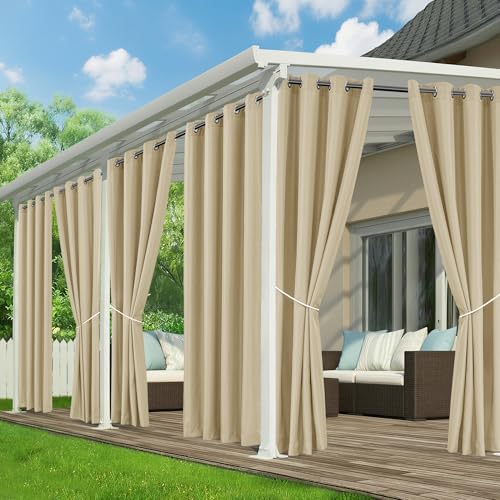
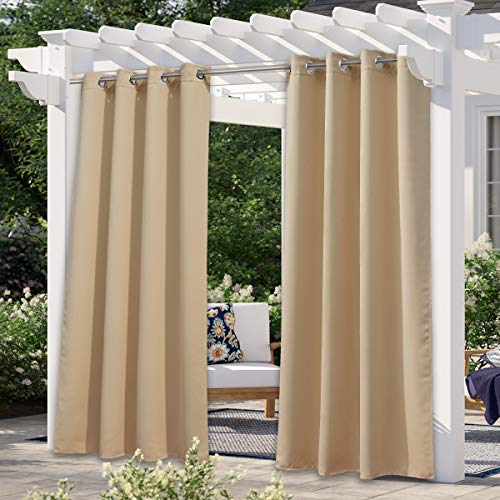


As an Amazon Associate we earn from qualifying purchases at no extra cost to you. Ratings are shown as listed on Amazon.
Best outdoor curtains by patio situation
| Situation | Best curtain type | What to look for | Typical budget |
|---|---|---|---|
| Occasional use and a tight budget | Polyester outdoor panels | 90–100% polyester, grommets, machine-washable finish | $25–$60 per pair |
| Strong afternoon sun | Solution-dyed polyester | UV-resistant fibers, dark or tightly woven fabric, weighted hem | $45–$100 per pair |
| Maximum privacy | Heavy polyester or outdoor canvas | Opaque weave, 220–320 GSM fabric, minimal light transmission | $60–$150 per pair |
| Humid or frequently damp porch | Mildew-resistant polyester | Quick-drying fabric, breathable storage, removable tiebacks | $35–$90 per pair |
| Permanent, upscale installation | Acrylic or premium solution-dyed fabric | Colorfast fibers, outdoor-rated track or rings, tailored hems | $100–$250 per pair |
Head-to-head: which outdoor curtain fabric is best?
Solution-dyed polyester: best all-around choice
Solution-dyed polyester is the safest default for most covered patios and porches. The color is incorporated into the fibers before they are spun, rather than applied only to the surface. That generally improves resistance to fading compared with inexpensive printed fabric.
Look for panels weighing roughly 180–280 GSM (grams per square meter). Around 180 GSM is easier to move and dry; 250 GSM or more provides better privacy and a more substantial drape. Polyester is also usually machine washable, although the water-repellent finish may weaken over time.
Outdoor acrylic: best for long-term sun exposure
Acrylic fabric is a strong choice for an uncovered or south-facing patio where sunlight is the main threat. It tends to resist fading well and feels more like upholstery fabric than lightweight polyester. Premium acrylic curtains can remain attractive for years, but they cost more and may have fewer ready-made size options.
Acrylic is not automatically waterproof. Rain can still pass through a woven fabric, and prolonged dampness can create mildew on dirt or organic residue. Choose it for color stability, not as a substitute for a roof.
Outdoor canvas: best for privacy and structure
Canvas has a dense, substantial appearance and blocks more light than thin decorative sheers. It suits screened porches, outdoor dining areas, and spaces where privacy matters more than easy opening and closing.
The trade-off is weight. A pair of heavy canvas panels can require a stronger rod, brackets attached to structural framing, and more drying time after rain. Avoid hanging untreated indoor canvas outside; it can absorb water, develop mildew, and become difficult to move.
Polyester sheers: best for airflow, not privacy
Sheer panels soften a porch and reduce glare while allowing breezes through. They are useful as a second layer in front of opaque curtains, but they do not provide dependable privacy after dark when the interior is illuminated. If privacy is a buying requirement, choose an opaque panel or use a double-track arrangement.
How much privacy and shade will you actually get?
Fabric color and construction matter more than the product name. A tightly woven, dark-colored panel usually blocks more visible light than a pale, loosely woven panel of the same thickness. Some curtains marketed as “room darkening” reduce glare but do not make an outdoor area fully dark, especially around the sides and bottom.
- Light filtering: reduces glare while preserving an open, airy feel.
- Privacy weave: obscures people and furniture in daylight, but silhouettes may remain visible at night.
- Opaque or blackout-style outdoor fabric: provides the most privacy, although edge gaps still reveal light and movement.
- Water-repellent finish: makes droplets bead temporarily; it does not mean the panel is waterproof.
For wind, do not assume a heavier curtain is always better. A large solid panel catches more wind load than a sheer. If the porch is exposed, use tiebacks, bottom weights, or curtain tracks that allow the panels to move rather than relying on a tension rod.
Sizing: the calculation that prevents an underfilled curtain wall
Measure the curtain area from the actual mounting points, not from the edge of the roof. Measure width at the top, middle, and bottom because porch posts and railings are not always perfectly parallel.
For a gathered appearance, multiply the total opening width by 1.5 for moderate fullness or 2 for a richer fold. For example, a 12-foot opening needs:
- 12 × 1.5 = 18 feet of total curtain width for moderate fullness
- 12 × 2 = 24 feet of total curtain width for deep folds
If each panel is 54 inches wide, a pair provides 108 inches, or 9 feet, of flat fabric. You would need two pairs for moderate fullness and three pairs for a fuller 24-foot installation. Many listings describe a pair as two panels, so confirm whether the stated width applies to one panel or the package.
For length, mount the rod 2–4 inches above the opening when possible and end the curtain 1/2–1 inch above the deck or floor. Curtains that drag collect water, pollen, and grit at the hem. If the surface is uneven, choose a slightly shorter panel rather than allowing the lowest corner to sit in moisture.
Hanging hardware matters as much as the fabric
Most outdoor curtain failures begin with hardware, not cloth. Standard indoor rods can rust, bend, or pull out of a porch post under wind load.
- Grommets: quick to install and easy to slide, but metal can become noisy and may rub against a rough rod.
- Tab-top panels: attractive and inexpensive, but slower to open and more difficult to remove for washing.
- Clip rings: make removal simple and fit many fabrics, though low-quality clips can discolor or weaken in sunlight.
- Outdoor curtain tracks: best for frequent opening and closing or wide spans; they cost more but distribute weight well.
- Tension rods: suitable only for protected, light-duty openings. Wind and heavy fabric can make them slip.
Use stainless steel, aluminum, or explicitly outdoor-rated powder-coated hardware. Fasten brackets into posts, beams, or blocking rather than thin decorative trim. For a span longer than about 6 feet, add a center support unless the rod manufacturer specifies otherwise.
Decision matrix: choose based on how you use the space
| Your priority | Recommended specification | Avoid |
|---|---|---|
| Lowest ownership cost | Washable polyester, replaceable grommet panels | Delicate fabric requiring specialty cleaning |
| Daily opening and closing | Clip rings or an outdoor track, moderate 180–240 GSM weight | Very heavy canvas on a basic rod |
| Seasonal use only | Removable polyester panels with breathable storage bag | Leaving fabric outdoors all winter |
| High wind exposure | Split panels, tiebacks, bottom weights, secure brackets | One oversized unrestrained curtain wall |
| Nighttime privacy | Opaque, tightly woven panels with overlapping center edges | Sheers used as the only layer |
Installation and maintenance steps that extend curtain life
- Wash or rinse before installation. Remove manufacturing dust and inspect stitching, grommets, and hems.
- Install the rod with a slight clearance. Leave enough space for the panel to move without scraping the wall or post.
- Secure the lower section. Use tiebacks, weights, or compatible bottom clips where wind is common.
- Keep fabric off wet surfaces. A hem sitting on a deck can remain damp long after the rest of the panel dries.
- Rinse monthly in dusty or pollen-heavy areas. Dirt feeds mildew and can act like abrasive grit in the weave.
- Dry completely before storage. Folded damp fabric is one of the fastest ways to create mildew odor and permanent spotting.
Follow the care label, but cold water and a gentle cycle are common for polyester outdoor curtains. Avoid chlorine bleach unless the manufacturer specifically permits it; bleach can weaken fibers and damage color. Do not store panels in sealed plastic immediately after use. A breathable fabric bag or clean cotton cover is safer once the curtains are fully dry.
Common buying mistakes
Buying by color alone is the most visible mistake, but buying by “waterproof” wording is close behind. Ask whether the fabric is water-repellent, water-resistant, or genuinely coated, and whether that coating is expected to wear away with washing.
Also check the panel width, package quantity, and finished length separately. A low price may reflect one narrow panel rather than a complete pair. Finally, inspect the grommet material and stitching. A faded curtain can be replaced; a panel that tears around every attachment point usually cannot be repaired neatly.
Bottom line
Choose solution-dyed polyester around 180–280 GSM for the best balance of price, UV resistance, mildew management, privacy, and easy care. Upgrade to outdoor acrylic when long-term color retention in intense sun matters most, or to outdoor canvas when maximum privacy and a structured look justify stronger hardware. Whatever fabric you select, accurate width calculations, outdoor-rated supports, and complete drying will have more effect on ownership life than a small difference in color or pattern.





Write Your Review
No reviews yet. Be the first to share your experience!