

Key takeaways
- For a low-pile rug, choose a firm felt-and-rubber or thin non-slip pad about 1/8 to 1/4 inch thick.
- For a medium-pile rug, a 1/4-inch pad usually adds comfort without creating an unstable, overly soft surface.
- For a thick rug, avoid stacking a thick pad beneath it unless nearby doors and furniture clear the added height.
- Trim the pad so it is 1 to 2 inches smaller than the rug on every side; an exposed pad edge can become a trip hazard.
- Confirm that the pad is compatible with hardwood, vinyl, laminate, or other flooring, since some rubber backings can mark certain finishes.
The best large area rugs for living rooms are usually an 8-by-10 for a compact seating group, a 9-by-12 for a standard sofa-and-chairs arrangement, and a 10-by-14 or larger when the room and budget allow all major furniture to sit comfortably on the rug.
Our top picks


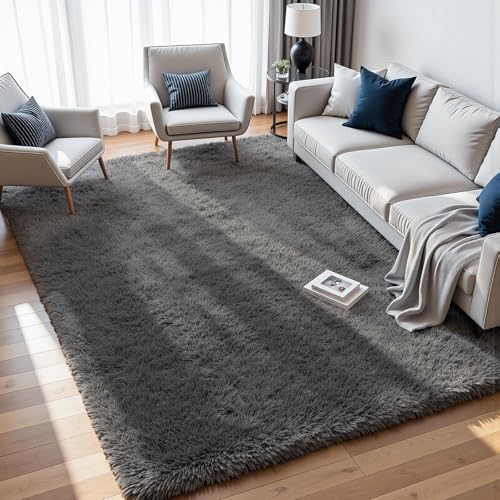

As an Amazon Associate we earn from qualifying purchases at no extra cost to you. Ratings are shown as listed on Amazon.
Quick picks by living-room situation
| Room or priority | Best size | Best rug type | Why it works |
|---|---|---|---|
| Small living room with sofa and coffee table | 8 × 10 feet | Low-pile wool blend or washable synthetic | Fits front legs of seating without overwhelming the floor |
| Average room with sofa, two chairs, and coffee table | 9 × 12 feet | Medium-pile wool, polypropylene, or recycled polyester | Creates one connected conversation area |
| Open-plan room or sectional | 10 × 14 feet or larger | Low-to-medium pile with a firm pad | Defines the seating zone and keeps furniture from looking scattered |
| Pets, children, or frequent spills | 8 × 10 or 9 × 12 feet | Machine-washable cover or solution-dyed synthetic | Prioritizes stain management and easier replacement |
| Quiet, formal room with low foot traffic | 9 × 12 feet | Hand-knotted or hand-tufted wool | Offers texture and longevity when maintained carefully |
How to choose between 8-by-10, 9-by-12, and larger rugs
Choose an 8-by-10 for a compact seating layout
An 8-by-10-foot rug covers 80 square feet and is often the most practical choice for an apartment or a living room roughly 10 by 12 feet. Place the sofa’s front legs on the rug, then position the coffee table fully on top. If you have accent chairs, their front legs should also land on the rug if space permits.
This size is less successful when the sofa nearly fills the room. A narrow border of exposed rug around the furniture can make the arrangement look cramped, especially if the rug is positioned too close to one wall. Leave approximately 12 to 24 inches of visible floor around the rug where possible, but prioritize furniture fit over an exact border.
Choose a 9-by-12 for a complete conversation area
A 9-by-12-foot rug provides 108 square feet—35% more coverage than an 8-by-10. That extra area is significant. It can accommodate a sofa, two chairs, a coffee table, and side tables while making the seating group read as one design unit.
For many average-size living rooms, this is the safest choice when the budget and floor area allow it. A 9-by-12 is particularly useful with an L-shaped sectional: place the front portion of the sectional and the coffee table on the rug, while the rear legs may remain on the floor. Measure the sectional’s depth before buying, because a deep sofa can consume much of the rug’s usable area.
Move to 10-by-14 or larger in an open plan
A 10-by-14-foot rug covers 140 square feet, while a 12-by-15-foot rug covers 180 square feet. These sizes suit large sectionals, long rooms, and open-plan spaces where a smaller rug would float beneath the coffee table instead of anchoring the furniture.
For an open-plan home, the rug should define the living zone without extending so far into a dining or walkway area that chairs, doors, or foot traffic catch its edges. Use painter’s tape to mark the proposed rug outline on the floor for at least a day. Walk around it, open nearby doors, and check whether the furniture remains balanced from the room’s main viewing angle.
Material and pile: the head-to-head comparison
| Material or construction | Typical pile | Shedding | Best use | Main drawback |
|---|---|---|---|---|
| Wool | Low to medium, sometimes high | Moderate at first; decreases with regular vacuuming | Long-term living rooms and natural texture | Higher price and sensitivity to harsh cleaning |
| Polypropylene | Low to medium | Very low | Families, pets, and value-focused purchases | Can look less dimensional than wool |
| Polyester | Low to plush | Very low fiber shedding | Color-rich designs and softer budget rugs | Oil-based stains may be difficult to remove |
| Jute or other plant fiber | Low to medium | Visible fiber dust and occasional loose strands | Casual, coastal, and textural rooms | Rougher feel and weaker spill resistance |
| Viscose or rayon | Low to medium, silky | Usually little fiber shedding | Decorative, low-traffic spaces | Water marks, crushing, and staining are common concerns |
Low-pile rugs, generally under about 0.25 inch, are easiest under doors, coffee-table legs, and robot vacuums. Medium pile, around 0.25 to 0.5 inch, gives more softness without becoming difficult to maintain. Shag and other high-pile rugs above roughly 0.75 inch feel comfortable but collect more debris, show furniture dents, and may cause robot vacuums to stall.
Best choices by ownership priority
Best for durability: wool or a dense synthetic
Wool is resilient because its fibers bend and recover rather than staying permanently crushed. A dense wool rug can be a strong long-term choice, particularly in a room used every day. Expect some initial shedding, especially from a new hand-tufted or hand-knotted rug. Vacuum without an aggressive beater-bar setting and remove loose fibers gradually rather than pulling them by hand.
Polypropylene is usually the easier value choice for households that expect spills, muddy shoes, or frequent rearranging. It does not have the same natural depth as wool, but a tightly woven, solution-dyed synthetic can provide useful stain resistance at a lower general market price.
Best for children and pets: washable or performance synthetic
Washable rugs with a removable cover can simplify small accidents, but large 9-by-12 and 10-by-14 covers are heavy and may not fit in a standard home washing machine. Check the care instructions and the machine’s drum capacity before assuming “washable” means convenient.
For a large rug that cannot realistically be laundered at home, a low-pile polypropylene or polyester design is often more practical. Choose a pattern with moderate visual variation: it disguises everyday lint better than a solid pale surface, while still allowing you to see spills quickly.
Best for softness: medium pile, not necessarily shag
A medium-pile rug can provide a comfortable feel underfoot without the maintenance burden of deep shag. If softness is the main goal, compare fiber density and construction rather than pile height alone. A dense 0.4-inch wool rug may feel more substantial and wear better than a loosely made 0.75-inch synthetic rug.
Do you need a rug pad?
In most living rooms, yes. A rug pad reduces sliding, adds cushioning, protects the flooring, and limits premature wear caused by friction between the rug and the floor. It can also make a thin flatweave feel less harsh underfoot.
- For a low-pile rug, choose a firm felt-and-rubber or thin non-slip pad about 1/8 to 1/4 inch thick.
- For a medium-pile rug, a 1/4-inch pad usually adds comfort without creating an unstable, overly soft surface.
- For a thick rug, avoid stacking a thick pad beneath it unless nearby doors and furniture clear the added height.
- Trim the pad so it is 1 to 2 inches smaller than the rug on every side; an exposed pad edge can become a trip hazard.
- Confirm that the pad is compatible with hardwood, vinyl, laminate, or other flooring, since some rubber backings can mark certain finishes.
A practical sizing calculation
Suppose your seating arrangement measures 11 feet wide by 9 feet deep, including the sofa, two chairs, and the space around the coffee table. An 8-by-10 rug technically covers 80 square feet, but its 8-foot width leaves little margin for that 11-foot arrangement. A 9-by-12 rug provides a 9-foot short dimension and a 12-foot long dimension, giving roughly 6 inches of rug beyond the seating width on each side if the layout is centered. In practice, the 9-by-12 will look more intentional and keep more chair legs supported.
If the arrangement measures 13 by 10 feet, move up to a 10-by-14. The additional 32 square feet over an 8-by-10 is not wasted space: it provides room for front or rear furniture legs, side tables, and a clearer visual boundary around the seating group.
Common mistakes that shorten a rug’s life
- Buying by room size alone: measure the furniture footprint and door clearances first.
- Skipping the pad: movement creates curled corners, abrasion, and uneven wear.
- Using the wrong vacuum setting: aggressive brush rolls can pull loops or increase shedding.
- Rubbing spills: blot from the outside toward the center, then follow the manufacturer’s cleaning instructions.
- Ignoring furniture dents: rotate the rug or reposition heavy furniture periodically, and lift rather than drag pieces.
- Choosing delicate fibers for busy rooms: viscose and loosely woven plant fibers are better reserved for lower-traffic areas.
Bottom line
For most buyers, the best large area rugs for living rooms are an 8-by-10 low-pile rug for a compact layout, a 9-by-12 for a complete sofa-and-chair arrangement, or a 10-by-14-plus rug for a large sectional or open-plan space. Select wool when longevity and natural texture matter most, dense synthetic fibers when easy ownership matters most, and a washable design only after confirming that its full size is manageable. Whatever the material, accurate furniture measurements and a properly fitted rug pad will affect the result more than a small difference in pattern or color.



Write Your Review
No reviews yet. Be the first to share your experience!