

Key takeaways
- Mattress up to 12 inches: a 14–16 inch pocket is usually suitable.
- Mattress measuring 13–15 inches: choose a 16–18 inch pocket.
- Mattress and topper measuring 16–18 inches together: look for an 18–22 inch pocket.
- For unusually thick pillow-top beds, prioritize a stated maximum mattress depth over a generic “deep pocket” label.
Best Egyptian Cotton Sheets for Softness
The best Egyptian cotton sheets for softness combine verified long-staple cotton with a smooth sateen weave, a sensible thread count of roughly 400–600, and a fitted-sheet pocket that matches your mattress—not simply the highest number on the package.
Quick picks by sleeping situation
| Situation | Best choice | Useful specifications | Why it works |
|---|---|---|---|
| Maximum softness and a silky hand | Long-staple Egyptian cotton sateen | 400–600 thread count; 100% cotton; 16–18 inch pocket | Sateen exposes more yarn surface, creating a smoother, warmer-feeling finish. |
| Hot bedroom or frequent night sweats | Egyptian cotton percale | 200–400 thread count; lightweight fabric; 14–16 inch pocket | The crisp, airy weave usually releases heat better than dense sateen. |
| Limited budget | Verified long-staple cotton, moderate thread count | 300–400 thread count; 100% cotton; about 4–5 oz per square yard | You pay for fiber quality and construction rather than inflated thread-count claims. |
| Deep mattress or mattress topper | Deep-pocket fitted sheet with full elastic | 18–22 inch pocket; elastic around the entire edge | Extra depth prevents corner pop-off and reduces stress on the fitted-sheet seams. |
| Most washing and everyday use | Medium-weight sateen or percale with reinforced hems | 300–500 thread count; double-stitched hems; shrinkage listed | A moderate fabric weight balances softness, drying time, and resistance to abrasion. |
How to tell whether Egyptian cotton is authentic
“Egyptian cotton” describes cotton grown in Egypt, while “long-staple” and “extra-long-staple” describe fiber length. These terms are related but not interchangeable. A sheet can be made from long-staple cotton without being Egyptian cotton, and a label using “Egyptian cotton” does not, by itself, prove the fiber’s origin.
Our top picks

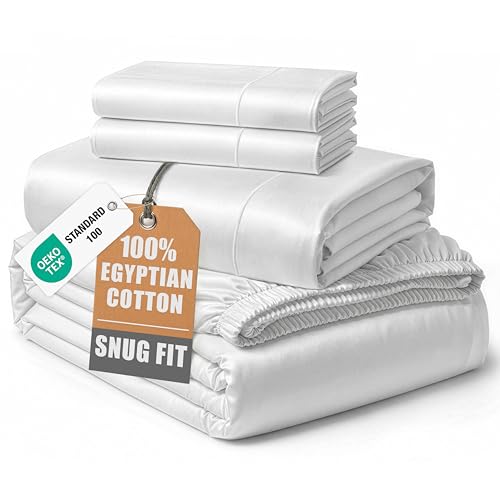

As an Amazon Associate we earn from qualifying purchases at no extra cost to you. Ratings are shown as listed on Amazon.
Look for a clear fiber statement such as “100% Egyptian cotton,” rather than vague wording such as “made with Egyptian cotton.” The latter may refer to a blend. Also check whether the manufacturer identifies a recognized Egyptian cotton certification or traceability program, such as Cotton Egypt Association accreditation. Certification language should be specific enough to verify; a decorative logo with no explanation is weak evidence.
Be cautious with “Egyptian-quality,” “hotel cotton,” or “luxury cotton.” These are marketing descriptions, not proof of Egyptian origin. If the product page gives only a very high thread count and never states the fiber origin, treat the sheets as unverified.
Thread count: what is worth paying for?
Thread count is the number of threads woven into one square inch, but counting methods are not always consistent. Some manufacturers count individual yarn plies separately. A two-ply yarn can therefore make a nominal 1,000-thread-count label without providing the same density as 1,000 single threads.
For soft, durable bedding, a well-made 300–600 thread-count sheet is often a more useful target than an extreme number. Around 200–400 can feel lighter and airier, particularly in percale. Around 400–600 often gives sateen a plush, smooth hand. Above approximately 600, extra density may add weight and warmth without adding proportional softness. It can also slow drying and make the fabric feel stiff if the yarn quality is poor.
Think of thread count as one specification among several. Fiber length, yarn quality, weave, finishing, fabric weight, and stitching have greater influence on how the sheets feel after repeated laundering.
Sateen versus percale for softness and breathability
Sateen
Sateen usually uses a one-yarn-over, three-yarn-under structure. Its relatively smooth surface feels silky and tends to soften quickly after washing. It is a strong choice if you want a cozy, polished bed or prefer sheets that feel less crisp.
The trade-off is warmth. Sateen generally traps more heat than percale, especially when it is tightly woven or heavily finished. Dense sateen may also show surface abrasion and pilling sooner if washed with rough garments or dried at excessive heat.
Percale
Percale uses a simple one-over, one-under weave. It feels crisp, matte, and breathable, with a texture that becomes pleasantly soft over time rather than immediately silky. Choose it for warm rooms, layered bedding, or anyone who dislikes a slippery sheet.
Percale can wrinkle more readily and may feel slightly firm during its first few washes. That is not necessarily a quality problem. A lightweight, long-staple percale can be more comfortable through summer than a heavier sateen with a higher thread count.
Fit the pocket depth before judging softness
Measure the mattress from its base to the highest sleeping surface, including a topper or mattress pad. Add about 2 inches for movement and tuck. For example, a 13-inch mattress plus a 3-inch topper equals 16 inches. Adding 2 inches gives a target fitted-sheet pocket of at least 18 inches.
That calculation helps avoid buying a nominally soft sheet that constantly pulls loose. A pocket that is too shallow puts tension on the corner seams, while an excessively deep pocket can leave loose fabric that bunches beneath the sleeper.
- Mattress up to 12 inches: a 14–16 inch pocket is usually suitable.
- Mattress measuring 13–15 inches: choose a 16–18 inch pocket.
- Mattress and topper measuring 16–18 inches together: look for an 18–22 inch pocket.
- For unusually thick pillow-top beds, prioritize a stated maximum mattress depth over a generic “deep pocket” label.
Full-perimeter elastic is preferable to elastic only at the corners. Check that the fitted sheet has a directional label or strong corner construction if your mattress is tall; these small details make installation easier and reduce twisting.
Ownership realities: what wears out first?
On regularly used sheets, the first failures are commonly thinning in the center of the fitted sheet, fraying at the top hem, and elastic losing its recovery. Rough mattress surfaces, body oils, overloading the washer, and high dryer heat accelerate these problems. A smooth pillowcase can still feel excellent while the fitted sheet is already nearing replacement, so sets do not always wear evenly.
To extend useful life, wash sheets separately from towels, denim, and garments with zippers. Those items create abrasion and lint. Use the recommended amount of liquid or powder detergent; excess detergent can leave a harsh residue that masks the fabric’s softness. Avoid chlorine bleach unless the care label specifically permits it, since repeated bleaching can weaken cotton fibers and elastic.
Use cool or warm water according to the care label, leave room for the sheets to move, and remove them promptly from the dryer. Low or medium heat is gentler than high heat. Line drying can reduce thermal damage, although completely drying sheets before storage is important to prevent musty odors. Fabric softener is optional, but frequent use can coat fibers and reduce absorbency.
A practical value calculation
Suppose a sheet set costs $180 and lasts four years with weekly washing. Four years contain approximately 208 weekly uses, so the set costs about $0.87 per wash ($180 ÷ 208). If a cheaper $90 set lasts only 18 months, it provides about 78 weekly uses and costs roughly $1.15 per wash.
This is not a guarantee that the more expensive set is better. It shows why durability, fit, and care instructions matter alongside the purchase price. A moderately priced, verified cotton set that remains comfortable for several years can be better value than a heavily advertised high-thread-count set that becomes thin or loses its elastic quickly.
Buying checklist
- Confirm whether the product says 100% Egyptian cotton or only “made with” Egyptian cotton.
- Look for traceability or certification details rather than relying on a logo alone.
- Choose sateen for a smoother, warmer feel and percale for a crisper, cooler feel.
- Treat 300–600 thread count as a useful range, not a quality guarantee.
- Check fabric weight or construction details if breathability is important.
- Measure the mattress, topper, and pad before selecting pocket depth.
- Look for full-perimeter elastic, reinforced hems, and a stated shrinkage allowance.
- Read the care label before buying, especially if you need hot washing or tumble drying.
FAQ
Are Egyptian cotton sheets always softer than other cotton sheets?
No. Fiber origin matters, but finishing, yarn quality, weave, and laundering also determine softness. A well-made long-staple cotton sheet from another growing region can feel softer than a poorly constructed or misleadingly labeled Egyptian cotton sheet.
Do Egyptian cotton sheets get softer after washing?
Many do, particularly when they use long-staple fibers and a moderate finish. Wash them according to the label and avoid excessive heat. A sheet that becomes rough after only a few washes may have weak fibers, heavy finishing, detergent buildup, or excessive drying heat.
Is sateen or percale better for hot sleepers?
Percale is usually the safer starting point because its weave feels more breathable and crisp. Lightweight sateen can still work if you prefer a silky surface, but dense or heavy sateen is more likely to feel warm.



Write Your Review
No reviews yet. Be the first to share your experience!