

Key takeaways
- Remove loose debris first. Shake a small rug or sweep a large one before adding water. Wet leaves and grit are harder to remove and can stain lighter fibers.
- Rinse with a hose. Work from the cleaner end toward the dirty end so soil does not migrate back across the rug.
- Use mild soap for marks. A small amount of gentle dish soap and a soft brush is usually sufficient. Test on an inconspicuous corner before treating the center.
- Dry completely on both sides. Drape it over a railing only if the railing will not damage the edge. Otherwise, elevate it on clean supports and turn it over once.
- Store it dry and loosely rolled. Roll with the patterned side outward, wrap it in a breathable cover, and keep it off a damp garage or basement floor.
The best outdoor patio rugs are low-pile, UV-resistant polypropylene rugs sized to leave a visible border around your furniture, with balcony-friendly dimensions, breathable drainage, and cleaning needs matched to how often the space is used.
Our top picks
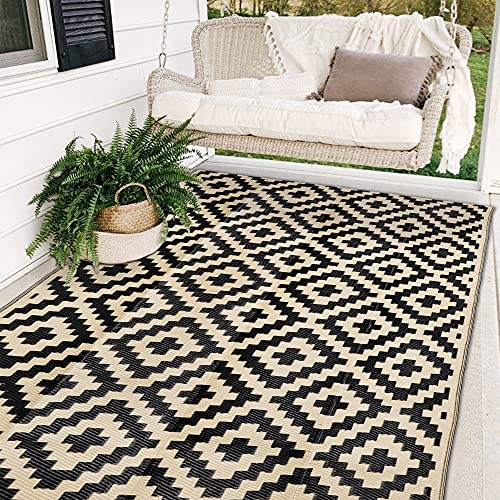
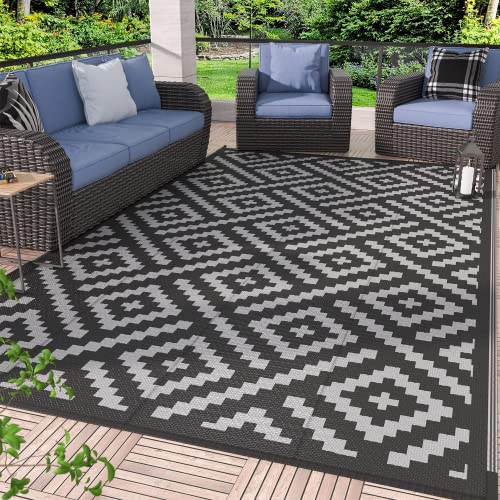


As an Amazon Associate we earn from qualifying purchases at no extra cost to you. Ratings are shown as listed on Amazon.
Quick picks by outdoor space
| Outdoor situation | Best rug size | Best construction | Why it works |
|---|---|---|---|
| Small apartment balcony | 5 × 7 ft or 6 × 9 ft | Flat-weave polypropylene, 0.15–0.25 in pile | Fits beneath compact seating without blocking doors or railings |
| Long, narrow balcony | 2.5 × 7 ft or 3 × 10 ft runner | Open-weave or perforated backing | Uses the length of the balcony while allowing water to escape |
| Two-chair deck seating area | 5 × 7 ft or 6 × 9 ft | Reversible flat weave | Provides a defined seating zone with little furniture repositioning |
| Dining table for four | 8 × 10 ft | Dense flat weave with reinforced edges | Allows chairs to remain on the rug when pulled out |
| Large patio sectional | 9 × 12 ft or 10 × 14 ft | Heavy-duty polypropylene or recycled-plastic weave | Keeps all front legs, and often all legs, inside one cohesive area |
How to choose the right outdoor rug size
Measure the furniture footprint first, then add the space needed for movement. For a lounge arrangement, the minimum useful rule is to place the front legs of every seat on the rug. A more finished arrangement places all furniture legs on it.
For an outdoor dining table, measure the tabletop and add at least 30 inches to both the length and width. That accounts for chairs being pulled out. For example, a 60 × 36-inch table needs approximately:
60 + 60 inches = 120 inches, or 10 feet long
36 + 60 inches = 96 inches, or 8 feet wide
That makes an 8 × 10-foot rug the practical minimum. If the dining area is frequently used or the chairs have wide arms, a 9 × 12-foot rug gives more forgiving clearance.
Allow for doors, drains, and railings
Leave at least 2 to 4 inches of clearance at a swinging door, and avoid covering balcony drains or inspection panels. On a narrow balcony, a rug that is 2 to 4 inches narrower than the usable floor width is safer than one that touches both walls. Tight wall-to-wall placement traps moisture and makes sweeping difficult.
Flat weave versus high pile: which construction wins outdoors?
Flat-weave rugs
Flat-weave rugs are the safest default for patios. Their low profile reduces tripping, lets chairs slide more easily, and dries faster than plush designs. Polypropylene is especially useful because it resists ordinary outdoor moisture, is relatively light, and can be cleaned with soap and water.
The trade-off is that a thin weave may shift in strong wind. Use discreet outdoor rug corner weights or a breathable, non-staining rug pad designed for exterior flooring. Do not use an indoor felt pad; it can retain water against the deck or concrete.
Open-weave and perforated rugs
These designs are useful on uncovered balconies, pool-adjacent patios, and locations where rain is common. Their holes or looser structure allow water and air to pass through. They also tend to collect less standing moisture beneath the rug.
Open weaves can feel less substantial underfoot and may catch on sharp furniture feet. Check that the edges are tightly finished and use furniture with broad, smooth contact points.
Low-pile textured rugs
A low textured pile can make a covered patio feel more comfortable, but it requires more attention. Dirt settles between the fibers, and a dense backing can slow drying. Choose this style only when the rug is under a roof or can be lifted regularly for ventilation.
Why high pile is usually a poor patio choice
Shag and thick indoor-style rugs hold leaves, sand, and water. Their backing can remain damp long after the surface feels dry, leading to discoloration on wood or composite decking. They also make dining chairs harder to move and can create a raised edge at doorways.
UV resistance, drainage, and the details that determine lifespan
Outdoor rugs fade first where sunlight is strongest: the exposed center, doorway side, and edges near reflective walls. Look for wording such as “UV-resistant” or “solution-dyed,” rather than assuming every plastic rug has the same color stability. Solution-dyed fibers have color integrated through the material, which is generally more durable than a surface-only print.
No outdoor rug is completely fade-proof. A dark navy or charcoal pattern usually shows sun bleaching sooner than a mixed, medium-tone pattern. Rotating the rug 180 degrees every few months can even out exposure if the furniture layout allows it.
Drainage depends on more than the top weave. A rug with a breathable or perforated underside dries faster than one with a solid rubber-like backing. On a wood deck, lift the rug after heavy rain and inspect beneath it. Even a moisture-resistant rug can trap dirt and dampness where it contacts the boards.
Decision matrix: match the rug to your routine
| Your situation | Recommended choice | Avoid | Maintenance expectation |
|---|---|---|---|
| Limited budget, occasional use | Reversible polypropylene flat weave in a 5 × 7 ft or 6 × 9 ft size | Premium thick pile that adds cost without improving drainage | Shake or sweep monthly; hose when visibly dirty |
| Daily use, uncovered patio | UV-resistant, open-weave rug with finished edges | Dense backing and very dark solid colors | Brush weekly; lift after heavy rain |
| First-time buyer | Lightweight reversible rug with a clear care label | Heavy rugs that are difficult to move alone | Easy seasonal cleaning and storage |
| Frequent outdoor dining | Dense low-profile weave in 8 × 10 ft or larger | Long pile that catches chair legs and crumbs | Sweep after meals; rinse promptly after spills |
| Wet climate or poolside use | Perforated or open weave with rapid drainage | Solid waterproof backing | Rinse and stand on edge to dry as needed |
Cleaning and storage: the ownership habits that matter
Most polypropylene outdoor rugs can be maintained with a simple sequence:
- Remove loose debris first. Shake a small rug or sweep a large one before adding water. Wet leaves and grit are harder to remove and can stain lighter fibers.
- Rinse with a hose. Work from the cleaner end toward the dirty end so soil does not migrate back across the rug.
- Use mild soap for marks. A small amount of gentle dish soap and a soft brush is usually sufficient. Test on an inconspicuous corner before treating the center.
- Dry completely on both sides. Drape it over a railing only if the railing will not damage the edge. Otherwise, elevate it on clean supports and turn it over once.
- Store it dry and loosely rolled. Roll with the patterned side outward, wrap it in a breathable cover, and keep it off a damp garage or basement floor.
Do not pressure-wash a delicate weave, use chlorine bleach without checking the care instructions, or leave a wet rug folded. Those shortcuts can loosen fibers, strip color, or create permanent odor. Clean spills quickly, particularly grease, sunscreen, and drinks with sugar, because outdoor dust adheres to them.
What wears out first?
On inexpensive rugs, the binding and corners often fail before the center. Repeated chair movement abrades the same edge, while wind can curl an unweighted corner. On sunny patios, color fading is usually noticeable before the material becomes unusable. On decks, trapped grit beneath the rug can scratch the surface even when the rug itself looks fine.
Inspect the rug at the beginning and end of the outdoor season. Replace it if the edges unravel into a trip hazard, the underside becomes brittle, or the weave no longer lies flat. A rug pad is not a substitute for inspection: it can reduce sliding, but it cannot solve poor drainage or a damaged binding.
Best overall buying formula
For most spaces, choose a reversible, low-profile polypropylene flat weave with UV-resistant color, finished edges, and no impermeable backing. Size it so the furniture arrangement—not merely the empty floor—is supported. Use an open or perforated construction for exposed, rainy locations; choose a denser weave for covered dining areas where chair stability and easy sweeping matter more.
The right outdoor patio rug is therefore less about the boldest pattern or thickest texture and more about fit, airflow, sunlight, and the cleaning routine you will actually follow.






Write Your Review
No reviews yet. Be the first to share your experience!