

Key takeaways
- Best all-around choice: Little Giant Velocity M22. A versatile aluminum ladder with multiple configurations, a 300-pound duty rating, and a useful balance of indoor maneuverability and outdoor reach.
- Best for higher exterior work: Werner MT-22. Its 22-foot class gives more extension-ladder reach than compact models, while its 300-pound rating accommodates the user plus tools and materials within the stated limit.
- Best for smaller homes and apartments: a 13- to 17-foot aluminum multi-position ladder. These are easier to carry through doorways and store in a closet, though they sacrifice high roofline access.
- Best for frequent, demanding use: a heavy-duty 300-pound multi-position ladder with wide stabilizing feet and replaceable parts. Pay more attention to hinge construction, rung wear, and service support than to the maximum advertised height.
The best multi position ladders for most home projects are the Little Giant Velocity M22 for broad all-around use, the Werner MT-22 for higher outdoor work, and a compact 17-foot-class model for homeowners who prioritize storage and occasional indoor jobs.
A multi position ladder can work as an A-frame, extension ladder, staircase ladder, or, on some models, a two-person trestle-and-plank setup. That flexibility is useful, but it also means comparing more than the maximum height. The right choice depends on the configuration you will use most, your ceiling and storage space, the ladder’s duty rating, and how confidently you can lock and reposition it.
Our top picks


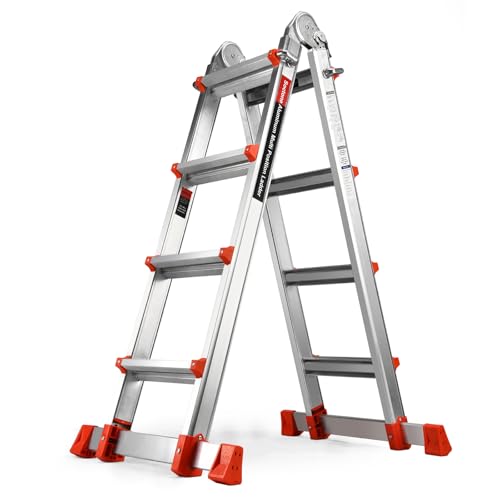

As an Amazon Associate we earn from qualifying purchases at no extra cost to you. Ratings are shown as listed on Amazon.
Best multi position ladders by situation
- Best all-around choice: Little Giant Velocity M22. A versatile aluminum ladder with multiple configurations, a 300-pound duty rating, and a useful balance of indoor maneuverability and outdoor reach.
- Best for higher exterior work: Werner MT-22. Its 22-foot class gives more extension-ladder reach than compact models, while its 300-pound rating accommodates the user plus tools and materials within the stated limit.
- Best for smaller homes and apartments: a 13- to 17-foot aluminum multi-position ladder. These are easier to carry through doorways and store in a closet, though they sacrifice high roofline access.
- Best for frequent, demanding use: a heavy-duty 300-pound multi-position ladder with wide stabilizing feet and replaceable parts. Pay more attention to hinge construction, rung wear, and service support than to the maximum advertised height.
Head-to-head comparison
The figures below are representative published specifications for well-known ladder types and models. Exact dimensions can vary by model revision, accessories, and the configuration being measured. “Reach” is not the same as standing height: manufacturers generally calculate it using a person’s safe working reach above the highest permitted standing step.
| Option | Typical configurations | Maximum reach or size | Duty rating | Approx. weight | Storage consideration |
|---|---|---|---|---|---|
| Little Giant Velocity M22 | A-frame, extension, staircase, trestle-and-plank compatible | About 19 ft in A-frame form; up to about 22 ft as an extension ladder | 300 lb | About 39 lb | Folds shorter than a conventional 22-ft extension ladder, but still needs a long wall or rack |
| Werner MT-22 | A-frame, extension, staircase, wall-access configurations | Up to about 28 ft working reach, depending on setup and user height | 300 lb | About 44 lb | Long and heavy; measure the storage wall, vehicle, and doorway route first |
| 17-ft-class multi-position ladder | A-frame, extension, staircase | About 13 ft A-frame height; roughly 17 ft extension length | 250–300 lb | About 30–38 lb | Usually manageable in a garage, utility room, or tall closet |
| Compact 13-ft-class multi-position ladder | A-frame, extension, staircase | About 10 ft A-frame height; roughly 13 ft extension length | 250–300 lb | About 25–32 lb | Best for indoor storage and frequent carrying, but limited on two-story exteriors |
For ordinary ceiling lights, crown molding, curtain hardware, and painting, a 13- or 17-foot model is usually easier to position safely than a 22-foot ladder. For gutters, high siding, and one-story roof edges, a 17- to 22-foot model is more practical. A larger ladder is not automatically better: extra length adds weight, storage difficulty, and leverage when you are carrying it around a room.
What to compare before buying
Configuration and working height
Look for independent adjustment on both sides if you regularly work on stairs or uneven ground. Some ladders can be set up with one side shorter than the other; others require a level surface or a separate accessory. For an A-frame, compare the maximum permitted standing height rather than the top of the ladder. Never treat the highest cap or top step as a standing platform unless the manufacturer specifically permits it.
Extension mode is useful for gutters and exterior walls, but the ladder must be positioned at the correct angle and extend above the landing where access requires it. A 22-foot ladder therefore needs considerably more clear ground length than its folded size suggests.
Weight limits
A 300-pound duty rating includes your body weight, clothing, tools, paint, and anything else on the ladder. For example, a 210-pound user carrying a 20-pound tool bag and 10 pounds of materials has already reached 240 pounds. A 250-pound-rated ladder leaves only 10 pounds of theoretical capacity, which is an uncomfortable margin for movement and does not make the ladder suitable for exceeding its label.
For routine home use, a 300-pound rating is a sensible minimum when several people may use the ladder or when you carry tools. It does not mean the ladder is safe to overload, use as a bridge, or place on a box to gain height.
Locking systems and hinges
Prefer clearly visible, spring-loaded locks that engage automatically or provide an obvious indicator when fully seated. Before climbing, inspect both sides: a ladder can appear straight while one lock is only partly engaged. Multi-position hinges should move smoothly without grinding, excessive side play, or a pin that fails to return completely.
Many designs use telescoping sections, rung locks, or combination hinges. More mechanisms mean more inspection points. Keep them free of paint, mud, and grit, but do not modify or lubricate them unless the manufacturer’s instructions permit it. A slippery or contaminated locking surface can make partial engagement harder to notice.
Materials, feet, and stability
Aluminum is relatively light and resists ordinary outdoor corrosion, making it the common choice for multi-position ladders. It must be kept away from electrical sources because aluminum conducts electricity. Fiberglass versions are heavier but are the usual choice where electrical exposure is a concern; they still require the electrical precautions stated by the manufacturer.
Inspect the rubber feet and end caps more often than the frame. They are commonly the first parts to wear, harden, split, or lose grip. Wide feet, flared rails, and a stabilizer bar can improve contact with the floor, but none compensates for loose soil, wet flooring, or a ladder set at an unsafe angle.
Decision matrix for real home use
| Your situation | Recommended size or type | Why | Main compromise |
|---|---|---|---|
| Small storage area, occasional indoor use | Compact 13-ft class, 250–300 lb | Lightest and easiest to carry through furnished rooms | Insufficient reach for many exterior tasks |
| One ladder for decorating, stairs, gutters, and maintenance | 17-ft class, 300 lb | Best balance of reach, weight, and storage | May not reach high second-story work safely |
| Frequent gutter, siding, or roof-edge work | 22-ft class, 300 lb, with stabilizer features | More extension reach and outdoor versatility | Heavy, awkward, and demanding to transport |
| Uneven stairs or split-level interiors | Model with independently adjustable sides | Allows a more level climbing surface | More hinges and locks require careful inspection |
| Electrical work near wiring or service equipment | Appropriately rated fiberglass model | Nonconductive material is preferable to aluminum | Usually heavier and bulkier |
Setup and maintenance that affect safety
- Plan the configuration on the ground. Read the ladder’s labels and confirm that the selected mode is permitted. Do not change configuration while standing on it.
- Check every lock. Extend or fold each section until the pins or hinges fully engage. Pull gently on the rails to verify that nothing shifts unexpectedly.
- Prepare the surface. Remove rugs, tools, loose gravel, and wet debris. Never level a ladder with cardboard, lumber, furniture, or improvised shims.
- Position your body correctly. Keep your belt buckle between the rails and both feet on an approved step. Climb down and move the ladder instead of leaning sideways.
- Clean after use. Wipe dust and wet residue from rungs, hinges, feet, and telescoping rails. Let the ladder dry before folding it.
- Store it supported. Secure a long ladder horizontally at multiple points or vertically where it cannot fall. Avoid leaving it in standing water, extreme heat, or a location where children can operate the locks.
Do not drill the rails, replace hardware with generic bolts, paint over warning labels, or use a damaged ladder “just once.” Replace worn feet and other approved parts through the manufacturer or an authorized source. If a rail is bent, a rung is loose, or a hinge has unusual play, retire the ladder until it has been assessed according to the manufacturer’s service guidance.
Is a multi position ladder worth the extra cost?
Compared with buying separate step and extension ladders, a multi position model can reduce equipment clutter and cover more tasks. The trade-off is that it costs more than a basic step ladder and is often heavier than either a compact step ladder or a single-purpose extension ladder.
Consider a $250 ladder used for 25 projects over five years: the equipment cost is about $10 per use before maintenance. If you expect only two indoor projects, a $60 step ladder may be the better value. If you routinely switch between floor levels, stairs, exterior walls, and storage areas, the added configurations can justify the higher purchase price.
Bottom line
Choose the Little Giant Velocity M22 if you want a proven, versatile all-purpose format and can manage its weight. Choose the Werner MT-22 when exterior reach is the priority and you have adequate storage and transport space. For mostly indoor work, choose a 13- or 17-foot-class model instead of paying for height you will rarely use. Whichever model you select, prioritize a 300-pound rating, visible locking engagement, replaceable feet, and a size you can safely carry and store.







Write Your Review
No reviews yet. Be the first to share your experience!