

Key takeaways
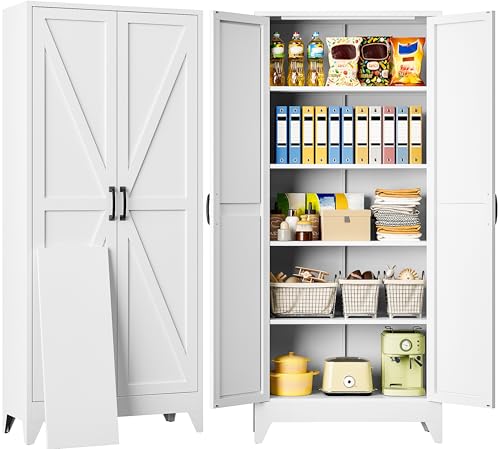
- Check the adjustment interval: shelf holes spaced about 1 inch apart offer more flexibility than widely spaced positions.
- Prefer full-width shelves: they distribute weight better than narrow split shelves.
- Inspect the supports: metal shelf pins or brackets are more dependable than small plastic pegs for heavy contents.
- Confirm the usable opening: the cabinet’s outside height is not the same as the height between shelves.
- Look for anti-tip hardware: tall cabinets should be anchored to a wall stud or suitable masonry surface.
The best storage cabinets are the ones whose material, shelf capacity, dimensions, and door style match the room and the weight of what you actually plan to store—not simply the cabinet with the most shelves.
For most homes, a powder-coated steel cabinet is the strongest choice for garages, utility rooms, and busy entryways; a melamine or laminate cabinet offers better value for bedrooms and offices; and solid wood or wood veneer is preferable when appearance matters as much as storage. Before buying, measure the available footprint, check the shelf weight limit, and leave enough clearance for doors, drawers, and baseboards.
Our top picks


As an Amazon Associate we earn from qualifying purchases at no extra cost to you. Ratings are shown as listed on Amazon.
Best storage cabinet types by room
| Room or situation | Best cabinet type | Useful size range | Why it works |
|---|---|---|---|
| Kitchen or dining area | Laminate pantry cabinet or sideboard | 30–36 in. wide, 12–18 in. deep | Easy to wipe clean; adjustable shelves handle appliances and serving ware |
| Bedroom | Engineered-wood wardrobe or tall cabinet | 24–36 in. wide, 16–24 in. deep | Uses vertical space for folded clothing, linens, and accessories |
| Home office | Lockable metal or laminate file cabinet | 18–36 in. wide, 15–20 in. deep | Protects paperwork and supports heavier office equipment |
| Bathroom | Moisture-resistant MDF or powder-coated steel | 12–24 in. wide, 8–14 in. deep | Compact proportions and sealed surfaces cope better with humidity |
| Garage or workshop | Heavy-gauge steel cabinet | 30–48 in. wide, 18–24 in. deep | Handles tools, hardware, and heavier loads without absorbing spills |
| Entryway | Slim shoe or utility cabinet | 24–36 in. wide, 8–14 in. deep | Fits narrow circulation areas while concealing everyday clutter |
Material durability: what holds up longest?
Powder-coated steel
Steel is the best option for high-impact areas and heavy contents. A cabinet made from approximately 20- to 24-gauge steel can support substantial loads when it has reinforced shelves, welded seams, and a properly braced back panel. Powder coating resists ordinary scratches and makes cleanup easy, but it is not rust-proof. Chips, damp floors, and prolonged exposure to condensation can eventually cause corrosion.
Look for shelves rated to at least 75–150 pounds each for garage storage, depending on whether the load is distributed. A thin steel cabinet with a high advertised total capacity may still have shelves that bend under concentrated weight.
Solid wood and wood veneer
Solid wood provides good repairability and a substantial appearance, while veneer uses less material and can be more dimensionally stable. These cabinets are suitable for living rooms, dining rooms, and bedrooms, but the finish is more vulnerable to standing water, moving impacts, and direct heat. Check whether shelves are solid wood, plywood, or particleboard; a veneer exterior does not guarantee a strong interior.
Particleboard, MDF, and laminate
Engineered wood delivers the widest range of affordable cabinet styles. Laminate or melamine surfaces are practical for offices and pantries because they resist stains and wipe clean. The vulnerable areas are usually the bottom edges, screw joints, and shelf-pin holes. Moisture can swell an unsealed edge, and repeated assembly or overloading can loosen particleboard fasteners.
For a cabinet expected to last several years, prioritize thick edge banding, cam-lock or metal fasteners, a fully attached back panel, and shelves at least 5/8 inch thick. In a bathroom, choose sealed edges and keep the cabinet elevated from any floor that may become wet.
Adjustable shelves matter more than shelf count
A cabinet with four fixed shelves may offer less useful storage than one with three shelves that can move. Adjustable shelves let you create tall compartments for bottles, appliances, binders, or cleaning tools instead of wasting vertical space.
- Check the adjustment interval: shelf holes spaced about 1 inch apart offer more flexibility than widely spaced positions.
- Prefer full-width shelves: they distribute weight better than narrow split shelves.
- Inspect the supports: metal shelf pins or brackets are more dependable than small plastic pegs for heavy contents.
- Confirm the usable opening: the cabinet’s outside height is not the same as the height between shelves.
- Look for anti-tip hardware: tall cabinets should be anchored to a wall stud or suitable masonry surface.
As a practical rule, leave 1–2 inches of clearance above the tallest item you use regularly. That space makes removal easier and avoids scraping the cabinet’s underside.
Weight limits: calculate the real load
Do not compare only the cabinet’s maximum total capacity. Divide the expected contents between shelves and account for concentrated loads. For example, suppose a pantry cabinet has four shelves rated for 40 pounds each. If you store six 5-pound countertop appliances on one shelf, that is 30 pounds before adding accessories, so the shelf appears within its rating. However, placing all six toward the front can stress the shelf and fasteners more than distributing them across its depth.
For books, binders, canned goods, and tools, choose at least a 25% capacity margin. If your estimated shelf load is 48 pounds, look for a shelf rated at least:
48 pounds × 1.25 = 60 pounds
Ratings are usually based on evenly distributed weight. A toolbox, cast-iron cookware, or compact appliance places more stress in one area, so use a stronger shelf or divide the items among two levels.
Decision matrix: which cabinet fits your situation?
| Your priority | Recommended choice | Minimum features to seek | Trade-off |
|---|---|---|---|
| Lowest reasonable cost | Flat-pack laminate cabinet | 5/8-inch shelves, sealed edges, adjustable pins | Less tolerant of moisture and repeated relocation |
| Frequent daily use | Metal or hardwood cabinet | Reinforced hinges, durable finish, smooth hardware | Usually heavier and more expensive |
| Small room | Slim vertical cabinet | 8–14-inch depth, wall anchoring, doors that do not obstruct walkways | Less front-to-back capacity |
| Heavy storage | Steel utility cabinet | 75-pound-plus shelf rating, reinforced shelves, leveling feet | More industrial appearance |
| Decorative living space | Wood, veneer, or quality laminate sideboard | Finished back, concealed hinges, cable management if needed | Often lower weight limits than workshop cabinets |
Room-specific sizing mistakes to avoid
Measure three dimensions: the available width, the maximum depth, and the unobstructed height. Then measure obstacles that product listings often omit, including baseboards, radiators, outlets, window trim, light switches, and door swing paths.
A 16-inch-deep cabinet placed in front of a 4-inch baseboard may sit 20 inches from the wall, which can turn a comfortable passage into a bottleneck. In an entryway, keep roughly 36 inches of walking clearance where possible. For a bathroom, measure around the toilet, vanity doors, and plumbing connections rather than assuming the empty wall is fully usable.
For tall cabinets, include the assembly angle. A cabinet that is 78 inches tall may require more than 80 inches of ceiling clearance to tilt upright, particularly if it is assembled on the floor.
Ownership realities: what wears out first?
- Hinges and catches: doors that are opened several times a day may sag or stop aligning before the cabinet body fails. Adjustable hinges are easier to correct.
- Shelf edges: dragging heavy objects can chip laminate or wear paint. Lift items instead of sliding them.
- Fasteners: particleboard joints can loosen after repeated overloading or moving. Tighten hardware periodically, without overtightening.
- Bottom panels: mopping water and leaks commonly damage the lowest edge. Use furniture glides or a raised plinth where appropriate.
- Odors and dust: ventilate new engineered-wood cabinets and wipe them with a barely damp cloth rather than saturating unfinished edges.
For routine care, dust first, use a mild diluted cleaner suitable for the finish, and dry all surfaces immediately. Avoid abrasive pads, solvent-based cleaners, and adhesive hooks on painted or veneered panels unless the manufacturer approves them.
How to choose the final cabinet
- Write down the heaviest and tallest items the cabinet must hold.
- Measure the space, including trim, clearance, and the delivery route.
- Choose a material suited to the room’s moisture and impact level.
- Compare usable shelf dimensions and individual shelf ratings, not just total capacity.
- Confirm that shelves are adjustable and that wall-anchoring hardware is included or compatible.
- Allow a 25% weight margin and leave some empty volume for future storage.
General market pricing in 2026 ranges from about $80–$250 for basic laminate cabinets, $150–$500 for better-finished bedroom, office, and pantry units, and $250–$1,000 or more for heavy-duty steel or solid-wood cabinets. Paying more is most worthwhile when it buys thicker shelves, stronger hardware, sealed edges, adjustable storage, or a finish appropriate for demanding conditions.
Frequently asked questions
Are metal cabinets better than wood cabinets?
Metal cabinets are better for heavy, messy, or humid utility areas, while wood and engineered-wood cabinets usually look better in living spaces. Neither material is automatically superior; shelf construction and finish determine much of the real-world performance.
How deep should a storage cabinet be?
Choose 8–14 inches for narrow entryways and bathrooms, 12–18 inches for pantries and offices, and 18–24 inches for tools, appliances, and bulky household goods. Greater depth is not always better because items can disappear behind one another.
Should every tall cabinet be anchored?
Yes. A tall or top-heavy cabinet should be secured to a suitable wall surface, especially in homes with children, pets, seismic activity, or uneven floors. Follow the cabinet’s anchoring instructions and use hardware appropriate for the wall structure.







Write Your Review
No reviews yet. Be the first to share your experience!