

Key takeaways
- Use a digital probe thermometer for the basking surface or the air temperature at the animal’s level.
- Use a second thermometer on the cool side to confirm a gradient.
- Use an infrared temperature gun to check several surfaces, but do not rely on it alone for air temperature.
- Set temperatures according to the species’ care guidance and life stage.
- Recheck readings after changing substrate, décor, screen covers, room heating, or lamp height.
The best reptile heat lamps are chosen by the enclosure’s required basking temperature, usable beam size, fixture rating, and whether the animal also needs UVB—not by wattage alone.
A good setup creates a measurable temperature gradient: a warm basking zone at one end and a cooler retreat at the other. The correct lamp may be a halogen basking bulb, a focused incandescent spot bulb, a mercury-vapor bulb, or a ceramic heat emitter paired with separate lighting. The choice depends on species, enclosure dimensions, room temperature, screen or mesh losses, and the distance between the lamp and the basking surface.
Our top picks


As an Amazon Associate we earn from qualifying purchases at no extra cost to you. Ratings are shown as listed on Amazon.
Quick picks by enclosure and use
| Situation | Best lamp type | Typical starting wattage | What to verify |
|---|---|---|---|
| Small terrestrial enclosure, about 20–40 gallons | Focused halogen or basking spot bulb | 35–75 W | Basking temperature and beam diameter at the perch |
| Medium enclosure, about 40–75 gallons | Halogen flood or spot bulb | 75–100 W | Whether the beam heats enough of the animal’s body without warming the cool side |
| Large or tall enclosure | Higher-wattage halogen, multiple lower-wattage bulbs, or radiant heat panel | 100–160 W total | Fixture capacity, ceiling clearance, and heat distribution |
| Night heating where visible light is undesirable | Ceramic heat emitter or deep-heat projector | 50–150 W | Thermostat control and a guard that prevents contact burns |
| Heat and UVB from one overhead source | Mercury-vapor bulb | 80–160 W | Minimum distance, ventilation, UVB replacement schedule, and bulb orientation |
These wattages are starting points, not universal prescriptions. A 75-watt bulb can run too hot in a small, poorly ventilated enclosure and too cool in a tall enclosure with a cold room and a large screen top.
Which reptile heat lamp type is right?
Halogen basking bulbs
Halogen bulbs are often the most versatile choice for a daytime basking area. They produce bright visible light and concentrated radiant heat, and many are available as spot or flood patterns. A spot bulb creates a smaller, hotter basking area; a flood bulb spreads heat more evenly across a wider surface.
Examples include the Zoo Med Repti Basking Spot Lamp, Exo Terra Intense Basking Spot, and Arcadia Halogen Basking Spot. Match the bulb’s wattage to the fixture and measure the actual basking surface with a digital probe thermometer or infrared temperature gun. Halogen bulbs are consumables: performance and brightness decline with age, and a darkened or visibly damaged bulb should be replaced.
Incandescent basking and spot bulbs
Standard incandescent basking bulbs can provide useful heat and visible light, particularly in uncomplicated daytime setups. They are usually inexpensive and easy to replace, but their beam shape and lifespan vary. Avoid choosing a household decorative bulb solely because it fits the socket; its heat pattern may be unsuitable, and some fixtures are not rated for the required temperature.
Mercury-vapor bulbs
Mercury-vapor lamps produce heat, visible light, and UVB. Products such as Zoo Med Powersun and Exo Terra Solar Glo are designed for specific mounting distances and should not be treated like ordinary basking bulbs. They generally need a larger enclosure and careful distance control because both heat and UV intensity can be excessive at close range.
A mercury-vapor lamp is not automatically the best all-in-one solution. It may be difficult to maintain a cool side in a compact enclosure, and UVB output declines before the lamp necessarily appears burned out. If reliable heat and UVB adjustment are important, separate heat and linear UVB fixtures can offer more control.
Ceramic heat emitters and deep-heat projectors
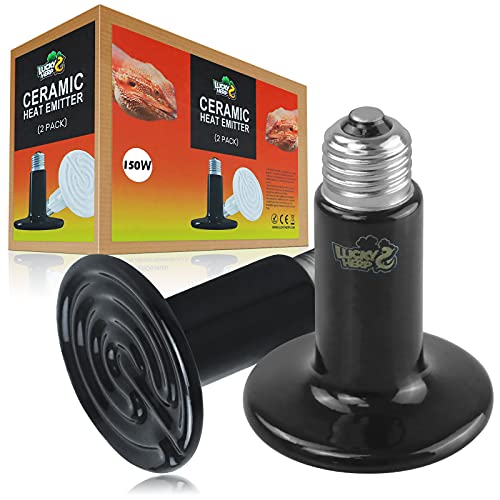
A ceramic heat emitter produces infrared heat without visible light, making it useful for maintaining nighttime warmth when the species should experience darkness. A deep-heat projector is another infrared option that can warm surfaces differently from a conventional spot bulb. Neither should be assumed to provide UVB.
These emitters become extremely hot. They require a heat-rated ceramic-socket fixture, a protective guard, and thermostat control. Never place one where the animal can touch it directly.
How to match heat output to enclosure size
Think in terms of the basking surface rather than the whole enclosure. The lamp should heat a defined zone while leaving a genuine cool retreat. In a horizontal enclosure, place the basking platform at one end and keep the opposite end away from direct radiation. In a tall enclosure, account for the distance from bulb to perch: adding height can reduce basking temperature substantially.
A practical sizing calculation helps. Suppose a 75-watt bulb raises the basking surface from a 72°F room temperature to 96°F at a 10-inch distance. If the perch is moved to 14 inches, the basking temperature may fall noticeably because radiant intensity decreases with distance. Do not estimate the new temperature mathematically and assume it is safe; reposition the perch gradually and measure again. Fixtures, mesh, airflow, and bulb design make real enclosures behave differently.
For a broad basking zone, a flood bulb or two lower-wattage bulbs may be preferable to one intense spot. Multiple lamps also create redundancy, but they increase electrical load and the risk of overheating. Each lamp needs independent measurement and a fixture with adequate capacity.
Temperature control and monitoring
A thermostat is the safest way to prevent runaway heating, especially with ceramic emitters, deep-heat projectors, and setups in rooms with changing temperatures. Use a thermostat whose probe is positioned where the animal actually basks—not directly against the bulb and not on the cool side. Follow the controller’s instructions about dimming, pulse-proportional, or on/off operation; the wrong control mode can shorten bulb life or cause temperature swings.
- Use a digital probe thermometer for the basking surface or the air temperature at the animal’s level.
- Use a second thermometer on the cool side to confirm a gradient.
- Use an infrared temperature gun to check several surfaces, but do not rely on it alone for air temperature.
- Set temperatures according to the species’ care guidance and life stage.
- Recheck readings after changing substrate, décor, screen covers, room heating, or lamp height.
Temperature targets vary considerably among reptiles. A professional exotics veterinarian or an established species-specific husbandry guide is the appropriate source when the correct range is uncertain.
Fixture compatibility and safe mounting
Check four ratings before installing any bulb: socket type, maximum wattage, heat resistance, and indoor-use suitability. High-output reptile lamps commonly require an E26 ceramic socket rather than a plastic socket. The fixture’s maximum wattage must meet or exceed the bulb’s rating, with no extension cord or timer that is unsuitable for the load.
- Mount the fixture outside the enclosure whenever possible, above a secure screen or ventilation panel.
- Use a lamp stand, bracket, or hanger that cannot be displaced by vibration, pets, or routine cleaning.
- Install a wire guard around any hot emitter accessible from inside the enclosure.
- Keep the specified clearance from plastic, wood, fabric, foliage, and the animal.
- Route the cord with a drip loop so condensation cannot run toward the outlet or controller.
- Let the bulb cool fully before touching it, cleaning the fixture, or replacing it.
Do not rest a dome fixture directly on an unstable screen, stack heavy décor beneath it, or use a bulb that exceeds the fixture rating. A lamp can cause burns, melt plastic, crack glass, or start a fire even when the enclosure temperature appears normal.
Ownership realities: replacement, cleaning, and common mistakes
Bulbs are consumables, not permanent equipment. Heat output can change as a bulb ages, while UVB output can decline without an obvious visual warning. Record installation dates and follow the manufacturer’s replacement guidance, using a UV meter where appropriate for UVB-dependent species.
Dust and mineral deposits reduce light and alter heat transfer. After switching off and cooling the fixture, clean the reflector according to its instructions. Keep misting systems and water bowls positioned so they cannot spray a hot bulb. A cracked bulb, loose socket, scorched cord, flickering lamp, or damaged guard requires immediate removal from service.
The most common mistake is increasing wattage before checking distance and ventilation. Another is heating the entire enclosure instead of providing choice. A third is using a red or blue “night” bulb continuously; visible colored light can interfere with a species’ normal dark period. For nighttime heat, use a non-light-emitting source controlled by a thermostat when the animal’s care requirements call for it.
Bottom line
For most daytime basking setups, start by comparing a halogen spot or flood bulb in the appropriate wattage range, then select the one that produces the required basking temperature while preserving a cooler retreat. Choose a mercury-vapor bulb only when its UVB and distance requirements suit the enclosure. Choose a ceramic heat emitter or deep-heat projector for controlled, light-free warmth—not as a substitute for UVB. Measure every installation, use a correctly rated ceramic fixture and guard, and let the enclosure’s actual temperatures—not the label’s wattage—make the final decision.



Write Your Review
No reviews yet. Be the first to share your experience!