

Key takeaways
- Brightness control: Choose at least three levels if the lamp will be used by more than one person or at different distances.
- Color-temperature control: A neutral or cool-white setting can feel appropriate for daytime work; warmer settings may be more comfortable in a living room, but they do not automatically provide the same measured lux.
- Memory function: Useful when the lamp returns to your preferred intensity after being switched off.
- Stable stand: A broad, non-slip base matters more than a thin design if the lamp will be adjusted frequently.
- Low-glare diffuser: Helps prevent distracting reflections on glasses and computer screens.
The best light therapy lamps for home use are the ones that deliver a clearly stated 10,000 lux at a usable distance, block UV, fit your available surface, and offer a timer and brightness controls you will actually use.
Our top picks
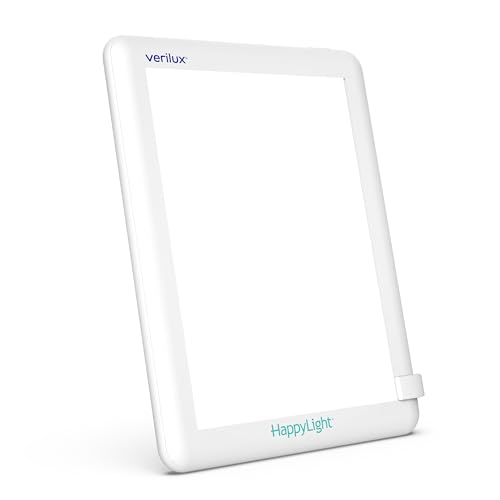


As an Amazon Associate we earn from qualifying purchases at no extra cost to you. Ratings are shown as listed on Amazon.
Quick picks by home situation
| Situation | Best type or example | Why it fits | Typical price range |
|---|---|---|---|
| Small desk or bedside table | Compact panel such as Verilux HappyLight Luxe | Small footprint, adjustable brightness and color temperature | $30–$70 |
| Frequent daily use | Full-size panel such as Carex Day-Light Classic Plus | Larger light-emitting area and a more forgiving placement zone | $80–$150 |
| Maximum coverage | Large professional-style panel such as Northern Light Technologies Boxelite-OS | Broad panel designed for use from farther away | $200–$350 |
| Decor-friendly, slim design | Compact desktop panel such as Circadian Optics Lumos 2.0 | Low-profile design that is easy to leave beside a monitor | $40–$80 |
| Lowest initial cost | Small, adjustable LED light box | Affordable, but usually requires more precise positioning | $25–$50 |
These are buying categories rather than universal winners. The right choice depends less on the highest advertised brightness than on how much light reaches your eyes at the distance you can maintain comfortably.
What brightness ratings really mean
Brightness for a light therapy lamp is normally expressed in lux, the amount of visible light arriving on a surface. A lamp advertised as “10,000 lux” does not necessarily provide 10,000 lux everywhere in the room. That figure applies at a particular distance, often 12 inches, 14 inches, or 16 inches.
Check the manufacturer’s distance specification before comparing models. A 10,000-lux lamp measured at 12 inches may be less convenient than one producing the same rating at 18 or 24 inches. A useful calculation illustrates why: if a lamp provides 10,000 lux at 12 inches but only 5,000 lux at 18 inches, moving it 6 inches farther away may require roughly twice as much exposure time to receive a similar amount of light. The exact result depends on the panel’s optics, so use the published chart rather than assuming every lamp follows an ideal physics model.
Adjustable intensity is valuable in a real home. You may want a lower setting while reading or working close to the panel, then a higher setting when the lamp sits farther away. A model with four or more brightness levels is generally more practical than a single-output lamp.
Panel size and placement distance
Panel size affects both comfort and positioning. A narrow panel can meet its rating only when your face stays in a small central area. A larger panel spreads light across a wider angle, making it easier to read, eat breakfast, or use a computer without continually aiming your head at the lamp.
| Panel category | Approximate illuminated area | Useful distance | Best for |
|---|---|---|---|
| Compact | About 5 × 7 to 6 × 9 inches | Usually 8–16 inches | Small desks, occasional use, travel |
| Medium | About 8 × 10 to 10 × 12 inches | Usually 12–24 inches | Home offices and regular morning routines |
| Large | About 12 × 15 inches or larger | Often 18–36 inches | Shared rooms, wider seating positions, frequent use |
Place the lamp slightly to the side rather than directly in front of your eyes. The light should reach your eyes indirectly while you look at a book, monitor, or breakfast—not by staring into the LEDs. Keep the panel at approximately eye level or a little higher, and follow the stated distance for the selected brightness setting.
Before buying, measure the intended surface. Allow room for the stand, power cable, and any rear tilt mechanism. A lamp that technically fits a 24-inch desk may be awkward if its base occupies 10 inches of depth.
UV protection: the specification to verify
Choose a lamp that explicitly states UV-free or UV-filtered output. Visible-light therapy lamps are designed to provide bright visible light without relying on ultraviolet radiation. “Full spectrum” is not enough by itself; ask whether the product filters UV and look for a clear manufacturer statement.
UV protection does not make every lamp appropriate for every person. If you have an eye condition, take medication that increases light sensitivity, or have another reason to be cautious with bright light, consult a qualified health professional before using one. Stop using the lamp and seek advice if it causes significant eye discomfort, unusual visual symptoms, or other concerning effects.
Timers and adjustable settings that matter
A timer is more useful than a decorative feature because it prevents an accidental extra-long session and makes a routine easier to repeat. Look for automatic shutoff at intervals such as 15, 30, 45, or 60 minutes. A simple countdown is often preferable to an app that requires your phone every time.
- Brightness control: Choose at least three levels if the lamp will be used by more than one person or at different distances.
- Color-temperature control: A neutral or cool-white setting can feel appropriate for daytime work; warmer settings may be more comfortable in a living room, but they do not automatically provide the same measured lux.
- Memory function: Useful when the lamp returns to your preferred intensity after being switched off.
- Stable stand: A broad, non-slip base matters more than a thin design if the lamp will be adjusted frequently.
- Low-glare diffuser: Helps prevent distracting reflections on glasses and computer screens.
How to set up a lamp accurately
1. Measure the usable position
Place the lamp where you expect to use it and measure from the front of the panel to your eyes. Do not measure from the wall or from the rear of the housing.
2. Match the distance to the output
Read the manual’s lux chart. If 10,000 lux is available only at 12 inches, do not assume the lamp still delivers that rating from 24 inches. Increase brightness, move the lamp closer, or choose a larger model rated for greater distance.
3. Aim the light from the side
Position the panel roughly 30–45 degrees to one side, with the light directed toward your face but not straight into your pupils. Keep your normal activity in front of you.
4. Use the timer consistently
Start with the manufacturer’s recommended duration and intensity rather than creating a longer session to compensate for an inconvenient setup. Consistency makes it easier to notice whether the product is comfortable and practical for you.
5. Recheck glare and heat
After several minutes, check whether the lamp reflects in your screen or glasses, feels hot, or forces you to squint. Tilt the panel, lower the intensity, or increase the distance according to the manual.
Ownership details that product listings overlook
LED light therapy lamps usually do not require bulb replacement, but their power adapters, hinges, buttons, and stands are the parts most likely to become annoying first. A lamp used every weekday may be repositioned hundreds of times a year, so a firm hinge and replaceable or standard power adapter can matter more than a marginally higher lux rating.
Clean the diffuser with the lamp unplugged, using a soft, dry or lightly damp microfiber cloth. Avoid spraying cleaner directly onto the panel and do not block ventilation openings. Dust can reduce output and make a white housing look yellowed over time. Store the lamp away from moisture, and avoid covering it while it is operating.
Common mistakes include placing the lamp behind the user, using it from twice the rated distance, staring directly at the LEDs, and buying a tiny panel for a routine that requires frequent movement. A larger, slightly less powerful-looking lamp can be the better purchase if it gives you a comfortable position and consistent coverage.
Bottom line
For most home users, the best light therapy lamps combine a stated 10,000-lux rating at a clearly specified distance, UV-filtered output, a medium or large panel, multiple brightness levels, and an automatic timer. Choose a compact Verilux or Circadian Optics-style panel when space is limited; choose a Carex-style full-size panel for a regular desk routine; and consider a larger Northern Light Technologies-style unit when coverage and distance matter more than price. Compare the measured output, not just the headline number, and follow the product instructions and professional guidance where health considerations apply.


Write Your Review
No reviews yet. Be the first to share your experience!