

Key takeaways
- Resin: Best resistance to rain and occasional neglect. Inspect the lid overlap and bottom drainage points.
- Powder-coated steel: Strong and visually slim, but a chip in the coating can expose metal to rust. Rinse salt deposits from coastal furniture.
- Aluminum: Lightweight and corrosion-resistant, though thin panels can dent and may not feel as rigid when used as a seat.
- Teak: Naturally durable and attractive. It weathers silver-gray without necessarily losing structural strength, but it is not a watertight storage container.
- Acacia: Attractive and less expensive than teak, but requires more protection from standing water, direct rain, and rapid temperature swings.
The best outdoor storage benches are the Keter Eden or Solana for most patios, a Suncast resin bench for smaller budgets and lighter-duty storage, a powder-coated steel bench for dry climates, and a teak or acacia bench when natural appearance matters more than maximum waterproofing.
The right choice depends less on the advertised gallon figure than on whether the bench can safely support two adults, keep cushions dry through your local weather, allow trapped moisture to escape, and open without becoming a finger-trap or a heavy falling lid. The comparison below focuses on those ownership details rather than appearance alone.
Our top picks
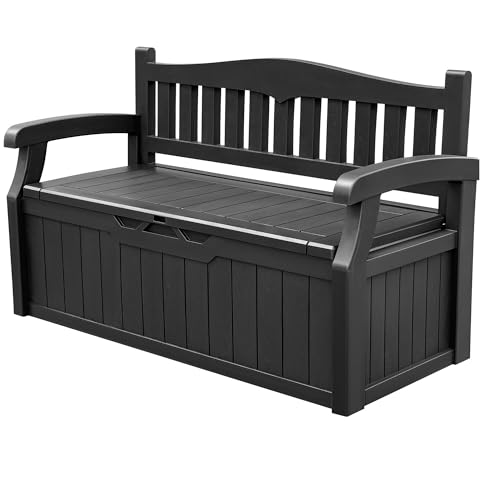
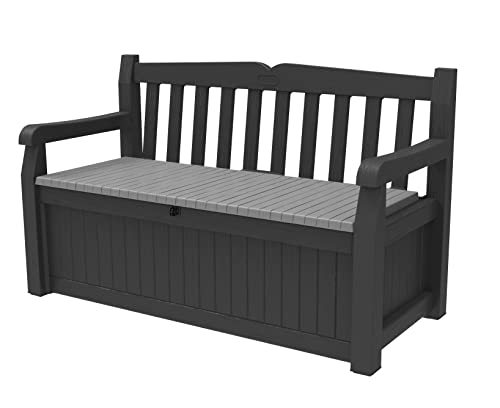


As an Amazon Associate we earn from qualifying purchases at no extra cost to you. Ratings are shown as listed on Amazon.
Quick comparison of the best outdoor storage benches
| Bench type or example | Typical exterior size | Storage volume | Seating capacity | Weather performance | Best for |
|---|---|---|---|---|---|
| Keter Eden or Solana resin bench | 50–53 in W × 20–24 in D × 32–35 in H | About 60–70 gal | 2 adults | Strong rain resistance; add ventilation for damp climates | All-purpose patio storage |
| Suncast resin storage bench | About 48–52 in W × 20–23 in D × 32–35 in H | About 40–50 gal | 2 adults, depending on model | Good against rain and sun; check the floor and lid seal | Value-conscious buyers and smaller patios |
| Powder-coated steel storage bench | 45–55 in W × 18–24 in D × 30–35 in H | About 35–55 gal | 2 adults | Good in dry conditions; scratches and coastal salt require attention | Modern designs and covered patios |
| Teak storage bench | 45–60 in W × 18–24 in D × 32–36 in H | About 25–45 gal | 2 adults | Good outdoors when maintained; not automatically watertight | Premium natural wood appearance |
| Acacia storage bench | 40–55 in W × 18–23 in D × 32–36 in H | About 20–40 gal | 1–2 adults | Best under cover; vulnerable to prolonged wetting and drying cycles | Budget-friendly wood furniture |
Capacity figures are approximate because manufacturers measure interior volume differently. A stated 70-gallon capacity does not mean 70 gallons of usable cushion space: hinges, sidewalls, lid hardware, and a sloping interior can reduce practical capacity by 10–20 percent.
Best overall: a resin bench with a 60–70 gallon interior
A molded resin bench, such as the Keter Eden or Keter Solana, is the strongest general-purpose choice for an uncovered patio. Resin does not absorb water like untreated wood, will not rust like bare steel, and usually needs only occasional washing. These benches commonly hold two adults and have enough room for several seat cushions, a small throw, gardening gloves, or pool accessories.
Look for a double-wall or reinforced resin body, a lockable lid, and a floor raised slightly above the patio. A lock provision is useful for limiting casual access, but it is not a substitute for a weatherproof security box. Resin can also become hot in direct sun, and dark finishes may fade or expand slightly over time.
Important limitation: waterproof is not the same as dry inside
Most outdoor benches resist falling rain rather than forming an airtight seal. Warm, humid air entering during the day can condense on the cooler interior at night. If you store fabric cushions, choose a bench with controlled ventilation or add a breathable liner that does not block drainage. Never seal damp cushions inside and expect the bench to dry them.
Best value for a compact patio: a smaller resin bench
A Suncast-style resin storage bench in the 40–50 gallon range is a sensible choice where space and cost matter more than maximum capacity. A 48-inch bench can fit against a balcony wall or beneath a window while still offering two-person seating. It is usually easier to assemble and move than a large deck box.
Its trade-off is organization. Forty gallons sounds substantial, but a typical 20-by-20-inch outdoor cushion stack may occupy 10–14 gallons, while folded blankets and toys quickly consume the rest. Measure the items you actually own before buying. If the bench will be opened several times each day, a smaller interior may be more convenient than a deep container where items disappear underneath one another.
Best for wet, humid, or coastal weather
For frequent rain, choose resin first, then powder-coated aluminum or galvanized steel, and use wood only when the bench can sit under a roof. The material is only part of the decision; joints, drainage, and hardware often fail before the main body does.
- Resin: Best resistance to rain and occasional neglect. Inspect the lid overlap and bottom drainage points.
- Powder-coated steel: Strong and visually slim, but a chip in the coating can expose metal to rust. Rinse salt deposits from coastal furniture.
- Aluminum: Lightweight and corrosion-resistant, though thin panels can dent and may not feel as rigid when used as a seat.
- Teak: Naturally durable and attractive. It weathers silver-gray without necessarily losing structural strength, but it is not a watertight storage container.
- Acacia: Attractive and less expensive than teak, but requires more protection from standing water, direct rain, and rapid temperature swings.
In a freeze-prone region, leave room for stored items to expand, keep the bench off snow or standing water, and avoid forcing a frozen lid open. Water that enters a crack and freezes can split wood and distort plastic components.
Seating capacity is not just a width measurement
A 48-inch bench is commonly marketed as a two-person seat, but actual comfort depends on depth, leg position, and the strength of the lid. For two adults, aim for at least 45 inches of usable seat width and approximately 18–22 inches of seat depth. A lid that flexes under load may be suitable for occasional sitting but unsuitable as everyday seating.
Check the stated weight capacity and how it is defined. Some manufacturers specify a distributed load across the entire lid; others provide a lower point-load limit. Avoid standing on the lid, sitting on a corner, or placing a heavy planter on it unless the instructions explicitly permit that use.
Lid safety and daily usability
The lid is the part you will notice most after installation. A full storage bench lid can weigh enough to pinch fingers or slam shut in wind. Prefer soft-close hinges, gas-assisted struts, or a lid that stays open beyond a defined angle. A simple chain or strap can limit opening, but it does not prevent a heavy lid from falling.
Also check the opening clearance. A bench with a 50-inch exterior width may have only a 42-inch usable opening after thick sidewalls and hinge housings are accounted for. Measure the largest object you plan to store, not just the total volume. A folded stroller, long cushion, or pool noodle may not fit even when the gallon capacity looks generous.
Decision matrix: which bench fits your situation?
| Your situation | Recommended choice | Why | What to avoid |
|---|---|---|---|
| Uncovered patio, frequent rain, weekly use | 60–70 gallon resin bench | Best balance of volume, rain resistance, and low maintenance | Unsealed wood and fabric-only storage boxes |
| Apartment balcony or narrow terrace | 40–50 gallon bench under 52 inches wide | Fits a wall while providing two seats | Deep boxes that block walking clearance |
| Covered patio in a dry climate | Powder-coated steel or teak | Appearance and structural rigidity matter more than maximum sealing | Unprotected steel in sprinklers or coastal air |
| Daily access to toys, throws, or pool gear | Bench with assisted lid and broad opening | Safer and quicker to use repeatedly | Heavy lid with no stay-open mechanism |
| Maximum cushion storage on a budget | 70-gallon resin model | Usually the lowest cost per usable gallon | Small wooden benches with decorative but shallow compartments |
How much storage do you really need?
Use a simple sizing calculation before shopping. Measure each item as packed for storage, then multiply length by width by height in inches. Add the results and divide by 231 to convert cubic inches to U.S. gallons. For example, six cushions packed into a combined space of 30 × 20 × 18 inches equal 10,800 cubic inches, or about 47 gallons. Allow another 15 percent for easy removal: 47 × 1.15 equals about 54 gallons. In that case, a nominal 60-gallon bench is a safer minimum than a 50-gallon model.
Do not compress wet textiles to make them fit. A little unused space improves airflow and reduces the chance that fabric will remain pressed against condensation.
Ownership realities: what wears out first?
- Hinges and struts: These take repeated load and may loosen before the body shows wear. Tighten fasteners periodically without overtightening plastic.
- Weather seals: Foam or rubber strips flatten, peel, and collect grit. Replace them when the lid no longer overlaps evenly.
- Wood finish: Teak and acacia gradually discolor and develop surface checking if neglected. Clean gently and follow the finish manufacturer’s maintenance instructions.
- Resin panels: Scratches and fading are mostly cosmetic, but cracks around hinges or corners can allow water in and are difficult to repair invisibly.
- Stored fabric: Cushions are often damaged by moisture and mildew before the bench itself fails. Store them dry and use washable, breathable bags rather than airtight plastic.
For routine care, empty the bench every few months, vacuum grit from the hinge area, wash resin with mild soap and water, and inspect the underside for blocked drainage. Keep the bench level; a tilted lid can leave one corner exposed to rain and put uneven stress on the hinges.
Bottom line
Choose a 60–70 gallon resin bench such as the Keter Eden or Solana when you want the best all-around combination of seating, volume, and weather resistance. Choose a smaller Suncast-style resin bench for a compact patio or lower budget. Select powder-coated metal for a covered contemporary setting, and teak or acacia when natural wood is the priority and you are prepared to maintain it. Whatever the material, prioritize a safe lid mechanism, a genuinely usable opening, ventilation for textiles, and enough spare capacity for items to come out dry and without force.






Write Your Review
No reviews yet. Be the first to share your experience!