

Key takeaways
- A digital temperature readout rather than a simple low-medium-high dial.
- Separate heating and holding control, so chocolate does not continue climbing after reaching the target.
- A sensor positioned near the actual chocolate mass, not only near the heating element.
- An agitator or continuous circulation system that reduces hot and cool pockets.
- A practical way to adjust the target by one-degree increments or similarly small steps.
The best chocolate tempering machine for most home makers is a compact, seed-assisted countertop temperer holding about 1.5–2 lb of chocolate: it offers better temperature control than a bain-marie without taking over the kitchen. Choose a larger ChocoVision machine only if you routinely make large batches, and choose a simple heated melter only if you are prepared to temper by hand.
Our top picks


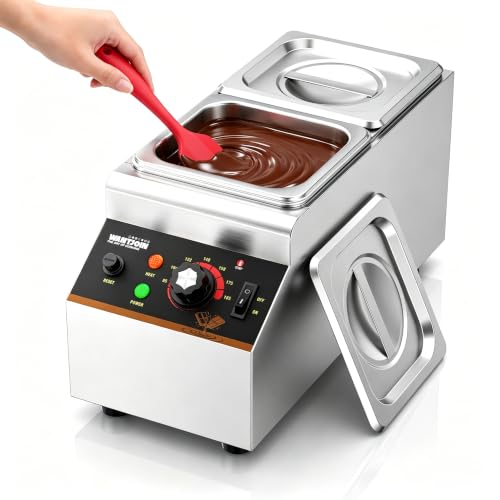
As an Amazon Associate we earn from qualifying purchases at no extra cost to you. Ratings are shown as listed on Amazon.
Best chocolate tempering machines by home-use situation
| Best for | Recommended machine type | Typical capacity | Typical footprint | Approximate market range |
|---|---|---|---|---|
| Occasional truffles, bars, and dipped treats | Compact seed-assisted temperer | 1.5–2 lb | 12–16 in wide; 12–16 in deep | $250–$500 |
| Frequent home production or farmers-market batches | Mid-size continuous temperer | 4–6 lb | 16–22 in wide; 16–22 in deep | $900–$2,000 |
| Large batches and serious confectionery work | Commercial-style continuous temperer | 10–17 lb or more | 20–30 in wide; 20–30 in deep | $2,000–$5,000-plus |
| Lowest-cost experimentation | Heated chocolate melter plus manual tempering | 1–6 lb, depending on vessel | 8–18 in wide | $60–$300 |
These are useful buying ranges rather than guarantees: dimensions, controls, and capacities vary by model and region. A tempering machine should also be judged by its minimum practical batch size. A 6-lb machine may technically hold a small amount, but its temperature sensor and agitator usually behave more predictably when the bowl is reasonably full.
Best compact choice: a 1.5–2 lb seed-assisted temperer
For most households, the compact class is the sensible choice. Machines such as the ChocoVision Revolation 2 are designed around small batches and use automatic temperature control with seed chocolate to establish the correct crystal structure. This is especially useful for molded bars, shells, dipped strawberries, and small batches of truffles.
The main advantage is repeatability. Instead of manually heating, cooling, and reheating chocolate while checking it with a thermometer, you select a chocolate type or target temperature, add melted chocolate and seed, and allow the machine to maintain the working range. You still need to use sound chocolate-making technique, but the machine reduces the amount of timing and stirring required.
Expect a compact machine to occupy roughly the same counter area as a small bread maker, although the bowl and lid may add height. This is a better fit than a commercial unit if you have limited storage or make chocolate once or twice a month.
Best for frequent batches: a mid-size continuous temperer
A 4–6 lb temperer makes more sense when you repeatedly fill molds, supply gifts, or sell small quantities. The larger reservoir reduces the need to stop and reload, and a continuous outlet can make dipping or molding faster than scooping chocolate from a bowl.
The trade-off is substantial countertop commitment. A machine in this class may weigh 30–60 lb and need a permanent location. It also wastes more chocolate during a small session because some chocolate remains in the bowl, auger, or outlet. If you use only 1 lb at a time, the compact machine can be cheaper to operate even when its purchase price is higher.
ChocoVision’s larger Revolation models are examples of the type to consider, but check the current capacity and electrical specifications carefully. Product names can refer to different generations, and the usable working capacity is more important than the maximum bowl volume.
Best for high volume: a large ChocoVision-style continuous machine
Large units, including machines in the ChocoVision Rev2B category, are aimed at demanding production rather than casual home use. Capacities around 15–17 lb can be valuable when you need a steady supply of tempered chocolate for large molds, repeated dipping, or extended work sessions.
For a home kitchen, the limiting factor is often not performance but ownership. These machines can require a dedicated 120-volt circuit or other electrical arrangement, weigh more than 60 lb, and need two people or a sturdy cart for safe movement. They are difficult to justify unless you use the capacity at least weekly.
Temperature precision: what matters beyond the display
Chocolate is sensitive to relatively small temperature changes. Dark chocolate is commonly worked around 88–90°F, milk chocolate around 86–88°F, and white chocolate around 84–87°F, although the ideal range depends on the couverture and manufacturer instructions.
A useful machine should provide:
- A digital temperature readout rather than a simple low-medium-high dial.
- Separate heating and holding control, so chocolate does not continue climbing after reaching the target.
- A sensor positioned near the actual chocolate mass, not only near the heating element.
- An agitator or continuous circulation system that reduces hot and cool pockets.
- A practical way to adjust the target by one-degree increments or similarly small steps.
A display that reads to 0.1 degrees does not necessarily mean the chocolate itself is controlled to that accuracy. The quality of the sensor, insulation, circulation, and calibration matters more than extra digits on the screen.
Heating methods compared
Seed-assisted automatic tempering
This is the best all-around method for home makers who want convenience. The machine melts chocolate, adds or retains seed chocolate, and controls the temperature while agitation encourages stable cocoa-butter crystals. It is generally the easiest option for repeated results, but it costs more and still requires careful cleaning.
Heated bowl or bain-marie melters
A melter keeps chocolate warm but does not necessarily temper it. You must melt the chocolate, cool it while stirring, add seed or use another tempering method, and verify the result. These units are inexpensive and compact, but a melter should not be advertised or purchased as a true tempering machine unless it controls the tempering cycle and circulation.
Continuous auger systems
Auger-based machines move chocolate through a controlled heating and cooling path. They are efficient for dipping and larger batches, but chocolate can remain inside narrow passages after use. Their cleaning routine is more involved, and the auger or pump is the component most likely to become troublesome when chocolate hardens inside it.
Decision matrix: match the machine to your habits
| Your situation | Most suitable choice | Why | What to avoid |
|---|---|---|---|
| Beginner, under six batches per year | Manual tempering or compact melter | Lower cost and enough control to learn the process | Large continuous equipment |
| Beginner making molded chocolates monthly | 1.5–2 lb automatic temperer | Small footprint and manageable batch size | A machine with a 6-lb minimum practical load |
| Experienced maker, weekly batches | 2–6 lb temperer | Faster loading and more stable working temperature | Very small bowls that require constant refilling |
| Limited counter space | Compact removable-bowl model | Easier storage and simpler washing | Fixed auger systems with narrow internal channels |
| Large molds or frequent dipping | Continuous 4–17 lb model | Less interruption and a useful outlet | Buying by maximum capacity alone |
Cleanup and durability: the ownership details that matter
Chocolate hardens into difficult-to-remove plugs, so cleaning design should influence your purchase as much as temperature control. Look for a removable bowl, removable paddle, wide openings, and few seams around the chocolate path. A dishwasher-safe stainless-steel bowl is helpful, but never assume the motor housing, electrical controls, or complete assembly can be washed.
Clean while the chocolate is still soft. Drain or scrape out as much as possible, wipe the bowl with paper towels, and then follow the manufacturer’s instructions for warm cleaning. Avoid pouring water into a machine that contains chocolate around a motor, heater, or control panel. Water contamination can also cause seized chocolate and may damage electrical components.
The parts most likely to wear or cause problems are the paddle or auger drive, seals, temperature probe, detachable bowl coating, and control switches. Keeping chocolate below the recommended fill line, preventing hardened chocolate from entering the drive mechanism, and avoiding metal tools on coated bowls can extend service life. Ask whether replacement paddles, probes, seals, and bowls are available before buying an unfamiliar machine.
A simple capacity calculation before you buy
Suppose a batch uses 24 molded cavities, each requiring 0.8 oz of chocolate. The mold needs 19.2 oz, but you may need approximately 25% extra for filling, scraping, and returning chocolate to the bowl:
19.2 oz × 1.25 = 24 oz
That batch needs about 1.5 lb of working chocolate. A compact 1.5–2 lb machine is therefore appropriate, while a 6-lb machine offers little practical benefit unless you are making several batches without stopping. This calculation also explains why buying the biggest machine is not always the best choice: unused capacity can increase waste and make temperature control less convenient.
Setup habits that improve results
- Weigh the chocolate and confirm the machine’s minimum and maximum working capacity.
- Use couverture or another chocolate intended for tempering; coatings made with compound fats follow different rules.
- Keep the bowl, utensils, and molds completely dry.
- Melt gently, then follow the machine’s seed or tempering instructions for the specific chocolate type.
- Let the chocolate circulate until the temperature stabilizes before filling molds.
- Keep the machine covered between pours so dust and condensation do not enter the bowl.
- Drain and clean before chocolate hardens inside the working parts.
For most home chocolate makers, a compact automatic temperer is the best balance of capacity, precision, cleanup, and footprint. Choose a larger continuous machine only when your weekly volume justifies its weight, cost, cleaning demands, and permanent counter space; otherwise, a smaller bowl with accurate control will be easier to use and less wasteful.




Write Your Review
No reviews yet. Be the first to share your experience!