

Key takeaways
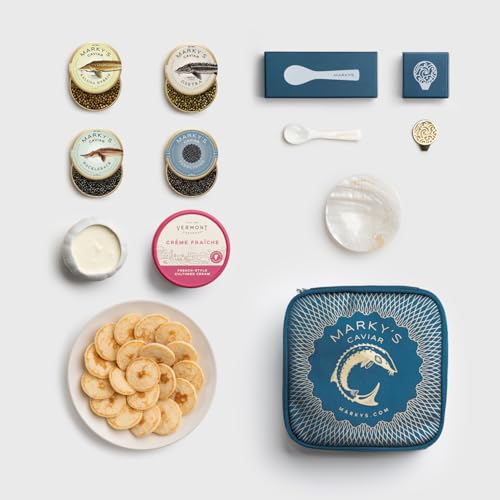
- Sealed caviar tin or jar: The package should state the net weight, species, origin or farm, lot information where applicable, and a clear use-by date.
- Insulated packaging: Look for a thermal liner and sufficient gel ice to keep the product cold during transit.
- Serving spoon: Mother-of-pearl, horn, glass, ceramic, or food-safe plastic are appropriate. Stainless steel is better kept away from the roe because metal can introduce a metallic taste.
- Simple accompaniments: Blinis, crème fraîche, or toast points add convenience, but they should be separately sealed and dated.
- Serving instructions: The recipient should not have to guess whether the product needs refrigeration, when to open it, or how quickly to use it.
Best Caviar Gift Sets for Every Budget
The best caviar gift set depends less on the largest tin and more on the recipient’s experience, the number of guests, and whether the package includes useful serving pieces: for an affordable introduction, choose 30–50 grams of salmon roe or American hackleback; for a polished splurge, choose 50–125 grams of American sturgeon or osetra with a mother-of-pearl spoon and insulated overnight shipping.
Quick Picks by Budget and Occasion
| Budget | Best choice | Typical quantity | Typical market range | Best for |
|---|---|---|---|---|
| $40–$80 | Salmon roe or lumpfish roe with blinis | 50–100 g | $40–$80 | First-time tasters and casual hosts |
| $75–$150 | American hackleback or paddlefish caviar | 30–60 g | $75–$150 | Small dinner parties and thoughtful gifts |
| $150–$300 | American white sturgeon or entry-level osetra | 30–50 g | $150–$300 | Milestone gifts and experienced tasters |
| $300–$700+ | Premium osetra or a two-caviar tasting set | 50–125 g total | $300–$700+ | Serious enthusiasts and larger celebrations |
Prices vary with harvest, grade, origin, certification, packaging, and shipping. Treat these figures as general U.S. market ranges rather than fixed prices.
Our top picks


As an Amazon Associate we earn from qualifying purchases at no extra cost to you. Ratings are shown as listed on Amazon.
Which Caviar Variety Makes the Best Gift?
Salmon roe: the colorful, generous option
Salmon roe has large orange beads, a noticeable pop, and a clean marine flavor. It is usually sold in larger quantities for less money than sturgeon caviar, making it a strong choice when the recipient enjoys seafood but may not be familiar with traditional caviar. The beads are visually impressive on blinis, deviled eggs, potatoes, or sushi-inspired appetizers.
American hackleback and paddlefish: affordable caviar-style gifts
Hackleback and paddlefish roe are freshwater alternatives with small to medium beads and a briny flavor. Hackleback is often darker and more delicate, while paddlefish can have a pronounced saline character. These are better choices than an inexpensive “beluga” label: true beluga caviar is rare, highly expensive, and subject to strict trade restrictions.
American white sturgeon: the balanced upgrade
White sturgeon caviar generally offers medium-sized beads, a firm texture, and a buttery, mildly nutty flavor. It is an excellent middle ground for a recipient who has tried roe before but does not need the most expensive variety. A 30- or 50-gram tin is often enough for two people to taste generously or four people to sample.
Osetra: the special-occasion choice
Osetra is valued for medium-sized beads and complex flavors that may suggest butter, nuts, seaweed, or a clean mineral finish. It is best given to someone who appreciates subtle differences between varieties. Look for the species and farm or fishery information on the label rather than relying only on words such as “royal” or “imperial,” which can be used differently by different sellers.
How Much Caviar Do You Need?
Use these serving estimates when comparing gift sets:
| Use case | Recommended amount per person | What it provides |
|---|---|---|
| Tasting alongside other appetizers | 10–15 g | A few small tastes with blinis or potato |
| Generous appetizer serving | 20–25 g | Several bites and a clear comparison of flavor |
| Main feature of a caviar service | 30–50 g | A substantial portion with minimal accompaniments |
A 30-gram tin is therefore not automatically “for two.” It may be luxurious for two people tasting small portions, adequate for four people at a larger party, or insufficient for two guests who want caviar to be the central course.
Price per Serving: A More Useful Comparison
Consider two hypothetical gift sets. Set A costs $90 and contains 30 grams. At 15 grams per tasting, it provides two servings, or $45 per serving. Set B costs $180 and contains 60 grams. It provides four 15-gram servings, also $45 per serving. Set B is not cheaper per serving, but it is better for a couple hosting more than one occasion and may include a more premium variety.
Now compare a $120, 30-gram set with a $160, 50-gram set. The first costs $60 per 15-gram serving; the second costs $48 per serving. The larger set has a lower cost per gram and may be the better value, provided the recipient can eat it soon after opening. Caviar is perishable, so buying more is not always economical.
What Should Be Included in a Gift Set?
Essential components
- Sealed caviar tin or jar: The package should state the net weight, species, origin or farm, lot information where applicable, and a clear use-by date.
- Insulated packaging: Look for a thermal liner and sufficient gel ice to keep the product cold during transit.
- Serving spoon: Mother-of-pearl, horn, glass, ceramic, or food-safe plastic are appropriate. Stainless steel is better kept away from the roe because metal can introduce a metallic taste.
- Simple accompaniments: Blinis, crème fraîche, or toast points add convenience, but they should be separately sealed and dated.
- Serving instructions: The recipient should not have to guess whether the product needs refrigeration, when to open it, or how quickly to use it.
Nice extras that are not always worth paying for
Branded plates, decorative tins, and oversized boxes can make a gift feel luxurious but do not improve the caviar. A compact, well-insulated package with a good spoon is more useful than a large presentation box filled with disposable decoration. If the set includes a caviar key, check whether the tin actually uses a pry-off lid; many small jars simply use a screw cap.
Decision Matrix: Match the Set to the Recipient
| Recipient situation | Recommended format | Why | Avoid |
|---|---|---|---|
| Has never tried caviar | 30–50 g two-variety tasting set | Encourages comparison without a large commitment | A very large tin of premium roe |
| Hosts four to six people | 60–125 g with blinis and crème fraîche | Provides roughly 10–20 g per guest | A 30 g tin marketed as a party set |
| Has limited refrigerator space | One 30 g tin in a compact package | Uses less storage and is easier to finish | Multi-jar assortments with bulky accompaniments |
| Already knows caviar | 50 g or more of a specified sturgeon variety | Prioritizes flavor and origin over novelty | Unspecified “premium” roe |
| Gift must arrive on a particular date | Overnight, temperature-controlled delivery | Reduces time in transit for a highly perishable product | Untracked economy shipping |
Shipping and Storage Details That Matter
Caviar should travel in an insulated container with frozen gel packs and a tracked delivery method. Overnight shipping is preferable, especially during warm weather, although the exact service depends on the seller’s cutoff times and destination. Schedule delivery for a day when someone can bring the package indoors; leaving it on a porch can compromise quality even if the box initially contains ice.
On arrival, the tin should be cold, not warm. A gel pack may be partly thawed while the product remains safe and chilled, so inspect the caviar’s temperature and condition rather than judging the package by the ice alone. Refrigerate it immediately at the coldest stable part of the refrigerator, generally around 28–32°F (-2–0°C), without freezing it. Do not store it in the refrigerator door.
Once opened, press plastic wrap directly against the surface, close the container, and use it within one to three days according to the seller’s instructions. Do not dip used utensils back into the tin, and do not leave it sitting at room temperature throughout a long party. Set out a small amount at a time and replenish it from the refrigerator.
Common Buying Mistakes
- Confusing roe with sturgeon caviar: Roe is a broad term for fish eggs; caviar traditionally refers to processed sturgeon roe, although commercial naming conventions vary.
- Choosing by tin size alone: A 125-gram tin may be poor value if the recipient cannot finish it promptly.
- Ignoring the accompaniments: A set with an attractive spoon but no serving base may require a separate purchase of blinis, crème fraîche, or toast points.
- Ordering without checking delivery timing: Perishable gifts should not be shipped immediately before a weekend, holiday, or planned absence.
- Using ordinary metal utensils: Serve with mother-of-pearl, glass, ceramic, or plastic to keep the flavor clean.
Bottom Line
For most first-time recipients, the best caviar gift set is a 30–50 gram two-variety assortment with a proper nonmetal spoon and overnight cold packaging. Choose salmon roe when visual impact and generous portions matter, hackleback or paddlefish for value, American white sturgeon for a versatile upgrade, and osetra for an experienced recipient or major celebration. Before paying for decorative extras, compare the species, net weight, cost per 15-gram serving, shipping method, and storage instructions—the details that determine whether the gift is enjoyable after it arrives.




Write Your Review
No reviews yet. Be the first to share your experience!