

Key takeaways
- Capacity: A compact two-tier basket typically holds 6–10 pounds of produce; a larger three-tier model may hold 12–20 pounds. Rated capacity matters because overloaded baskets become difficult to pull from and more likely to tip.
- Tier spacing: Allow at least 7 inches between usable surfaces for apples, oranges, and pears. Choose 9–11 inches of clearance if you store bananas, avocados, or taller produce in the lowest basket.
- Airflow: Open wire or perforated metal sides are preferable to solid containers. Ventilation helps moisture escape, although it does not stop fruit from ripening or spoilage.
- Footprint: Measure the counter area, including the space needed to remove a basket. A unit that technically fits against a wall may be inconvenient if the upper tier blocks access to the back.
- Stability: Look for a broad base, non-slip feet, a low center of gravity, and baskets that do not swing excessively when loaded.
- Material: Powder-coated steel is usually the best balance of strength and price. Stainless steel resists surface rust better, while wood adds warmth but requires more care around moisture.
Best Tiered Fruit Baskets for Kitchen Counters
The best tiered fruit basket for kitchen counter use is usually a stable, open-wire three-tier model with roughly 10–12 inches of vertical clearance, a footprint under 15 inches wide, and removable baskets that can be washed separately. It keeps bananas, apples, citrus, and smaller produce visible without turning the counter into a crowded storage zone.
What to Look For Before Buying
A tiered basket is not simply a larger fruit bowl. Its usefulness depends on how well each level matches the fruit you buy and how easily air can circulate around it.
Our top picks


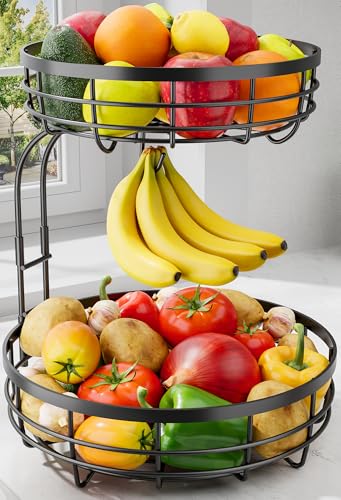
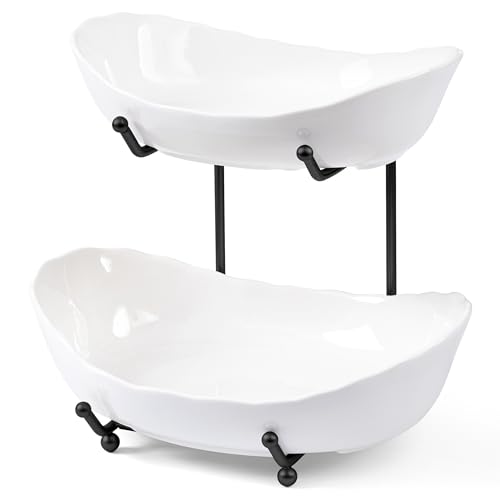
As an Amazon Associate we earn from qualifying purchases at no extra cost to you. Ratings are shown as listed on Amazon.
- Capacity: A compact two-tier basket typically holds 6–10 pounds of produce; a larger three-tier model may hold 12–20 pounds. Rated capacity matters because overloaded baskets become difficult to pull from and more likely to tip.
- Tier spacing: Allow at least 7 inches between usable surfaces for apples, oranges, and pears. Choose 9–11 inches of clearance if you store bananas, avocados, or taller produce in the lowest basket.
- Airflow: Open wire or perforated metal sides are preferable to solid containers. Ventilation helps moisture escape, although it does not stop fruit from ripening or spoilage.
- Footprint: Measure the counter area, including the space needed to remove a basket. A unit that technically fits against a wall may be inconvenient if the upper tier blocks access to the back.
- Stability: Look for a broad base, non-slip feet, a low center of gravity, and baskets that do not swing excessively when loaded.
- Material: Powder-coated steel is usually the best balance of strength and price. Stainless steel resists surface rust better, while wood adds warmth but requires more care around moisture.
Quick Comparison of Common Tiered Basket Designs
| Basket type | Typical footprint | Usable capacity | Tier clearance | Typical material | Best suited to |
|---|---|---|---|---|---|
| Compact two-tier | 10–12 in. wide × 8–10 in. deep | 6–10 lb. | 7–9 in. | Powder-coated steel or bamboo | Small counters and one- or two-person households |
| Standard three-tier | 12–15 in. wide × 10–13 in. deep | 12–18 lb. | 7–10 in. | Steel wire or stainless steel | Mixed fruit used throughout the week |
| Deep hanging-basket unit | 13–16 in. wide × 11–15 in. deep | 15–22 lb. | 8–11 in. | Steel chain and wire | Large families and high-volume produce storage |
| Wood-and-metal ladder style | 14–18 in. wide × 9–12 in. deep | 10–16 lb. | 8–10 in. | Wood shelves with steel frame | Decor-focused kitchens with moderate storage needs |
Best Choices by Kitchen Situation
Best for a small counter: compact two-tier basket
Choose a two-tier model when counter depth is limited or when you buy produce in small quantities. The lower level can hold heavier apples, oranges, or potatoes, while the upper level keeps bananas, lemons, or avocados at eye level. Its smaller footprint reduces the risk of bumping it while preparing food.
The trade-off is limited separation. If you regularly store more than about 8 pounds of fruit, the baskets may become crowded and airflow will decline. Avoid a compact unit with shallow, tightly packed tiers if your main goal is to store bulky fruit.
Best for mixed fruit: standard three-tier wire basket
A three-tier wire basket is the strongest all-purpose choice for most kitchens. Use the bottom tier for dense, heavy items; the middle tier for apples, pears, or oranges; and the top tier for frequently used fruit that you want immediately visible.
Prioritize baskets with a solidly joined frame rather than tiers attached by a thin central rod. A rigid frame stays steadier when one level is nearly empty and another is full. Removable baskets are also valuable because they make washing and rotating produce easier.
Best for a large household: deep hanging baskets
Hanging baskets offer high capacity without requiring a wide shelf, but they need enough vertical and side clearance. They work well when the unit can stand beside a pantry or against an unused wall section. Deep baskets can hold a large quantity of citrus, but they are less convenient for small fruit because items at the bottom become hidden.
Choose a design with a broad base or wall-safe stabilizer. A tall, narrow basket loaded with heavy produce can sway, especially if the upper basket is empty and the lowest basket is full.
Best for an open-plan kitchen: wood-and-metal ladder style
Ladder-style organizers generally look more like furniture than kitchen storage. They are a good match for visible counters where appearance matters as much as capacity. Slatted wood improves the visual warmth of the arrangement, while metal supports provide rigidity.
They are less forgiving of spills than all-metal baskets. Check whether the wood is sealed, and do not leave wet citrus, washed produce, or condensation sitting against it. This style is best for dry, regularly rotated fruit rather than long-term storage.
Decision Matrix: Match the Basket to Your Routine
| Your situation | Recommended design | Important specification | Why it fits |
|---|---|---|---|
| Under 12 inches of free counter width | Compact two-tier | Footprint no larger than 10 × 10 inches | Preserves preparation space |
| Fruit bought once a week | Three-tier wire | At least 12 lb. rated capacity | Separates varieties and reduces overfilling |
| Frequent daily use | Open, removable-basket design | Wide openings and washable surfaces | Makes rotation and cleaning convenient |
| Young children reaching for fruit | Low, wide two-tier unit | Broad base and non-slip feet | Less likely to tip when pulled |
| Decorative kitchen with moderate storage | Wood-and-metal ladder style | Sealed wood and 8-inch tier clearance | Blends storage with room decor |
How Much Capacity Do You Actually Need?
Estimate your weekly purchase before choosing a basket. If two people each eat one piece of fruit per day, seven days of produce may mean roughly 14 pieces. Assuming an average piece weighs 6 ounces, that equals about 5.25 pounds, before adding lemons, bananas, or backup fruit. A compact two-tier basket may be adequate.
For a family of four eating one piece each per day, the same calculation becomes 28 pieces, or approximately 10.5 pounds at 6 ounces each. Add a few bananas or larger citrus items and a three-tier basket rated for at least 15 pounds gives you useful headroom. Capacity should not be filled to the rim; leave visible gaps so fruit can be inspected and removed without disturbing everything else.
Materials and Durability: What Wears First?
In inexpensive metal baskets, the first weak points are often welds, painted joints, and the feet. Look closely at the connection between each basket and the frame. Uneven welds or a central support that flexes under light pressure can become annoying when the basket is loaded.
Powder-coated steel is suitable for normal dry-counter use, but chipped coating can expose the metal to rust. Stainless steel costs more, often within a general market range of about $35–$90 compared with approximately $20–$55 for basic coated-steel models, but it is easier to maintain in humid kitchens. Bamboo and wood models commonly fall around $30–$80 depending on construction and finish.
Rubber or silicone feet may flatten, detach, or collect crumbs over time. Replacement adhesive bumpers can usually restore grip, but a basket that rocks because its frame is bent is not worth continuing to load heavily.
Setup and Maintenance That Prevents Common Problems
- Measure first: Record the available width, depth, and height. Add at least 2 inches of clearance around the unit so you can lift fruit out comfortably.
- Place heavy fruit low: Put apples, oranges, and other dense items on the bottom tier. Keep lighter or taller produce above them.
- Separate fast-ripening fruit: Use different levels for fruit you intend to eat soon and fruit that needs more time. This makes inspection easier and reduces accidental bruising.
- Rotate from the front: Move older fruit forward every day or two. A tiered basket only improves visibility if the back row is not ignored.
- Clean after spills: Remove the baskets, wash them with mild dish soap, and dry every joint before reassembly. Moisture trapped at coated-metal seams is a common route to rust.
Do not place washed fruit into a crowded basket while it is still wet. Surface moisture can collect underneath produce and stain wood or encourage soft spots. Also avoid using the basket for heavy root vegetables unless the manufacturer gives it a suitable load rating; a fruit organizer is not automatically a pantry rack.
Final Recommendation
For most households, select a three-tier open-wire basket about 12–15 inches wide, rated for at least 12 pounds, with 7–10 inches of spacing and a broad non-slip base. Choose a compact two-tier design if your counter is narrow, a deep hanging model if weekly volume is high, or a wood-and-metal ladder style when visual appeal is a priority. The best tiered fruit basket for kitchen counter use is the one that leaves enough air around the produce, keeps every tier reachable, and remains stable when your shopping pattern changes.



Write Your Review
No reviews yet. Be the first to share your experience!