

Key takeaways
- Very limited counter space: Choose a narrow two-tier basket with a footprint of roughly 10–12 inches. It adds storage without occupying valuable worktop area.
- One or two people: A single basket holding 6–10 pounds is often more practical. Smaller weekly loads reduce forgotten, overripe fruit.
- Family that buys produce in bulk: A three-tier basket offers the most capacity, provided the ceiling structure and vertical clearance can support it.
- Low ceiling or overhead cabinets: Use a single basket or a short two-tier model. Leave at least 12 inches below the lowest basket so produce can be removed comfortably.
- No safe ceiling attachment point: Select a wall-mounted design and attach it to a stud or suitable masonry anchor, not only to a hollow-wall plug.
- Frequent cleaning: Favor open wire construction with removable tiers and a smooth, rust-resistant finish.
- Infrequent shopping: A deeper single basket may be preferable to a tall tiered unit because it is easier to inspect and rotate.
Best Hanging Fruit Baskets for the Kitchen
The best hanging fruit basket for kitchen use is usually a two- or three-tier wire basket when you need high capacity in a small footprint; choose a single hanging basket instead if you want lighter weight, easier cleaning, and simpler access.
Tiered vs. single-basket designs
These two formats solve different storage problems. A tiered basket stores more produce vertically, while a single basket puts less strain on its mounting point and makes every item visible at once.
Our top picks


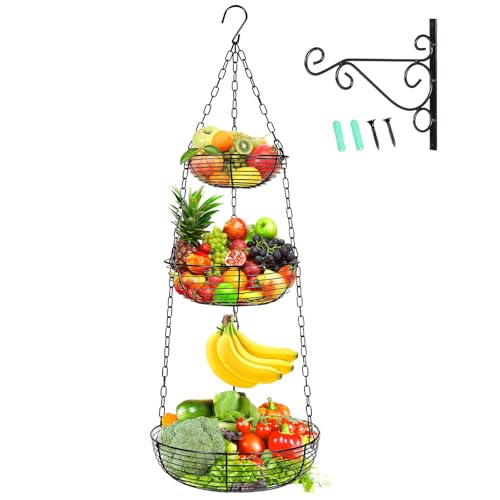
As an Amazon Associate we earn from qualifying purchases at no extra cost to you. Ratings are shown as listed on Amazon.
| Design | Typical capacity | Typical size | Mounting options | Best for | Main drawback |
|---|---|---|---|---|---|
| Single basket | 6–12 lb | 10–14 in wide, 8–12 in high | Ceiling or wall bracket | Small households and frequent shoppers | Limited capacity |
| Two-tier basket | 10–18 lb total | 10–14 in wide, 18–24 in high | Usually ceiling-mounted; some wall-mounted models | Families needing extra vertical storage | Upper tier can be difficult to reach |
| Three-tier basket | 15–25 lb total | 10–14 in wide, 26–36 in high | Usually ceiling-mounted | Large produce loads and pantry overflow | Greater sway, clearance, and load demands |
| Wall-mounted basket | 5–15 lb per basket | 10–16 in wide, 8–14 in deep | Stud, masonry, or rated wall anchor | Renters or kitchens without a suitable ceiling point | Projects into the work area |
Capacity figures are useful planning ranges rather than universal ratings. The manufacturer’s stated limit should always take priority, especially for baskets hung from drywall, plaster, or a lightweight ceiling fixture.
Best choice by kitchen situation
- Very limited counter space: Choose a narrow two-tier basket with a footprint of roughly 10–12 inches. It adds storage without occupying valuable worktop area.
- One or two people: A single basket holding 6–10 pounds is often more practical. Smaller weekly loads reduce forgotten, overripe fruit.
- Family that buys produce in bulk: A three-tier basket offers the most capacity, provided the ceiling structure and vertical clearance can support it.
- Low ceiling or overhead cabinets: Use a single basket or a short two-tier model. Leave at least 12 inches below the lowest basket so produce can be removed comfortably.
- No safe ceiling attachment point: Select a wall-mounted design and attach it to a stud or suitable masonry anchor, not only to a hollow-wall plug.
- Frequent cleaning: Favor open wire construction with removable tiers and a smooth, rust-resistant finish.
- Infrequent shopping: A deeper single basket may be preferable to a tall tiered unit because it is easier to inspect and rotate.
Capacity is not the same as usable capacity
A basket rated for 18 pounds should not necessarily be filled with 18 pounds of produce. Bananas, apples, citrus, and stone fruit can create concentrated loads, while a loosely filled basket distributes weight less evenly than its rating may imply.
A sensible everyday target is about 60–75% of the published maximum. For example, a two-tier basket rated for 16 pounds is more comfortable to use at around 10–12 pounds, especially if it hangs from a single ceiling hook. This leaves room for airflow and reduces stress on the chain, connector rings, and mounting hardware.
Remember that the load includes the basket itself. If the empty unit weighs 3 pounds and the hardware is rated for 20 pounds, the practical produce limit is not 20 pounds; it is approximately 17 pounds before allowing any safety margin.
Ceiling mounting or wall mounting?
Ceiling-mounted baskets
Ceiling mounting usually gives the smallest kitchen footprint. A basket that is 12 inches wide occupies only about 0.8 square feet of floor or counter projection, yet a three-tier version can provide several times the storage volume. It also keeps produce away from splash zones and frees the backsplash.
The trade-off is installation. The hook or bracket must be fixed into a ceiling joist, solid timber, masonry, or another structure specifically suitable for the load. A decorative ceiling hook installed only in drywall may hold an empty basket but fail once it is filled.
Measure the complete hanging height, including the chain and hook. A three-tier unit that is 30 inches tall can become awkward beneath an 8-foot ceiling if its top attachment adds another 8–12 inches. Avoid placing it over a stove, sink, doorway, or frequently used walkway.
Wall-mounted baskets
Wall-mounted baskets are easier to reach and often better for low ceilings. They can work well beside a pantry or on an unused section of wall, but their depth matters. A basket that projects 10 inches from the wall may interfere with cabinet doors, refrigerator handles, or a narrow passage.
Check the wall’s construction before buying. A stud-mounted bracket is usually more dependable than a general-purpose anchor. For masonry, use hardware intended for the specific wall material. If the basket will be used by children or in a busy walkway, choose a firmly fixed bracket rather than a freely swinging hook.
Ventilation: the feature that protects produce
Open wire or perforated metal allows air to circulate around fruit and helps moisture escape. This is especially important for soft fruit and citrus, which can deteriorate faster when pressed against a solid, damp surface.
Look for gaps of roughly 1/2 to 1 inch between wires or openings. Very wide gaps improve airflow but may allow small fruit to fall through. Very tight mesh provides more support but can trap condensation and makes crumbs harder to remove.
A hanging basket cannot prevent spoilage by itself. Do not store bruised fruit beside sound produce, and avoid packing the basket so tightly that pieces touch on every side. Keep bananas separate from produce that needs to last longer, and inspect the underside of each tier because hidden fruit is a common source of waste.
Materials, finishes, and what wears first
- Powder-coated steel: Usually the best balance of stiffness, price, and appearance. Inspect cut edges and welds for chips where corrosion may begin.
- Stainless steel: A strong choice for humid kitchens, although it generally costs more. Confirm that the chain and fasteners are also corrosion-resistant.
- Chrome-plated steel: Easy to wipe and often inexpensive, but scratches or damaged plating can expose the underlying metal.
- Woven seagrass or rattan: Attractive and lightweight, but less suitable for damp produce or frequent wet cleaning. These materials need to dry fully.
- Plastic-coated wire: Gentle on fruit and quiet when items are placed inside, but the coating can split around joints or hooks over time.
In most hanging designs, the connectors and chain links wear before the basket body. Repeated swinging can enlarge attachment holes, loosen threaded hooks, or bend thin rings. During monthly cleaning, check for flaking finish, stretched links, bent welds, and any gap that was not present when new. Stop using the basket if the attachment hardware is bent or visibly corroded.
How to set up a hanging fruit basket safely
- Measure the location. Record width, depth, total height, cabinet clearance, and the distance needed to reach the lowest tier.
- Calculate the working load. Add the empty basket weight to your intended produce weight, then keep the result below the lowest-rated component.
- Identify the structure. Locate a joist, stud, or suitable masonry fixing. Do not assume that a ceiling or wall can support a loaded basket.
- Install the supplied or correctly rated hardware. Tighten threaded parts fully and use the anchor type specified for the surface.
- Test gradually. Hang the empty basket first, then add a few pounds while checking for tilt, pulling, or unusual movement.
- Load by weight and firmness. Put heavier, firmer items in the lowest tier and delicate fruit in an upper or separate basket.
Cleaning and ownership costs
Most wire baskets need only warm water, mild dish soap, and a soft brush. Dry all joints and chain links immediately; standing water in a folded seam is a common route to rust. For woven baskets, use a lightly damp cloth rather than soaking the material.
Typical market prices are approximately $15–$35 for a basic single basket, $25–$60 for a two-tier model, and $40–$90 for a larger three-tier or stainless-steel design. Installation hardware may add $5–$20 if the included parts are unsuitable for the wall or ceiling. A cheaper basket is poor value if it requires replacement after finish damage or if its supplied hook cannot safely support the intended load.
Final recommendation
For most kitchens, a two-tier open-wire basket is the strongest compromise between capacity, ventilation, reach, and footprint. Choose a single basket when you buy small quantities or want the simplest, safest installation. Choose three tiers only when you have a verified structural mounting point, sufficient headroom, and a regular need for 15 pounds or more of produce. Whichever design you choose, prioritize the mounting rating and ease of cleaning over decorative details: those factors determine whether the basket remains useful after the novelty wears off.



Write Your Review
No reviews yet. Be the first to share your experience!