

Key takeaways
- Sling stud: Common on hunting rifles and compatible with Harris-style bipods. It preserves the front sling attachment only when the adapter supports both functions.
- Picatinny rail: Rigid, widely supported, and easy to remove or reposition. It may add height and can snag on a rifle carried against clothing.
- M-LOK: Keeps the attachment close to the handguard and reduces extra rail length. Installation requires access to the inside of the handguard and correct screw tension.
- Quick-detach systems: Convenient for switching between a bipod and a barricade stop, but they add cost and can introduce movement if the clamp is not adjusted correctly.
The best rifle bipods for most shooters are the Harris S-BRM for dependable value, the Magpul MOE Bipod for lightweight sporting rifles, the MDT CKYE-POD for adjustable field positions, and the Accu-Tac BR-4 or BT46 Atlas for heavier rifles that need stronger locks and more adjustment.
A good bipod is not simply a pair of folding legs. Its mounting system, height range, pan and cant controls, leg-lock design, and weight determine whether it feels steady on a bench, adapts to uneven ground, or becomes an awkward load during a long carry. The right choice depends on how your rifle is configured and where you shoot.
Our top picks
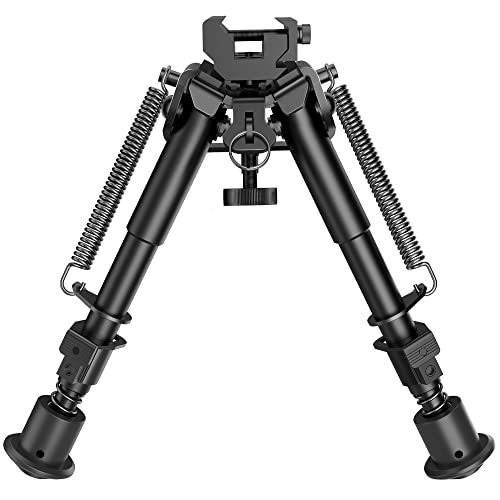


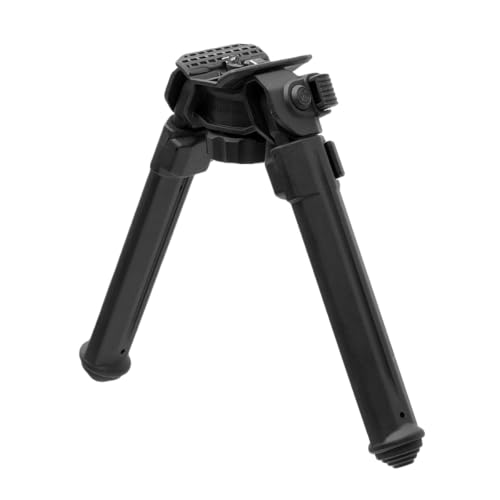
As an Amazon Associate we earn from qualifying purchases at no extra cost to you. Ratings are shown as listed on Amazon.
Best rifle bipods by shooting situation
| Situation | Best match | Why it fits | Typical market range |
|---|---|---|---|
| Budget-conscious general use | Harris S-BRM 6–9 inch | Proven sling-stud attachment, compact size, built-in swivel on the S model | $90–$130 |
| Light hunting rifle | Magpul MOE Bipod | Low weight, polymer-and-aluminum construction, easy one-handed leg deployment | $75–$110 |
| Uneven terrain and changing positions | MDT CKYE-POD | Wide adjustment range, independent leg positions, strong cant control | $250–$400 |
| Heavy precision rifle | Accu-Tac BR-4 or Atlas BT46 | Rigid construction, wide stance, multiple leg angles, suitable for repeated positional shooting | $250–$450 |
| Rifle with M-LOK handguard | Direct-attach M-LOK bipod | Cleaner fit and less adapter hardware than a sling-stud model | $70–$250 |
Prices are broad 2026 market ranges and vary by finish, mounting interface, and included hardware. A compatible mount may add roughly $20–$70 to the total.
What separates the leading designs
Harris S-BRM: the sensible all-purpose choice
The Harris S-BRM remains one of the easiest recommendations for a traditional hunting or sporting rifle with a front sling stud. Its 6–9 inch height range works well from a bench, prone position, and short grass. The “S” version swivels to compensate for uneven ground, although it does not offer the same independent leg adjustment found on more modern precision bipods.
Its steel construction is not ultralight: expect approximately 13 ounces before adding a separate adapter. That weight brings useful durability, but the leg notches and spring-loaded extensions can feel less refined than premium systems. The BRM’s main limitation is mounting flexibility. A sling-stud adapter is required for rifles equipped only with M-LOK or Picatinny rail, and the original swivel mechanism benefits from a tension adjustment to prevent unwanted movement.
Magpul MOE Bipod: best when carry weight matters
The Magpul MOE Bipod is a strong option for a lightweight hunting rifle or a rifle that spends more time being carried than fired from a supported position. The 7–10 inch version weighs about 8 ounces, and its low-profile folded form is less intrusive than many metal precision bipods.
It attaches to a compatible sling stud or rail adapter, depending on the version. Legs deploy by pressing a button and can be extended in multiple positions. The trade-off is a narrower adjustment envelope and less elaborate cant and pan control than a dedicated precision model. Choose it when low weight and simple deployment matter more than a broad stance or rapid fine adjustment on rough terrain.
MDT CKYE-POD: the adjustable field-position specialist
The MDT CKYE-POD is designed for shooters who regularly move between prone, kneeling, and improvised field positions. Depending on configuration, its legs offer several height ranges, often from a low prone setup around 4 inches to configurations exceeding 15 inches. The independent leg positions and wide footprint make it easier to level a rifle on slopes, rocks, and uneven ground.
This capability comes with considerable weight. A typical CKYE-POD is roughly 1.5–2.5 pounds depending on size and features, which is a meaningful addition to a hunting rifle. Its adjustment levers and locking hardware also require more deliberate setup than a Harris or Magpul. It is a better fit for a heavy precision rifle, competition rifle, or field rifle where positional flexibility outweighs pack weight.
Atlas BT10 and BT46: premium modular support
Atlas bipods use a Picatinny-style mounting system and are known for independent leg positions, a broad range of deployment angles, and compact folding profiles. The BT10 V8 is a popular short model for prone shooting, while the BT46 offers a taller and wider platform for more varied terrain. Depending on version, Atlas models provide pan and cant functionality with adjustable tension rather than a simple fixed hinge.
Expect approximately 11–14 ounces for many compact Atlas configurations, with taller models weighing more. They are particularly attractive for rifles already equipped with a Picatinny rail and for shooters who want repeatable leg positions without the bulk of a large competition bipod. Check the exact model carefully: Atlas naming and attachment options differ, and some versions require a separate rail clamp or quick-detach interface.
Accu-Tac BR-4: stable and wide for heavier rifles
The Accu-Tac BR-4 is a robust choice when stability is more important than minimal weight. Its adjustable leg angles, wide stance, and metal construction suit heavy rifles and high-volume range use. Many configurations weigh around 1.3–1.7 pounds, so it is less appealing on a lightweight mountain rifle.
Its strength is confidence on a hard surface or uneven firing point. Its drawbacks are bulk, a larger folded profile, and a mounting system that may sit higher or add more hardware than a compact hunting bipod. It makes the most sense when the rifle is already heavy and the bipod will remain attached for much of the session.
Mounting system: match the bipod to the rifle first
- Sling stud: Common on hunting rifles and compatible with Harris-style bipods. It preserves the front sling attachment only when the adapter supports both functions.
- Picatinny rail: Rigid, widely supported, and easy to remove or reposition. It may add height and can snag on a rifle carried against clothing.
- M-LOK: Keeps the attachment close to the handguard and reduces extra rail length. Installation requires access to the inside of the handguard and correct screw tension.
- Quick-detach systems: Convenient for switching between a bipod and a barricade stop, but they add cost and can introduce movement if the clamp is not adjusted correctly.
Do not assume a bipod includes every adapter shown in a photograph. Confirm whether the package contains a sling-stud mount, Picatinny clamp, M-LOK hardware, or only the bipod body.
How much height do you actually need?
For flat-ground prone shooting, a 6–9 inch bipod is usually sufficient. A 9–13 inch model is more useful in tall grass, snow, or uneven ground. Models extending beyond 13 inches can support kneeling and some seated positions, but they become heavier and less stable when fully extended.
A simple sizing check is to measure from the rifle’s mounting point to the ground in your normal shooting position, then add about 1 inch of usable clearance. For example, if that measurement is 7 inches, a 6–9 inch bipod gives adjustment room without forcing the legs near their maximum extension. If the measurement is 11 inches, a 9–13 inch model is the more appropriate range.
Pan, cant, and leg locks: the controls that affect stability
Cant lets the rifle roll left or right to follow uneven ground. It is valuable on slopes, but it should have a firm tension control or a lock. Excessive cant movement makes the reticle shift as you load the bipod.
Pan allows limited horizontal tracking without lifting the rifle. It can help follow a moving target at a range, but it is not essential for ordinary hunting and can reduce rigidity when left loose. For maximum stability, lock both functions after leveling the rifle.
Leg locks deserve close attention. Push-button systems are fast, while notched legs provide repeatable height. Twist locks can be compact but are slower and more vulnerable to grit in the threads. On any design, deploy both legs evenly and verify that each lock is fully engaged before loading the rifle forward.
Ownership realities: what wears first
- Hinge and swivel tension can loosen with repeated folding. Recheck it periodically rather than compensating by overtightening.
- Leg notches and locking buttons collect mud, sand, and fine range grit. Brush them clean before retracting the legs.
- Rubber feet wear faster on concrete and rock than on soil. Replacement feet are often available, but confirm compatibility before buying.
- Mounting screws can loosen under recoil. Use the manufacturer’s recommended torque and thread treatment; do not rely on maximum hand tightness.
- Do not use the bipod as a carrying handle or lever. Side-loading a leg can bend hardware or damage the attachment point.
After a wet outing, extend and dry the legs before storage. Wipe metal surfaces with a light protective cloth, keep lubricant away from friction-based leg locks, and inspect the mount for play before the next session.
Final buying advice
Choose the Harris S-BRM if you want durable, uncomplicated support for a sling-stud rifle. Choose the Magpul MOE Bipod when every ounce matters. Choose an Atlas BT10 or BT46 for a modular Picatinny-mounted precision setup, the MDT CKYE-POD for maximum positional adjustment, and the Accu-Tac BR-4 when a heavy rifle needs a broad, rigid platform.
The best rifle bipods are the ones that fit the rifle’s mounting system, reach the ground without excessive extension, and lock firmly enough that your aim does not change when you load the support. Prioritize those three points before paying for extra pan, quick-detach hardware, or an unusually wide height range.






Write Your Review
No reviews yet. Be the first to share your experience!