

Key takeaways
- Best all-purpose option: A 10- to 12-inch, 8- to 12-pound textured medicine ball with moderate bounce. It suits Russian twists, squats, presses, partner passes, chest throws, and controlled wall work.
- Best for wall throws and functional conditioning: A soft-sided wall ball such as a Dynamax Medicine Ball or Rogue Wall Ball. These have a larger diameter and forgiving shell, making them easier to catch than a small rubber ball.
- Best for slams: A dense, low-bounce slam ball, such as the Rogue Slam Ball or a comparable rubber-coated slam ball. It is designed to absorb impact rather than rebound toward you.
- Best for strength training in limited space: A compact rubber medicine ball from a line such as REP Fitness Medicine Balls or SPRI Medicine Balls. Smaller diameters are easier to hold during presses, lunges, and loaded carries.
- Best budget approach: Buy one 8- or 10-pound ball first, then add a lighter 4- to 6-pound ball for speed and a heavier 12- to 20-pound ball for slow strength work. A useful two-ball setup often costs less than buying a complete weight range.
The best medicine balls for home workouts are usually a 10- or 12-inch textured wall ball for throws and core work, a compact 6- to 10-inch rubber ball for strength training, or a dense slam ball if your program includes repeated floor slams.
The right choice depends less on brand than on four matching decisions: the ball’s weight to your experience, its diameter to your exercise, its shell to the surface you will use, and its bounce behavior to the type of throw you want to perform.
Our top picks
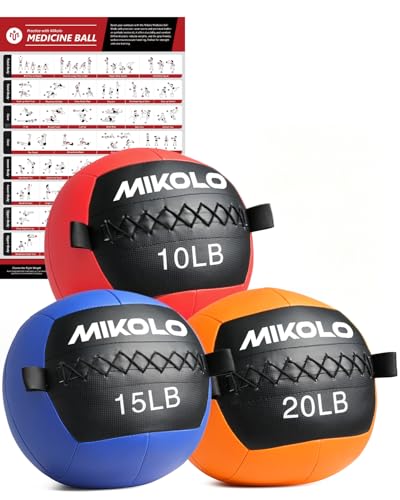


As an Amazon Associate we earn from qualifying purchases at no extra cost to you. Ratings are shown as listed on Amazon.
Best medicine balls by home-workout situation
- Best all-purpose option: A 10- to 12-inch, 8- to 12-pound textured medicine ball with moderate bounce. It suits Russian twists, squats, presses, partner passes, chest throws, and controlled wall work.
- Best for wall throws and functional conditioning: A soft-sided wall ball such as a Dynamax Medicine Ball or Rogue Wall Ball. These have a larger diameter and forgiving shell, making them easier to catch than a small rubber ball.
- Best for slams: A dense, low-bounce slam ball, such as the Rogue Slam Ball or a comparable rubber-coated slam ball. It is designed to absorb impact rather than rebound toward you.
- Best for strength training in limited space: A compact rubber medicine ball from a line such as REP Fitness Medicine Balls or SPRI Medicine Balls. Smaller diameters are easier to hold during presses, lunges, and loaded carries.
- Best budget approach: Buy one 8- or 10-pound ball first, then add a lighter 4- to 6-pound ball for speed and a heavier 12- to 20-pound ball for slow strength work. A useful two-ball setup often costs less than buying a complete weight range.
Medicine ball comparison: what the specifications mean
Product listings often emphasize weight, but diameter, surface texture, and bounce determine whether a ball feels practical in a living room or garage. The ranges below describe common home-workout categories rather than one exact model.
| Ball type | Typical weights | Typical diameter | Surface and bounce | Best uses |
|---|---|---|---|---|
| Compact rubber medicine ball | 2–20 lb | 6–10 in | Textured rubber; low to medium bounce | Strength training, carries, twists, presses, controlled passes |
| Soft wall ball | 4–30 lb | 10–14 in | Vinyl or synthetic-leather outer shell; minimal bounce | Wall throws, chest passes, rotational throws, squats |
| Slam ball | 10–50 lb | 9–14 in | Thick rubber shell; dead bounce or very low bounce | Floor slams, loaded carries, powerful conditioning intervals |
| Rebound medicine ball | 2–12 lb | 8–10 in | Elastic rubber; predictable medium or high bounce | Rebounder drills, wall passes, reaction training |
Weight: choose for control, not ego
For fast throws, the ball should move without making your technique slow or causing your shoulders to compensate. Many beginners do well with 4 to 8 pounds for upper-body throws and 8 to 12 pounds for squats, deadlift patterns, and rotational work. Experienced users may prefer 12 to 20 pounds for slower exercises, while heavier balls are more appropriate for carries, loaded squats, and short sets than for repeated overhead throws.
A practical test is whether you can complete 8 to 12 repetitions with the same range of motion and speed. If the final repetitions become visibly slower, your torso twists to compensate, or you cannot safely catch the ball, choose a lighter weight. For explosive movements, a ball that is too heavy changes the exercise into a grind.
Diameter and grip texture
A larger wall ball distributes weight over a broad surface and is easier to receive against the chest, but it can be awkward for one-handed movements. A small rubber ball is easier to squeeze, carry, and press, though its concentrated weight can feel less forgiving when caught at speed.
Look for a pebbled or cross-hatched rubber surface when your workouts involve sweaty hands. A smooth vinyl shell may feel comfortable during slow strength work but can become difficult to control during throws. Soft wall balls usually have more surface area and a gentler catch, but their fabric-like covers can absorb moisture and require more careful cleaning.
Head-to-head: wall ball versus slam ball
Choose a wall ball for throws
Wall balls are filled to retain their shape while remaining soft enough for repeated catches. Their larger diameter gives you a broad target for chest passes and overhead throws. Dynamax and Rogue wall-ball lines are familiar examples of this format, with multiple weight options and stitched or reinforced outer covers.
They are suitable for throwing at an appropriate target, but they are not automatically suitable for forceful floor slams. Repeated impact on concrete, sharp edges, or an abrasive outdoor surface can damage the cover or seams. Use a wall ball on a clean, smooth wall or a suitable throwing surface.
Choose a slam ball for impact
Slam balls use a thick rubber shell and dense filling intended to absorb energy. A dead-bounce design stays near the floor instead of springing back toward your face or hands. This makes it safer and more efficient for repeated slams, but less useful for catching drills or rebound exercises.
Do not substitute a low-bounce slam ball for a wall ball if your routine depends on a predictable return. The two shapes may look similar, but their internal construction produces a different response after impact.
Decision matrix for buying one ball
| Your situation | Recommended specification | Why |
|---|---|---|
| Beginner, occasional use | 4–8 lb, 8–10 in, textured rubber | Easy to control and versatile for basic strength work |
| Frequent home conditioning | 8–12 lb, 10–12 in wall ball or rebound ball | Handles varied drills without becoming cumbersome |
| Small apartment or fragile flooring | 4–10 lb soft wall ball; no hard slams | Reduces impact noise and limits floor damage |
| Garage with a durable floor | 10–20 lb low-bounce slam ball | Better suited to repeated impact and powerful conditioning |
| Strength-focused training | 10–20 lb compact rubber ball | Concentrated load works well for carries, squats, and presses |
| Throw-focused training | 4–12 lb wall ball with reinforced seams | Large, soft target improves catching comfort |
Durability and ownership realities
The first parts to wear are usually the outer texture, stitched seams, valve area, and bottom panel where the ball repeatedly lands. A textured rubber ball can become glossy and slippery with sweat and dust. A fabric-covered wall ball may develop fraying or staining. On slam balls, repeated impact against rough concrete can abrade the shell even when the internal bladder remains intact.
After each session, wipe the ball with a damp cloth and mild soap, then dry it fully before storage. Avoid soaking a stitched ball, using solvent-based cleaners, or leaving any medicine ball in direct sun or a hot car. Heat can affect adhesives, surface coatings, and internal pressure. Store it away from sharp equipment and do not place heavy objects on top of a soft wall ball.
Before buying, check whether the manufacturer specifies indoor use, outdoor use, or slam use. “Medicine ball” is a broad category, not a guarantee that every model can be thrown against a wall or floor. If the shell shows a split, exposed filling, a distorted shape, or a damaged valve, retire it rather than taping it for high-speed throws.
How to build a useful two-ball setup
For many home users, two contrasting balls cover more exercises than one very heavy ball. Start with an 8-pound textured rubber ball for presses, lunges, carries, and controlled core work. Add a 12- or 14-pound low-bounce slam ball if you want impact conditioning, or a 6-pound wall ball if throws are your priority.
For example, suppose you train three times per week and use the ball for four exercises each session. That is approximately 12 uses per week, or about 624 uses per year. A $40 ball used for one year costs roughly 6 cents per use before replacing it. The calculation is simple: $40 divided by 624 sessions. The more important variable is choosing a shell and bounce type that match your exercises; a cheaper ball that cannot safely perform your main movements is poor value.
Safety and final buying advice
Measure your available throwing distance and ceiling height before choosing a wall ball. Leave room behind and beside you, remove fragile objects, and use a partner only when both people can reliably catch and release the ball. Begin with lower volume and controlled throws, particularly after a long training break.
If you have an injury, persistent pain, balance concerns, or uncertainty about which movements are appropriate, ask a qualified fitness or healthcare professional for individualized guidance. For most buyers, the best medicine balls are not the heaviest or most heavily marketed: they are the ones with the right weight for controlled repetitions, a grip that remains secure, a diameter you can handle, and a shell designed for the impacts you actually plan to create.



Write Your Review
No reviews yet. Be the first to share your experience!