

Key takeaways
- 1.0–1.5 inches: road bikes and some fitness bikes.
- 1.5–2.25 inches: hybrids, commuters, and many older mountain bikes.
- 2.2–2.6 inches: modern mountain bikes and trail bikes.
- 3.8–5 inches: fat bikes, which need a dedicated wide slot.
The best floor bike storage racks for most home garages are a two- or four-bike freestanding rack with adjustable wheel slots, a steel base, and at least 12 inches of usable space per bicycle; choose a compact single-bike stand only when floor area is more valuable than capacity.
A floor rack is usually easier to install and more flexible than a wall or ceiling system, but the wrong design can waste valuable garage width, pinch disc rotors, or make one bicycle inaccessible whenever another is parked beside it. The right choice depends on wheel size, tire width, frame shape, how often you ride, and whether you need to store one bike or a household fleet.
Our top picks


As an Amazon Associate we earn from qualifying purchases at no extra cost to you. Ratings are shown as listed on Amazon.
Best floor bike storage racks by garage situation
| Garage situation | Best rack type | Typical capacity | Typical footprint | Why it fits |
|---|---|---|---|---|
| One frequently used road or hybrid bike | Vertical wheel-slot stand | 1 bike | 16–24 in. deep × 8–14 in. wide | Small footprint and quick one-handed parking |
| Two bikes with different wheel sizes | Adjustable two-bike floor rack | 2 bikes | 24–32 in. deep × 20–30 in. wide | Separate wheel channels reduce handlebar interference |
| Family storage in a narrow garage | Staggered or alternating-height rack | 3–5 bikes | 36–48 in. deep × 24–40 in. wide | Bars and saddles overlap less than on a straight rail |
| Mountain bikes, fat bikes, or e-bikes | Heavy-duty steel rack with wide channels | 1–4 bikes | 20–32 in. deep × 10–14 in. per bike | Supports wide tires and heavier frames without tipping |
| Very tight parking beside a car | Compact single-wheel cradle | 1 bike | 14–20 in. deep × 8–12 in. wide | Uses less floor space, but usually offers less stability |
Our top picks by use case
Best overall: an adjustable two-bike floor rack
An adjustable two-bike rack is the safest recommendation for a typical garage because it handles more bicycle types than a fixed, narrow-slot design. Look for independently adjustable wheel trays, a rubber-coated contact area, and a base weighing roughly 8–15 pounds. The ability to move the trays 12–18 inches apart matters more than a large advertised capacity: it lets you keep drop handlebars, mountain-bike bars, and pedals from colliding.
This style works particularly well when one bike has 700c wheels and the other has 26-, 27.5-, or 29-inch wheels. Check that the rack supports tires from about 1.25 to 2.5 inches wide if your household includes both road and trail bikes. A rack designed only for narrow road tires may not accept a commuter bike with 2-inch tires.
Best for maximum capacity: a staggered four- or five-bike rack
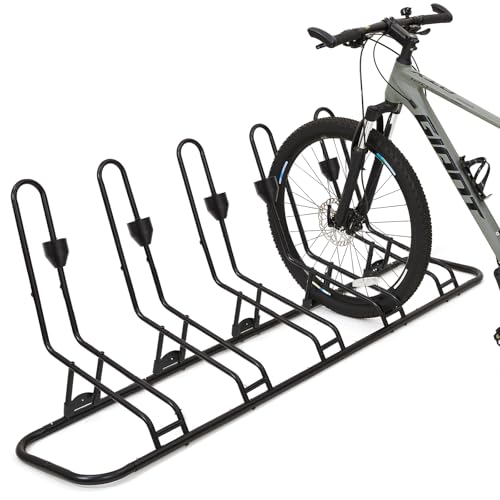
For several bicycles, choose a rack that alternates the front wheel positions or places adjacent bikes at different heights. A straight, closely spaced row may technically hold five bikes, but it often becomes a daily puzzle of overlapping handlebars and pedals.
Allow approximately 12–16 inches of width per bike for narrow bicycles and 16–20 inches for mountain or cargo bikes. A five-bike rack can therefore require 60–100 inches of practical access width even when its metal base is shorter. Measure the space needed to remove the outermost bike, not merely the rack’s listed dimensions.
Best for a single bike: a compact wheel cradle
A single-bike floor stand is ideal for a renter, a utility bike used every day, or a garage where every inch around a vehicle matters. The strongest designs support the wheel on both sides and use a broad base, rather than relying on a thin hook or a small triangular kickstand.
For routine parking, choose a stand that accepts your tire without squeezing the sidewalls. A 2.4-inch trail tire should not be forced into a 2-inch slot, and a fender may need an opening at least 1–2 inches wider than the tire itself. Compact stands are convenient, but they are generally less resistant to a sideways handlebar bump than a heavy multi-bike base.
Wheel compatibility is the first filter
Before comparing capacity or finish, measure the actual tire width. Common rack ranges are:
- 1.0–1.5 inches: road bikes and some fitness bikes.
- 1.5–2.25 inches: hybrids, commuters, and many older mountain bikes.
- 2.2–2.6 inches: modern mountain bikes and trail bikes.
- 3.8–5 inches: fat bikes, which need a dedicated wide slot.
Wheel diameter also affects stability. A rack with a tall vertical slot may hold 20-inch children’s wheels poorly because the tire does not extend far enough into the cradle. Conversely, a short tray can be unstable with a 29er if too little of the wheel is guided. If the household has children’s bikes, look for adjustable wheel hoops or a rack that specifically lists 12- to 20-inch compatibility.
Frame access and parking order
Floor racks should normally grip the tire, not the frame. Frame-holding designs can interfere with step-through bicycles, full-suspension frames, thick down tubes, rear racks, fenders, and internally routed cables. Wheel-contact racks also avoid rubbing a painted frame against metal.
For a two- or four-bike rack, park the least-used bike in the rear or innermost position. Put the frequently ridden bike in the outer position with its drivetrain facing away from the neighboring bicycle. If the rack has alternating slots, turn adjacent handlebars in opposite directions before adding another bike; this often saves 4–8 inches of effective width.
Stability: what separates a useful rack from a frustrating one
Capacity claims do not tell you how stable a rack will be. Compare these details:
- Base width: at least 8–12 inches front to back for a single-bike stand is a useful starting point; heavy e-bikes benefit from more.
- Material: powder-coated steel is usually more rigid than lightweight plastic, while thick molded plastic can resist rust and floor scratches.
- Contact points: rubber feet reduce sliding on smooth concrete and protect epoxy coatings.
- Wheel restraint: a deep tray or hoop is more secure than two short prongs, especially for wide tires.
- Weight rating: allow extra margin for an e-bike carrying a rack bag, lock, or child seat.
A practical check is to push the parked bike lightly at handlebar height. The rack can flex slightly, but its feet should remain planted and the wheel should not climb out of the tray. Avoid placing a lightweight rack directly in a vehicle’s door-swing path.
Worked space calculation for a tight garage
Suppose three bikes each need 16 inches of side-to-side clearance. A straight rack requires approximately 48 inches, before allowing room to pull out the outer bike. Add 12 inches of working space, and the usable zone becomes about 60 inches wide.
A staggered rack might reduce the metal base width to 38 inches, but it still needs roughly 8–12 inches of access on the open side. The saving is meaningful only if the staggered arrangement prevents handlebars from overlapping. Mark a rectangle on the floor with painter’s tape before buying; include the widest handlebars, pedals, and the path to the garage door.
Ownership realities and common mistakes
The parts most likely to wear first are rubber feet, plastic wheel guides, adjustment knobs, and hardware exposed to road salt. Inspect them every few months, tighten bolts after the first week of use, and replace cracked feet rather than compensating with cardboard or loose wood shims.
- Keep wet, muddy tires from sitting on bare steel; dry the rack to limit corrosion.
- Do not exceed the listed tire width by forcing a wheel into a narrow channel.
- Do not use a lightweight rack for a heavy e-bike unless its weight rating includes the complete bike.
- Leave space around hydraulic brake rotors and derailleur hangers when bikes are side by side.
- Place the rack on a level surface; a sloped driveway can make a freestanding rack feel unstable.
For most homes, an adjustable two-bike steel rack offers the best balance of access, compatibility, and floor efficiency. Choose a staggered multi-bike model when capacity is the priority, and a compact single-bike stand when the rack must fit beside a car or workbench. The winning specification is not the highest bike count: it is a rack that accepts every tire in your household while leaving enough clearance to remove the bike you use most.

Write Your Review
No reviews yet. Be the first to share your experience!