

Key takeaways
- Use a stud finder; brackets screwed into drywall alone pull out under heavy drapes.
- Level the brackets before drilling the second one.
- Choose finials that do not trap the curtain rings against the end.
- Ring clips make it easier to remove the curtains for washing than sewn-in rod pockets.
The best curtain rod for most windows is a 1 inch diameter steel rod with a center support bracket on spans over 48 inches, mounted 4 to 6 inches above the frame and extending 8 to 12 inches past each side. For heavy drapes choose a 1.25 to 1.5 inch rod, and for light sheers a slim 5/8 inch rod is enough. Matching rod strength to curtain weight and span matters more than finish.
Our top picks



As an Amazon Associate we earn from qualifying purchases at no extra cost to you.
Quick comparison of the picks
| Pick | Best for | Typical specs | Price range |
|---|---|---|---|
| 1 in steel adjustable rod with center support | Best overall | Spans 48-120 in, steel, 1 in diameter | Budget to mid-range |
| 1.25-1.5 in heavy-duty rod | Best for heavy drapes | Steel or iron, rated roughly 20-40 lb, double brackets | Mid-range |
| Double rod set | Best for layering sheers and drapes | Two parallel rods, 1 in and 5/8 in | Mid-range |
| Tension rod | Best for renters and small windows | No drilling, lightweight, spans up to roughly 48 in | Budget |
| Traverse (track) rod | Best for wide windows and easy opening | Cord-operated, hides hardware | Upper-mid |
Best overall: 1 inch steel adjustable rod
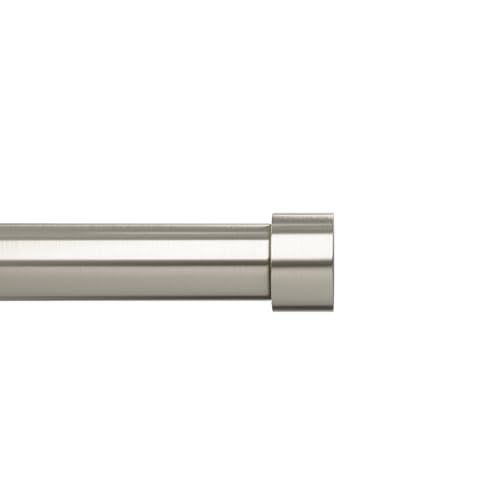
A 1 inch steel rod with an adjustable telescoping length fits most standard windows. Look for a center support bracket on any span over about 48 inches, because rods sag without one. Brushed nickel, matte black and oil-rubbed bronze are the most versatile finishes. The trade-off is that the telescoping joint limits strength compared with a one-piece rod.
Best for heavy drapes: 1.25 to 1.5 inch rod
Lined or blackout drapes can weigh 10 to 25 pounds per panel. A thicker rod with end brackets every 36 to 48 inches carries that load. These rods look substantial and suit tall windows. The trade-off is cost and the need to anchor into studs or use heavy-duty toggle anchors.
Best for layering: double curtain rod set
Double rods hold sheers on the inner rod and drapes on the outer. You can close the drapes for privacy at night and keep the sheers for daytime light. The trade-off is projection from the wall, often 4.5 inches or more, so check clearance around radiators, sills and window handles.
Best for renters: tension rod
A tension rod presses against the window frame, so no drilling is needed. It suits lightweight curtains, café curtains and short spans. It is not suitable for heavy drapes, and it can slip over time, so keep the load light and the spans under roughly four feet.
Best for wide windows: traverse rod
A traverse rod uses a cord or wand to open and close the curtains, keeping the fabric clean and the hardware largely hidden. It suits sliding doors and wide windows. The trade-off is a more complex installation and mechanisms that can wear in the long term.
How to choose: measurement worked example
Measure the window width, then add 8 to 12 inches on each side so the curtains can stack clear of the glass. For a 40 inch window that means a rod of 56 to 64 inches. Mount the rod 4 to 6 inches above the frame, or closer to the ceiling to make the room feel taller. Curtain panels should be 1.5 to 2 times the rod width in fullness, so 60 inches of rod needs about 90 to 120 inches of fabric.
| Curtain type | Weight per panel | Rod diameter | Support spacing |
|---|---|---|---|
| Sheer or cotton | Under 3 lb | 5/8 to 3/4 in | Every 48 in |
| Lined cotton or linen | 3-8 lb | 1 in | Every 48 in |
| Velvet or blackout | 8-25 lb | 1.25-1.5 in | Every 36 in |
Installation notes
- Use a stud finder; brackets screwed into drywall alone pull out under heavy drapes.
- Level the brackets before drilling the second one.
- Choose finials that do not trap the curtain rings against the end.
- Ring clips make it easier to remove the curtains for washing than sewn-in rod pockets.
Common mistakes
The most frequent errors are mounting the rod right at the window frame, which makes the window look smaller, skipping a center support on wide spans, and using a thin rod for lined drapes. Fix those three and the room looks more polished immediately.
Frequently Asked Questions
How wide should a curtain rod be?
Extend it 8 to 12 inches beyond each side of the window frame. That lets the curtains stack off the glass and lets in more light.
How high should I mount a curtain rod?
Mount it 4 to 6 inches above the window frame, or higher toward the ceiling for added height.
What is the strongest type of curtain rod?
Solid one-piece steel or iron rods of 1.25 inches or more with multiple brackets are the strongest. Telescoping rods are less strong at the joint.
Do I need a center support bracket?
Yes, for spans over about 48 inches or with heavy fabrics. It prevents sagging.
Can I install a curtain rod without drilling?
Yes, using a tension rod or adhesive hooks for very light fabrics. Heavier curtains need screws into studs or strong anchors.






Write Your Review
No reviews yet. Be the first to share your experience!