

Key takeaways
- Five-compartment layout: two narrow sections for forks and spoons, one for knives, one medium section for serving tools, and one wide section for spatulas or tongs.
- Six-compartment layout: useful when teaspoons, chopsticks, or reusable straws need their own area.
- Two-piece modular layout: better for wide drawers over 24 inches, where a single long tray may bow or leave inaccessible corners.
- Deep-tool layout: choose at least one compartment 3.5–5 inches wide for peelers, whisks, thermometers, and can openers.
The best bamboo drawer organizers are expandable, non-slip, and sized to leave about 1/4 inch of clearance on each side; for most homes, a 17–22 inch expandable tray suits kitchen drawers, while a 13–19 inch tray works better in many dresser drawers.
Our top picks


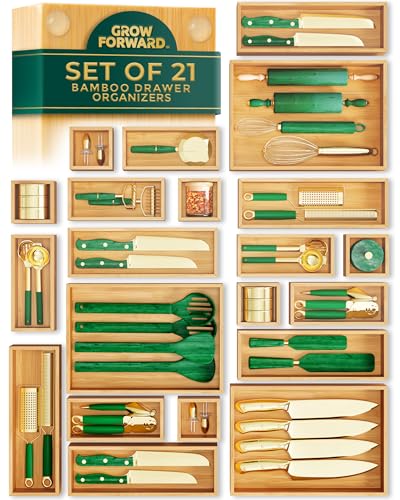

As an Amazon Associate we earn from qualifying purchases at no extra cost to you. Ratings are shown as listed on Amazon.
Quick picks by drawer and shopping priority
| Situation | Best organizer type | Useful size range | Why it fits | Typical 2026 market range |
|---|---|---|---|---|
| Standard kitchen utensil drawer | Five- or six-compartment expandable tray | 17–22 in wide, 17–20 in deep, 2–2.5 in high | Handles cutlery, cooking tools, and serving utensils without wasting the full drawer | $25–$55 |
| Wide kitchen drawer | Seven-compartment or two-piece modular system | 22–33 in wide, 18–21 in deep | Creates separate zones for tools, gadgets, and measuring equipment | $40–$90 |
| Small dresser drawer | Fixed four- to six-compartment tray | 12–16 in wide, 12–16 in deep, 2–3 in high | Uses less space and is less likely to shift when the drawer opens | $18–$35 |
| Deep dresser drawer | Expandable tray with removable dividers | 17–22 in wide, 14–20 in deep, 2.5–3.5 in high | Accommodates folded clothing, belts, socks, or accessories in different proportions | $28–$65 |
| Lowest-cost setup | Unfinished bamboo trays or small single-compartment bins | Choose pieces to match the drawer interior | Lets you buy only the compartments you need | $10–$35 per drawer |
What makes the best bamboo drawer organizers?
Bamboo is attractive and renewable, but the label alone does not determine quality. Look for laminated bamboo strips or panels with tight joints, a smooth sealed surface, and dividers that lock firmly rather than merely resting in shallow slots. The finish should be even, with no sharp corners, loose splinters, or strong solvent odor.
Expandable models are especially useful because kitchen and dresser drawers are rarely identical. A spring-loaded or sliding tray can fill an awkward gap, but expansion hardware also introduces the first likely failure point. Check that the rails move without scraping and that the tray remains rigid at its widest setting.
A removable divider is more valuable than a high compartment count. Narrow sections are useful for teaspoons, pens, jewelry, and socks, but they can be frustrating for large cooking tools or folded shirts. The most flexible layouts normally combine two or three narrow sections with one or two wider sections.
Head-to-head: expandable versus fixed bamboo trays
Expandable trays
Choose an expandable organizer when the drawer width is unusual, when you are organizing several drawers with different dimensions, or when you want to change the layout later. Many kitchen models expand from roughly 17 to 22 inches, while larger designs may reach about 33 inches. The extra width can provide one or two additional compartments.
The trade-off is reduced structural simplicity. A tray extended to its maximum width may flex when loaded with metal utensils. For a busy kitchen, place heavier objects over the solid central section and reserve the extension wings for lighter tools.
Fixed trays
Fixed organizers are usually more stable and often less expensive. They are a good choice for a dresser drawer containing socks, underwear, jewelry, or small accessories because those contents do not require constant reconfiguration. Fixed trays also waste less vertical space when their exterior dimensions closely match the drawer.
Their weakness is fit. A fixed tray that is 15 inches wide in a 17-inch drawer leaves a two-inch gap that can collect lint or allow the organizer to slide. Use two smaller trays, a non-slip liner, or a narrow filler bin rather than accepting a large unused space.
How to size an organizer correctly
- Measure the drawer interior, not the cabinet opening. Record the usable width, front-to-back depth, and height with the drawer fully open.
- Measure at several points. Older drawers can be narrower near the back, and side-mounted slides may reduce usable width.
- Subtract clearance. For a fixed tray, subtract about 1/4 inch from the measured width and depth. For an expandable model, select a range whose minimum size is smaller than the opening and whose maximum size is at least 1/4 inch below the tightest measurement.
- Check the height. A 2–2.5-inch organizer generally suits utensils and small accessories. A 3–4-inch tray may interfere with the drawer frame or make folded clothing difficult to remove.
- Account for the handle and drawer front. Some deep trays fit inside the box but prevent the drawer from closing because of an interior brace or rear stop.
For example, if a kitchen drawer measures 20 1/2 inches wide, 18 3/4 inches deep, and 3 1/4 inches high, target an organizer no wider than 20 1/4 inches, no deeper than 18 1/2 inches, and approximately 2–2 1/2 inches high. An expandable tray rated from 17 to 22 inches can work only if its extended body does not exceed the drawer’s actual narrowest point; set it near 20 inches rather than forcing the rails to their limit.
Best compartment layouts for kitchens
A practical kitchen layout separates items by motion and frequency, not just by object type. Put everyday cutlery in the front, cooking tools in a wider central compartment, and occasional items toward the back.
- Five-compartment layout: two narrow sections for forks and spoons, one for knives, one medium section for serving tools, and one wide section for spatulas or tongs.
- Six-compartment layout: useful when teaspoons, chopsticks, or reusable straws need their own area.
- Two-piece modular layout: better for wide drawers over 24 inches, where a single long tray may bow or leave inaccessible corners.
- Deep-tool layout: choose at least one compartment 3.5–5 inches wide for peelers, whisks, thermometers, and can openers.
Avoid placing sharp knives loosely in a bamboo tray. Use a dedicated knife block insert or a protected section designed for blades, and keep it away from the front edge where a hand may reach blindly.
Best layouts for dresser drawers
Dresser organizers need different proportions. Narrow compartments work well for socks, underwear, ties, and small accessories, while broad open sections are better for bras, scarves, folded T-shirts, or belts.
- Socks and underwear: use compartments about 3–5 inches wide and 10–14 inches long.
- Belts and ties: use a long section at least 2–3 inches wide, or a shallow tray that prevents coiling.
- Jewelry and accessories: choose a shallow organizer around 1.5–2 inches high with smaller removable dividers.
- Folded clothing: avoid over-dividing the drawer; two or three broad zones allow fabric to be lifted out without snagging.
For clothing, bamboo is most useful as a rigid boundary system. Do not pack garments above the organizer’s rim, since constant compression against the drawer frame can loosen joints and make the tray difficult to remove.
Bamboo durability and ownership realities
Quality bamboo performs well in dry indoor rooms, but it is not waterproof. The finish can dull first on the top edges, especially where oily utensils or damp hands make repeated contact. Sliding rails, corner joints, and thin divider tabs are the parts most likely to loosen over time.
Clean bamboo organizers with a barely damp cloth and dry them immediately. For kitchen use, wipe spills promptly rather than soaking the tray or placing it in a dishwasher. Mild dish soap diluted in water is suitable for occasional cleaning, but abrasive powders, bleach, and prolonged standing water can damage the finish or swell laminated sections.
Use a drawer liner beneath the organizer if the drawer base is glossy or the tray slides during opening. A thin non-slip liner is preferable to adhesive pads when you may need to remove the organizer for cleaning. Do not overload extension wings with cast-iron tools or dense batteries; the maximum load is rarely stated, so treat the outer sections as light-duty storage.
Seasonal humidity changes can cause small movement in natural bamboo. Leave the organizer in the room for a day before making a tight adjustment, especially after delivery during cold or humid weather. If a joint becomes loose, remove the contents and follow the maker’s repair guidance rather than adding glue to a sliding rail.
Decision guide: which style should you buy?
| Your priority | Recommended choice | What to compromise on |
|---|---|---|
| Lowest price | Fixed tray or separate bamboo bins | Less adjustability and more measuring |
| One organizer for multiple drawers | Expandable model with removable dividers | Some flex and more moving parts |
| Heavy daily kitchen use | Thick fixed tray or reinforced expandable tray | Potentially higher cost and fewer compartments |
| Changing clothing storage | Modular trays with broad open sections | Less visual uniformity than a single insert |
| Small or shallow drawer | Low-profile organizer under 2.5 inches high | Reduced capacity for large tools |
Bottom line
The best bamboo drawer organizers match the drawer before they match the décor. Select a fixed tray for maximum stability, an expandable tray for uncertain or changing dimensions, and a modular system for wide drawers. Prioritize a smooth sealed surface, strong divider joints, useful compartment widths, and at least 1/4 inch of fitting clearance. With dry cleaning, sensible loading, and a non-slip liner where needed, a well-sized bamboo organizer should remain useful for years without sacrificing drawer capacity.



Write Your Review
No reviews yet. Be the first to share your experience!