

Key takeaways
- Best overall for folded clothes: a six-shelf polyester organizer with rigid shelf inserts and two or more reinforced hanging straps.
- Best for small closets: a slim four-shelf organizer approximately 10–12 inches wide and no deeper than 12 inches.
- Best for heavier items: a reinforced canvas or thick polyester cubby with stitched seams, hook-and-loop straps, and shelves rated for roughly 8–12 pounds each.
- Best for shoes: a vertical shoe organizer with angled or divided compartments rather than open, deep shelves.
- Best for accessories: a hanging jewelry, scarf, or handbag organizer with pockets, loops, and transparent sections.
- Best budget approach: an uncomplicated polyester six-shelf unit with fewer pockets and no zippered drawers. Extra compartments often add cost without adding useful capacity.
The best hanging closet organizers are the ones that match your closet’s depth, the weight of the items you plan to store, and how often you will use each shelf—not simply the organizer with the most compartments.
For most standard closets, a six-shelf fabric organizer is the best all-purpose choice. Choose a narrow four- or five-shelf model for a compact closet, a reinforced hanging cubby for shoes and folded jeans, or a hanging accessory organizer when small items—not bulky clothing—are taking over the rod.
Our top picks
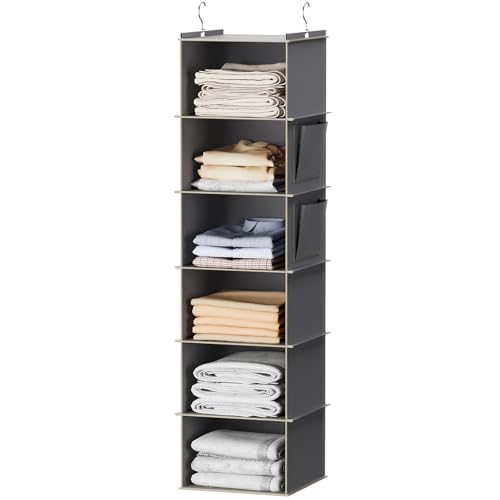
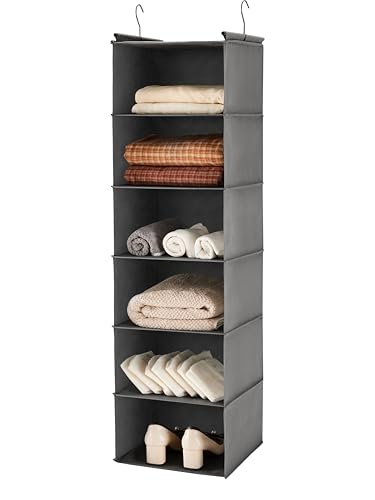
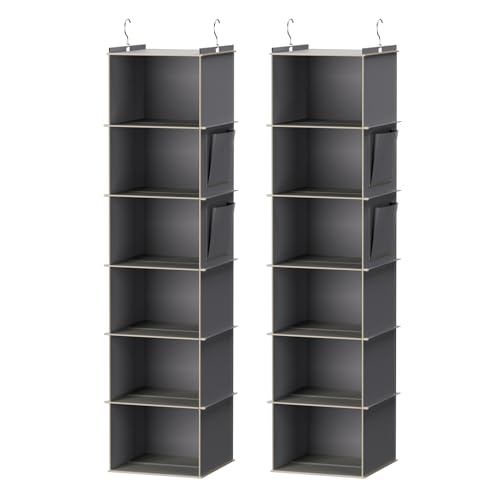
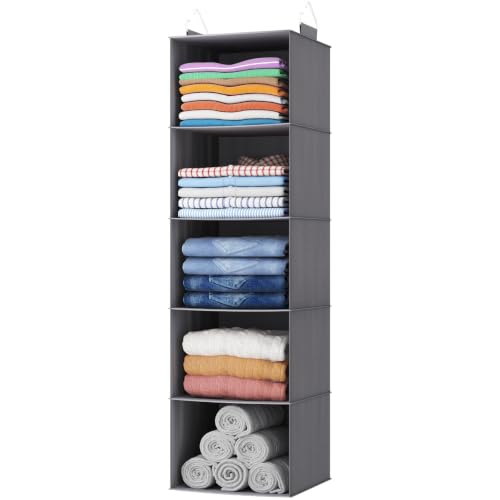
As an Amazon Associate we earn from qualifying purchases at no extra cost to you. Ratings are shown as listed on Amazon.
Best Hanging Closet Organizers by Situation
- Best overall for folded clothes: a six-shelf polyester organizer with rigid shelf inserts and two or more reinforced hanging straps.
- Best for small closets: a slim four-shelf organizer approximately 10–12 inches wide and no deeper than 12 inches.
- Best for heavier items: a reinforced canvas or thick polyester cubby with stitched seams, hook-and-loop straps, and shelves rated for roughly 8–12 pounds each.
- Best for shoes: a vertical shoe organizer with angled or divided compartments rather than open, deep shelves.
- Best for accessories: a hanging jewelry, scarf, or handbag organizer with pockets, loops, and transparent sections.
- Best budget approach: an uncomplicated polyester six-shelf unit with fewer pockets and no zippered drawers. Extra compartments often add cost without adding useful capacity.
Head-to-Head Comparison
The table below compares common organizer types and representative dimensions. Exact measurements vary by model, so use these figures as buying targets rather than universal specifications.
| Organizer type | Typical size | Useful capacity | Recommended load | Best material | Closet fit |
|---|---|---|---|---|---|
| Four-shelf slim unit | 10–12 W × 12 D × 48–54 H in. | 8–12 folded shirts or light sweaters | 4–6 lb per shelf | Polyester with cardboard or fiberboard inserts | Compact or shared closets |
| Six-shelf standard unit | 12–14 W × 12–14 D × 55–65 H in. | 15–24 shirts, sweaters, or trousers | 5–8 lb per shelf | 600-denier polyester or cotton canvas | Most standard closets |
| Reinforced hanging cubby | 14–16 W × 13–16 D × 55–70 H in. | 20–30 folded garments | 8–12 lb per shelf | Heavy canvas or thick polyester with metal or composite inserts | Wide rods with spare clearance |
| Vertical shoe organizer | 8–12 W × 10–14 D × 48–72 H in. | 8–16 pairs, depending on shoe size | 2–4 lb per compartment | Polyester mesh or washable fabric | Closets with unused vertical space |
| Pocket accessory organizer | 10–14 W × 3–6 D × 48–60 H in. | Belts, scarves, socks, jewelry, and small bags | 1–2 lb per pocket | Polyester with mesh or clear vinyl pockets | Very narrow spaces |
What Separates a Good Organizer From a Frustrating One?
Capacity is more than the number of shelves
Manufacturers may describe an organizer as having six shelves, but usable capacity depends on shelf height and depth. A shelf that is 12 inches wide, 12 inches deep, and 8 inches high can hold folded T-shirts comfortably. It may not fit a bulky sweatshirt without compressing the fabric or pushing the organizer out of shape.
Measure your typical folded stack before buying. If one stack is 9 inches high, a shelf opening of 8 inches will turn every retrieval into a tugging exercise. For sweaters, look for at least 10 inches of vertical clearance. For jeans and heavier trousers, width and shelf reinforcement matter more than the total number of compartments.
Shelf spacing determines accessibility
Closely spaced shelves maximize the advertised count but can be inconvenient. Six shelves with 8-inch openings provide more compartments than five shelves with 10-inch openings, yet the five-shelf version may hold more practical clothing.
Adjustable shelves are useful when you store different categories, but many soft organizers use fixed sewn-in shelves. Before purchasing, check whether the listed height refers to the entire organizer or the interior shelf opening. A 60-inch organizer does not necessarily provide six 10-inch compartments because the top and bottom panels consume space.
Hanging strength is concentrated at the top
The hanging straps, seams, and closet rod—not the shelf fabric—usually determine the safe load. Look for two wide straps rather than one narrow loop, reinforced stitching at the strap attachment points, and a fastening system that wraps around the rod securely.
A hook-and-loop closure is convenient and works well for light clothing. For heavier loads, stitched webbing or a molded hanger-style support is preferable. Avoid treating a published maximum load as a target. If the organizer is rated for 30 pounds, keeping the regular load closer to 20–24 pounds leaves a useful margin for shifting weight and repeated handling.
Fabric quality affects shape and smell
Thin nonwoven fabric keeps prices low, but it can sag when shelves are full and may crease permanently at the corners. Polyester canvas, commonly listed around 300 to 600 denier, generally offers better abrasion resistance. Cotton canvas feels substantial but can absorb moisture and may shrink or stain if washed incorrectly.
Rigid shelf inserts prevent the center of each shelf from bowing. Fiberboard is common and inexpensive; plastic or composite inserts are less vulnerable to accidental dampness. A removable insert is valuable because it allows the fabric body to be cleaned separately.
Will It Fit a Standard or Compact Closet?
Do not measure only the closet rod length. Measure the available width between neighboring garments, the distance from the rod to the floor, and the rod-to-back-wall depth.
- Standard reach-in closet: allow approximately 14 inches of width for a typical organizer and 12–14 inches of depth. Leave several inches beside it so clothes do not rub constantly against the shelves.
- Compact or shared closet: choose a unit no wider than 10–12 inches. A narrow organizer that remains accessible is more useful than a wide model hidden behind hanging clothes.
- Double-hang closet: check the lower rod height. A 60-inch organizer may collide with the floor or lower rod, so measure from the actual hanging point to the obstruction.
- Sloped or shallow closet: use a pocket organizer or slim shoe unit. Deep cubbies can block doors and make the back of the closet difficult to reach.
A simple fit calculation helps: if the clear rod-to-floor height is 64 inches and the organizer is 60 inches tall, the nominal clearance is 4 inches. That sounds sufficient, but allow extra space for the organizer’s hanging loops and for a slightly uneven floor. A 56–58-inch organizer would be a safer choice.
Brand and Product Examples Worth Considering
IKEA SKUBB hanging organizers are widely known for lightweight polyester construction and simple vertical storage. They suit shirts, linens, and accessories better than dense stacks of jeans or shoes. Their uncomplicated design is a benefit in small closets, though buyers should verify the dimensions for the specific SKUBB configuration.
Whitmor hanging organizers include several fabric shelf and accessory formats. They are worth considering when you want a conventional six-shelf layout or a dedicated shoe and pocket arrangement. Compare the listed shelf load and strap construction rather than assuming every Whitmor model has the same capacity.
Elfa closet components are a different category: their systems use a more structured framework and are generally better suited to planned, semi-permanent closet storage. They cost more than a soft hanging organizer and require more careful installation, but they can be a better choice when you need stable support for heavier belongings and expect to keep the setup for years.
For any brand, inspect the specification sheet for width, depth, interior shelf opening, material, and load guidance. Product names such as “large” or “deluxe” are not consistent measurements.
Ownership Realities: Cleaning, Sagging, and Common Mistakes
Fabric organizers collect dust where shelves meet the side panels. Empty the unit every few months, vacuum loose debris with a brush attachment, and follow the care label before spot-cleaning. Do not soak a fiberboard-supported organizer unless the manufacturer specifically permits it; moisture can swell the inserts and leave the shelves permanently uneven.
The first visible wear usually appears at the bottom corners, shelf seams, and strap attachment points. Overloading one shelf with shoes or denim accelerates sagging even when the total organizer weight seems reasonable. Distribute heavy items across multiple shelves, place lighter clothing above them, and avoid pulling a garment out from the middle of a tightly packed stack.
Another common mistake is filling the organizer before checking the rod. A tension rod may hold light garments but can bow or slip under the combined weight of the organizer and its contents. For a loaded unit, use a firmly mounted closet rod and keep the organizer near a support bracket whenever possible.
Final Buying Recommendation
Choose a six-shelf polyester organizer around 12–14 inches wide for general folded clothing, provided your closet has at least 12 inches of usable depth and a securely mounted rod. Select a slim four-shelf model when width is limited, a reinforced canvas cubby when heavier garments are involved, and a pocket or shoe organizer when the main problem is small-item clutter.
The best hanging closet organizers balance capacity with access. Prioritize interior shelf height, reinforced straps, removable rigid inserts, and a size that leaves breathing room around the unit. Those details matter more in daily use than an impressive compartment count.






Write Your Review
No reviews yet. Be the first to share your experience!