

Key takeaways
- Cabinet width: 36 + 36 + 30 = 102 inches.
- Remaining wall width: 108 − 102 = 6 inches.
- Practical result: the layout is too tight if the units need side clearance or if the wall is not perfectly square.
The best garage storage cabinets are durable steel units sized to your wall and loaded according to their actual shelf capacity—not simply the largest cabinets you can fit. For most garages, a lockable welded-steel floor cabinet with adjustable shelves offers the best balance of security, weight capacity, and everyday access; wall cabinets suit smaller tools and overhead space, while modular systems make sense when you expect to expand.
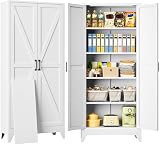
Our top picks
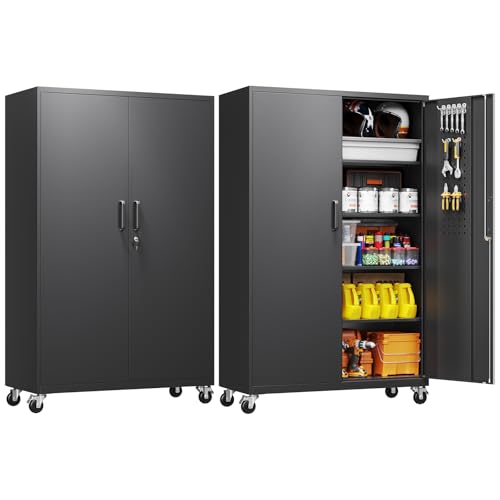


As an Amazon Associate we earn from qualifying purchases at no extra cost to you. Ratings are shown as listed on Amazon.
Best garage storage cabinets by situation
| Garage situation | Recommended cabinet type | Useful target dimensions | Typical capacity | Why it fits |
|---|---|---|---|---|
| Small single-car garage | Wall cabinet or slim floor cabinet | 24–30 in. wide, 12–18 in. deep | 100–300 lb total | Preserves parking and walking space |
| Typical two-car garage | Tall floor cabinet with adjustable shelves | 30–36 in. wide, 18–24 in. deep, 72–78 in. high | 400–800 lb total | Stores power tools, fluids, bins, and seasonal equipment |
| Heavy workshop use | Welded steel cabinet or modular steel system | 36–48 in. wide, 20–24 in. deep | 800–1,200 lb total | Handles dense tools and frequent opening |
| Rental or limited DIY experience | Freestanding, preassembled cabinet | 24–36 in. wide, 18–24 in. deep | 300–700 lb total | Requires less installation and fewer wall modifications |
These are practical buying targets rather than universal manufacturer ratings. Always use the cabinet’s published shelf and total-load limits, since a thin shelf may support much less than the cabinet body.
What to compare before buying
1. Dimensions and usable clearance
Measure more than the empty wall. Account for the garage door tracks, vehicle mirrors, electrical panels, water heaters, workbench overhangs, and the space needed to open doors. A cabinet that is 24 inches deep can occupy the same floor area as a shallow workbench, so mark its footprint with painter’s tape before ordering.
For a cabinet beside a parked vehicle, leave a practical passage rather than measuring to the absolute maximum. A 30-inch-wide cabinet with 18-inch depth is often easier to live with than a 36-inch model that forces you to squeeze between the car and the wall. Tall cabinets should also leave room for leveling feet and door swing; uneven concrete floors can make a seemingly suitable unit unusable.
Wall cabinets need a different check: locate studs, pipes, and wiring before drilling. A cabinet filled with metal tools can weigh well over 100 pounds, so drywall anchors alone are usually not an appropriate primary attachment.
2. Weight capacity and shelf design
Look for two separate figures: total cabinet capacity and capacity per shelf. Shelves rated at 100 pounds each may still require even loading, while a cabinet’s overall rating can assume the weight is distributed across several shelves.
Dense items such as socket sets, cast-iron clamps, batteries, and automotive parts should go low. Bulky but lightweight items—empty storage bins, extension cords, and cleaning supplies—can use upper shelves. Adjustable shelves are more valuable than a high headline capacity because they let you eliminate wasted vertical space.
For a workshop, favor shelves with a front reinforcement lip or a folded steel edge. Particleboard shelves can work for light household storage, but repeated exposure to damp floors, spilled fluids, or overloaded corners can cause swelling or sagging.
3. Material and corrosion resistance
Powder-coated steel is the usual choice for garages because it resists abrasion and is less vulnerable to dents than thin plastic. Welded steel cabinets generally feel more rigid and tolerate frequent use better than flat-pack units assembled with many fasteners. The trade-off is higher cost, greater shipping weight, and less convenient repositioning.
Stainless steel resists corrosion well but is usually unnecessary for a normal residential garage. Plastic resin cabinets avoid rust and are easy to clean, making them suitable for humid areas or light-duty lawn equipment, but they usually have lower shelf capacity and can flex under dense tools.
Regardless of material, corrosion usually begins at chipped paint, exposed fasteners, cabinet bottoms, and areas where wet equipment rests. A raised base, adjustable feet, or a separate plinth is useful if the garage floor gets damp.
4. Locking features and access
A lock is useful for chemicals, sharp tools, spare keys, and equipment shared by several people, but not every lock provides the same protection. A basic cam lock discourages casual access; a more substantial three-point locking system engages the top, middle, and bottom of a tall door and is harder to pry open.
Check whether the lock is keyed alike across multiple cabinets, whether replacement keys are available, and whether the doors can be opened when the cabinet is not perfectly level. Some cabinets use padlock hasps, which are convenient but leave the padlock exposed. For valuable tools, anchor the cabinet to studs or masonry as well as locking it; a locked cabinet that can be tipped or carried away is not a complete security solution.
Head-to-head: modular systems versus individual cabinets
Modular garage systems
Brands such as Gladiator and NewAge Products offer coordinated garage systems that may combine tall cabinets, wall cabinets, rolling units, and worktops. Their main advantage is planning: matching heights and depths create a continuous storage wall, and additional pieces can often be added later. They are a strong choice for a two-car garage, a dedicated workshop, or anyone who wants a finished appearance.
The drawbacks are cost and installation complexity. A complete system can cost several hundred to several thousand dollars depending on the number of units and work surface. Confirm that the system’s individual modules can pass through doorways and that wall cabinets have suitable mounting rails or brackets.
Individual freestanding cabinets
Standalone steel cabinets from garage-storage lines such as Husky, Gladiator, and Seville Classics are easier to phase in. You can start with one tall cabinet and add a rolling chest or wall unit when your storage needs become clearer. This approach is usually more economical for a small garage and makes it easier to match different storage jobs.
The compromise is visual consistency. Depths, handles, shelf heights, and shades of gray may differ between manufacturers. Freestanding units also need careful leveling and anchoring, especially if their doors are tall or the shelves hold dense tools.
A simple decision matrix
| Your priority | Choose | Avoid |
|---|---|---|
| Lowest initial cost | One flat-pack steel cabinet with adjustable shelves | Buying a complete modular wall before measuring needs |
| Frequent daily access | Welded cabinet, full-extension drawers, or rolling cabinet | Light shelves that require removing several bins to reach tools |
| Maximum security | Anchored steel cabinet with three-point locking | Unanchored plastic cabinet with a simple latch |
| Humid or occasionally wet garage | Powder-coated steel on feet or durable resin cabinetry | Unsealed particleboard directly on concrete |
| Small footprint | Wall cabinet 12–16 in. deep or a slim 18-in.-deep floor unit | Deep cabinet that blocks vehicle doors or walkways |
| Little assembly experience | Preassembled cabinet with delivery and leveling help | Large flat-pack system with many panels and doors |
Assembly and installation realities
Flat-pack cabinets are often cheaper to ship, but assembly can be the least predictable part of the purchase. Allow two adults for tall units, particularly when fitting doors or lifting the cabinet upright. A cordless drill, level, socket set, and rubber mallet are commonly useful, but avoid overtightening bolts into thin steel because distorted panels can prevent doors from aligning.
Assemble the cabinet on a protected surface, install shelves only after the frame is square, and test the doors before loading it. If a door rubs, first check that the cabinet is level; adjusting hinges before correcting a sloping floor can mask the real problem.
Anchor tall cabinets according to the manufacturer’s instructions. Use studs for drywall-mounted units and appropriate masonry hardware for concrete or block. Do not assume that a heavy cabinet is stable enough without an anchor, especially where children, pets, or earthquakes are concerns.
Worked sizing example for a two-car garage
Suppose an available wall is 108 inches wide and you want two 36-inch-wide tall cabinets plus one 30-inch rolling cabinet:
- Cabinet width: 36 + 36 + 30 = 102 inches.
- Remaining wall width: 108 − 102 = 6 inches.
- Practical result: the layout is too tight if the units need side clearance or if the wall is not perfectly square.
A better plan is one 36-inch cabinet, one 30-inch cabinet, and a 30-inch rolling unit, using 96 inches and leaving 12 inches for trim, uneven walls, or access to an outlet. This small margin is more useful than filling every inch on paper.
Ownership, maintenance, and common mistakes
Wipe dust and road salt from cabinet bottoms, dry wet tools before storage, and clean chemical spills promptly. Lubricate hinges and lock mechanisms with a product approved for the hardware; avoid allowing oily residue to collect on shelf surfaces. Recheck anchor bolts and shelf clips after the first month, then periodically if the cabinet is heavily used.
The parts most likely to wear are door hinges, magnetic catches, drawer slides, shelf clips, and lock cylinders—not the powder coating across the broad panels. Keep spare shelf clips if the manufacturer sells them, because a missing clip can turn a useful shelf into an unsafe one.
Common buying errors include ignoring door swing, placing a cabinet over a damp concrete seam, exceeding shelf ratings with batteries or metal parts, and storing flammable liquids beside heat-producing equipment. Keep fuels and chemicals in appropriate containers, follow their labels, and maintain any required ventilation or separation.
Bottom line
Choose a slim wall or floor cabinet for a compact garage, a 30–36-inch-wide adjustable-shelf cabinet for general household storage, and a welded or modular steel system for dense tools and frequent workshop use. Prioritize dimensions, per-shelf capacity, anchoring, and corrosion protection before comparing finishes or accessories. The best garage storage cabinets are the ones that fit with clearance, remain stable when fully loaded, and make the items you use most often easy to reach.






Write Your Review
No reviews yet. Be the first to share your experience!