

Key takeaways
- Smooth tile or vinyl: small polyurethane or rubber casters are usually adequate.
- Grout, thresholds, or low-pile carpet: prioritize wheels at least 5 inches in diameter.
- Thick carpet: choose large fixed wheels or a platform cart; small swivel casters may drag.
- Sloped floors: use locking casters and never leave a loaded cart unattended.
The best rolling laundry carts are the ones that match your load size, doorway width, floor surface, and storage space—not simply the cart with the largest advertised capacity.
Quick picks by laundry situation
| Situation | Best cart type | Useful target specifications | Why it fits |
|---|---|---|---|
| Small apartment or narrow laundry closet | Single-bag, two-wheel or compact four-wheel cart | 18–24 inches wide; 1.5–2.5 bushels; 6–8 inch wheels | Fits through tight openings and is easier to turn beside appliances |
| One or two loads several times a week | Medium four-wheel rolling hamper | 2.5–3.5 bushels; 35–50 pounds usable load; locking casters | Balances capacity, stability, and everyday maneuverability |
| Large family or shared laundry room | Heavy-duty platform or multi-bag laundry cart | 4–6 bushels; 75–150 pounds rated capacity; 5-inch or larger casters | Moves multiple loads without overloading a light household frame |
| Limited storage between laundry days | Folding-frame cart with removable bag | Under 5 inches thick when folded; 2–3 bushels; 8-inch wheels | Can stand beside a washer or fit in a closet after use |
What separates the best rolling laundry carts
Capacity: measure usable volume, not just the headline number
Laundry-cart capacity is commonly listed in bushels. One bushel is approximately 1.25 cubic feet, but the usable amount is lower when clothing is packed loosely or the bag has a narrow opening. A 2-bushel cart is usually suitable for a small household’s regular load, while a 3- to 4-bushel cart is more practical when clothing accumulates for several days.
Our top picks


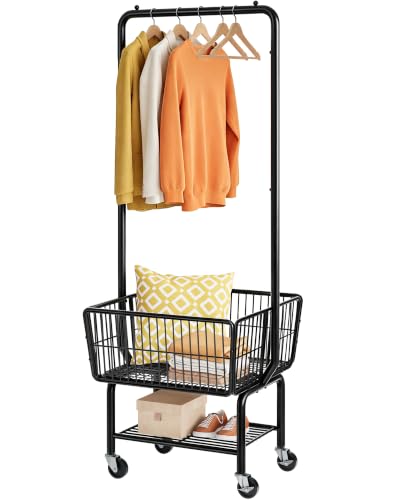
As an Amazon Associate we earn from qualifying purchases at no extra cost to you. Ratings are shown as listed on Amazon.
Do not choose capacity by weight alone. A cart may hold 50 pounds of laundry but become difficult to steer when the bag is full. Wet clothing is particularly demanding: water adds substantial weight, and a soft bag can sag toward the wheels. For transporting damp items, choose a rigid-sided or heavy-canvas design with a firm base.
Wheel performance depends on the floor
Small twin casters roll adequately on smooth tile but tend to catch on grout lines, thresholds, and uneven transitions. Larger wheels—roughly 6 to 8 inches in diameter—handle these obstacles better. They also reduce the effort needed to pull a loaded cart over a slight lip between rooms.
Four swivel casters provide easy turning in an open laundry room, but a cart with four swiveling wheels can feel less predictable in a narrow hallway. A two-wheel tilt-and-pull cart tracks more naturally in a straight line and can pivot around corners by lifting its front slightly. For a tight laundry closet, that trade-off is often worthwhile.
- Smooth tile or vinyl: small polyurethane or rubber casters are usually adequate.
- Grout, thresholds, or low-pile carpet: prioritize wheels at least 5 inches in diameter.
- Thick carpet: choose large fixed wheels or a platform cart; small swivel casters may drag.
- Sloped floors: use locking casters and never leave a loaded cart unattended.
Frame durability: inspect the joints before the fabric
The bag often receives the attention, but the frame and wheel mounts usually determine how long a rolling laundry cart remains useful. Powder-coated steel tubing resists everyday moisture and generally provides better stiffness than thin aluminum. Aluminum can be lighter and easier to carry upstairs, but a lightweight frame may flex under a full load.
Look for welded joints or reinforced brackets at the handle, lower crossbar, and caster plates. A frame that twists when you press the handle sideways will be harder to steer and more likely to loosen over time. Bolted wheels are useful because they can be tightened or replaced; permanently riveted, undersized caster mounts are more difficult to repair.
Head-to-head: common rolling-cart designs
| Cart design | Typical capacity | Typical empty weight | Best advantage | Main compromise |
|---|---|---|---|---|
| Two-wheel tilt cart | 1.5–3 bushels | 5–12 pounds | Tracks well and handles narrow corridors | Must be tilted; less stable when parked |
| Four-wheel folding hamper | 2–3.5 bushels | 8–18 pounds | Easy loading and compact storage | Small casters may struggle over thresholds |
| Rigid four-wheel utility cart | 3–5 bushels | 15–30 pounds | Stable, durable, and good for heavy loads | Consumes more storage space |
| Multi-bag sorter cart | 3–6 bushels total | 12–25 pounds | Separates lights, darks, and towels during collection | Wider turning radius and more fabric to clean |
| Platform laundry cart | 4–8 bushels or 75–150 pounds | 20–45 pounds | Moves several baskets or commercial-size loads | Usually excessive for a small home laundry area |
Handle height and maneuverability in tight spaces
A handle that is too low forces you to bend while pulling; one that is too high makes it difficult to control a heavy load. For most adults, an adjustable handle or a grip approximately 34 to 42 inches from the floor is a practical range. If two people of substantially different heights will use the cart, adjustment is more valuable than a padded grip.
Measure the route, not only the storage location. A cart that is 22 inches wide may fit beside a washer but fail to turn through a 24-inch doorway once your hands and the handle are included. Leave at least 2 inches of clearance on each side for a straight passage, and more if the cart must pivot.
For a narrow room, compare the cart’s turning envelope. A four-wheel cart with swivel casters can rotate in place, but its handle may sweep into cabinets. A two-wheel cart needs more space to tilt but usually occupies less width during a straight pull.
Folding storage: useful, with a few limitations
Folding carts are the best choice when the cart must disappear between uses. Check the folded thickness, not merely the word “collapsible.” Some frames fold flat to roughly 3 to 5 inches, while others still occupy 8 to 12 inches because the wheels or handle remain extended.
A removable bag is preferable for cleaning and storage. However, repeated folding can stress fabric attachment points and plastic hinges. Avoid dragging a folding cart sideways while fully loaded; that puts twisting force on the joints. Unload it before folding, and engage any frame locks before transporting laundry.
Ownership costs and maintenance
Household rolling laundry carts generally range from about $30 to $70 for compact fabric models, $60 to $150 for sturdier folding or multi-bag carts, and $120 to $300 or more for heavy-duty utility designs. The cheapest option is not always the lowest-cost choice if its casters or bag fail quickly.
For example, suppose a $45 compact cart lasts one year and is used three times per week. That is about 156 uses, or approximately 29 cents per use. A $110 reinforced cart lasting three years at the same frequency costs about 23 cents per use before replacement parts. The calculation is only useful if the larger cart actually fits your home and you can move its heavier frame.
- Empty the bag before cleaning the frame so moisture does not remain under the liner.
- Wipe metal tubing and caster plates dry after exposure to damp towels.
- Vacuum lint from wheel axles; accumulated fibers can make a good caster appear defective.
- Check bolts and caster fasteners every few months, especially on carts carrying heavy loads.
- Wash removable bags according to their care labels and let them dry completely before reinstalling.
The parts most likely to wear first are caster wheels, wheel bearings, bag seams, and plastic folding hinges. A replaceable bag or standard-size caster can extend the cart’s life; proprietary parts may make a damaged component uneconomical to repair.
How to choose your cart in five steps
- Measure the narrowest opening. Include door trim and the space needed to turn.
- Estimate your real load. Count how many loads you transport at once rather than choosing the largest capacity.
- Identify floor obstacles. Select larger wheels for thresholds, grout, and carpet.
- Check the handle position. Favor an adjustable handle or a height that lets you pull without bending.
- Verify storage and maintenance details. Confirm folded thickness, bag-washing instructions, caster replacement options, and frame locks.
For most homes, a medium four-wheel cart with 2.5 to 3.5 bushels of capacity, a steel frame, locking casters, and a removable bag offers the best balance. Choose a two-wheel model when corridor width and straight-line control matter most, a folding cart when storage is the primary constraint, and a heavy-duty platform or multi-bag cart only when your regular laundry volume justifies its extra size.





Write Your Review
No reviews yet. Be the first to share your experience!