

Key takeaways
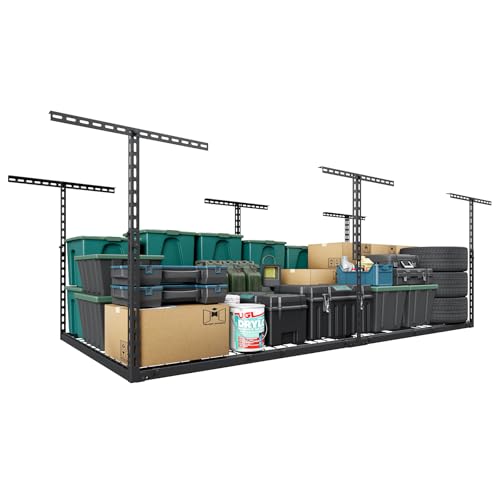
- Best for bulky seasonal storage: A 4-by-8-foot ceiling-mounted steel rack, typically rated around 500 to 600 pounds. Its broad platform fits multiple storage bins, but it needs a clear span and sturdy joist attachment.
- Best for a narrow garage bay: A 3-by-6-foot rack, often rated around 400 to 500 pounds. It takes up less ceiling area and is easier to keep away from garage doors and lights.
- Best when ceiling height varies: An adjustable rack with several drop-height settings, commonly spanning about 22 to 40 inches below the ceiling. Verify that the model’s adjustment range works with your car’s roof height.
- Best for awkward long items: A dedicated ceiling-mounted ladder or lumber rack. It is not a general-purpose platform, but open-sided supports can be more practical for long boards, ladders, or kayaks.
- Best for frequent access: A motorized lift system, provided its capacity, controls, and mounting requirements suit the intended load. It costs more and introduces moving parts, so it is not automatically the best choice for ordinary bins.
Best Overhead Garage Storage Racks: Choose by Fit, Load, and Vehicle Clearance
The best overhead garage storage rack is the one that fits your ceiling and stored items while keeping its rated load safely clear of your vehicle; for most garages, a 4-by-8-foot adjustable steel rack is the versatile starting point, while compact 3-by-6-foot models suit tighter bays.
Before buying, measure the ceiling joists, the tallest vehicle with its hatch or roof accessories, and the space needed to reach the rack. Published capacity is not a reason to load a rack to its limit: the ceiling structure, fasteners, installation quality, and load distribution all matter.
Our top picks


As an Amazon Associate we earn from qualifying purchases at no extra cost to you. Ratings are shown as listed on Amazon.
Shortlist by garage and storage situation
- Best for bulky seasonal storage: A 4-by-8-foot ceiling-mounted steel rack, typically rated around 500 to 600 pounds. Its broad platform fits multiple storage bins, but it needs a clear span and sturdy joist attachment.
- Best for a narrow garage bay: A 3-by-6-foot rack, often rated around 400 to 500 pounds. It takes up less ceiling area and is easier to keep away from garage doors and lights.
- Best when ceiling height varies: An adjustable rack with several drop-height settings, commonly spanning about 22 to 40 inches below the ceiling. Verify that the model’s adjustment range works with your car’s roof height.
- Best for awkward long items: A dedicated ceiling-mounted ladder or lumber rack. It is not a general-purpose platform, but open-sided supports can be more practical for long boards, ladders, or kayaks.
- Best for frequent access: A motorized lift system, provided its capacity, controls, and mounting requirements suit the intended load. It costs more and introduces moving parts, so it is not automatically the best choice for ordinary bins.
Comparison: what the numbers mean
The figures below are common ranges for residential products, not specifications for every model. Use the manufacturer’s manual for the exact dimensions, load rating, compatible ceiling structure, and mounting hardware before purchase.
| Rack type | Typical platform or span | Typical rated capacity | Height adjustment | Installation and clearance trade-off |
|---|---|---|---|---|
| Fixed steel platform | About 3 × 6 ft to 4 × 8 ft | About 400–600 lb | Usually fixed; roughly 18–24 in. drop is common | Bolts into ceiling framing; a fixed drop can be hard to reconcile with a tall vehicle. |
| Adjustable steel platform | About 3 × 6 ft to 4 × 8 ft | About 400–600 lb | Often about 22–40 in. below the ceiling, depending on model | More flexible positioning, but extra drop may reduce headroom and vehicle clearance. |
| Compact platform rack | About 2 × 4 ft to 3 × 6 ft | About 200–500 lb | Varies by model; commonly fixed or moderately adjustable | Can fit between obstacles more easily; smaller area means fewer bins per rack. |
| Motorized lift | Varies; often sized for one load zone | Commonly about 200–400 lb | Raises and lowers the platform by cable or mechanism | Requires suitable structure and careful setup; moving components need periodic inspection. |
| Open ladder or lumber rack | Typically a pair of supports spanning a chosen length | Model-specific; do not assume platform-rack capacity | Usually fixed | Leaves the ceiling open, but stored items must be secured against sliding or falling. |
How to check vehicle clearance before ordering
A rack’s listed drop is measured from the ceiling, not from the floor. Determine the lowest point of the proposed rack, including any hooks, brackets, or stored items, and compare it with the highest point of the parked vehicle.
- Measure from the floor to the highest point of the vehicle, including a roof box, antenna, or open hatch if relevant.
- Measure the ceiling at the intended mounting area. Note garage-door tracks, opener rails, lights, and pipes; these can obstruct both the rack and its installation.
- Calculate the available vertical space: ceiling height − rack drop − vehicle height. Treat the result as clearance, not as a target for a tight fit.
- Leave practical room for movement and loading. The garage door and opener also need their full travel path clear.
Example: With a 108-inch ceiling, a 30-inch rack drop, and a 76-inch-tall vehicle, the nominal gap is 2 inches (108 − 30 − 76). That is too tight for many garages: measurement variation, hanging items, or a slightly different parking position could cause contact. A shallower drop, a different mounting location, or a wall-based storage option may be safer.
Capacity, joists, and installation: the details that decide the purchase
Look for a clearly stated load rating and whether it applies to the complete rack or only a component. A 600-pound rating does not mean each anchor or joist can safely take 600 pounds. The installed system is limited by its weakest part: rack, fasteners, ceiling framing, or the way the load is arranged.
Most platform racks are designed to attach to structural framing, not drywall alone. Locate and confirm the ceiling joists, then follow the manufacturer’s specified fastener type, spacing, and installation pattern. Joist direction and spacing can affect whether the rack fits as advertised. If framing is unclear, damaged, or modified, ask a qualified installer to assess it rather than improvising anchors.
Installation commonly involves assembling a large frame overhead, marking joist locations, and lifting the rack into position. Check the package dimensions and whether two or more people are needed to lift it safely. A rack that fits the ceiling on paper may still conflict with a garage-door track or be impractical to assemble in a low, crowded bay.
Pick the right rack for your space
| Your situation | Better starting point | Why |
|---|---|---|
| Low ceiling or tall vehicle | Shallow-drop compact rack, or wall storage | Preserves clearance; a large adjustable rack may still hang too low. |
| High ceiling and many seasonal bins | 4 × 8 ft adjustable platform | Offers a broad storage area and flexibility to set the drop. |
| Limited ceiling area or obstacles | Smaller platform or multiple compact racks | Can be positioned around tracks, lights, or an opener more easily. |
| Long, narrow equipment | Purpose-built ladder or lumber supports | Open supports suit long items better than stacking them on a broad platform. |
| Items used often | Lower wall shelving or a suitable lift | Ceiling storage is inconvenient when access is frequent; a lift adds convenience but also cost and upkeep. |
Ownership realities: loading, access, and wear
Put dense items near the rack’s supports and distribute weight across the platform rather than piling it in one corner. Keep the combined load below the manufacturer’s limit, and account for the weight of containers. Label bins and reserve overhead storage for items you do not need every week; repeatedly lifting heavy boxes above shoulder height is awkward even when the rack is rated for them.
Over time, check fasteners and visible joints for looseness, corrosion, or deformation, following the maker’s maintenance guidance. For a motorized system, inspect cables and moving parts as directed and stop using it if anything appears damaged. Avoid storing items that can leak, shift, or fall through gaps unless they are contained securely.
For most households, the practical winner is a steel platform sized to the joists and available ceiling area—not necessarily the largest or highest-capacity model. Measure first, confirm the mounting structure, and choose a drop height that leaves a comfortable margin above the vehicle.






Write Your Review
No reviews yet. Be the first to share your experience!