

Key takeaways
- Place glasses securely on the upper rack if the manufacturer allows machine washing.
- Leave space between glasses so vibration does not cause rim-to-rim contact.
- Use a mild detergent and avoid abrasive powders that can leave a haze.
- Do not pour boiling water into a cold glass or ice-cold water into a hot one.
- Inspect rims regularly; a small chip can become a sharp edge and is a reason to retire the glass.
The best craft beer glasses are the ones whose shape suits the beer: a tulip for aromatic IPA, a snifter for concentrated stout, a tall pilsner glass for carbonation and visual clarity, and a straight pint for versatile everyday drinking.
Glass shape affects how quickly aromas collect, how much foam survives pouring, and how comfortably the beer reaches your palate. Capacity matters too: a 16-ounce beer should not be forced into a glass that leaves no room for a proper head. For most home bars, a small set of four shapes is more useful than a large collection of beer-branded glasses.
Our top picks


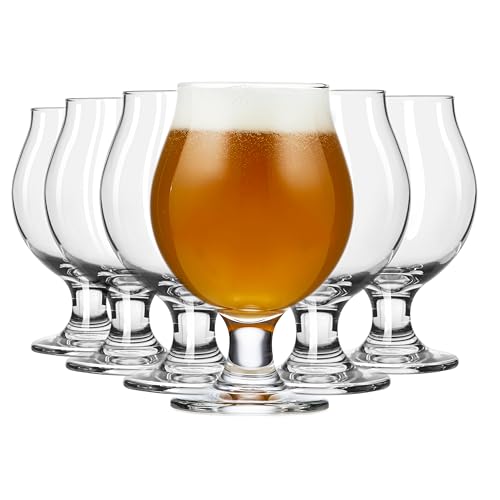
As an Amazon Associate we earn from qualifying purchases at no extra cost to you. Ratings are shown as listed on Amazon.
Best craft beer glasses by beer style
Best for IPA: tulip or IPA glass
A tulip glass has a rounded bowl, a narrowed opening, and often a short stem. The bowl gives hop aromas room to develop, while the narrower rim directs those aromas toward your nose. The inward curve also helps hold a dense head after pouring.
For heavily hopped American IPA, double IPA, and New England IPA, look for a capacity of about 16 to 22 ounces. A 16-ounce pour fits comfortably in a 22-ounce glass with enough space for foam. Spiegelau’s IPA glass is a well-known example of this general design, although the exact shape and care instructions vary by version.
A tulip also works well for Belgian-style ales, saisons, and many strong pale ales. It is less suitable for a large, casual pour if the bowl is narrow at the base, because sediment and yeast can collect in the curved bottom.
Best for stout: snifter or rounded tulip
A snifter’s broad bowl and narrow rim concentrate roasted malt, chocolate, coffee, dried-fruit, and alcohol aromas. The stem lets you warm the beer gently with your hand without covering the bowl, which is useful for imperial stout and other strong dark beers.
Choose approximately 12 to 20 ounces for stout. A smaller 12-ounce snifter is practical for rich beers served in modest portions; a 16- to 20-ounce version offers more room for foam and swirling. For standard dry stout, a rounded nonic pint is often more comfortable than a snifter because it supports a generous pour and is easier to clean.
Avoid filling any snifter to the rim. The shape only helps if there is empty space above the beer for aromas to gather.
Best for pilsner: tall pilsner glass
A pilsner glass is tall, narrow, and usually slightly flared at the top. Its height displays the beer’s color and carbonation, while the taper helps maintain a stable foam column. The narrower base can also make a lively lager feel more aromatic than it does in a wide tumbler.
Most useful pilsner glasses hold 12 to 16 ounces, with larger examples reaching around 20 ounces. Pick a 16-ounce model if you commonly buy American craft pilsners or 12-ounce bottles; choose 20 ounces if you prefer 16-ounce cans and a substantial head.
Tall glasses are more vulnerable to tipping and may not fit beneath every dishwasher rack or cabinet. Check the glass height before buying a set, particularly if storage space is limited.
Best all-rounder: nonic pint
A nonic pint has a slight bulge near the top. The ridge gives your fingers a secure grip, protects the rim from chipping when glasses are stacked, and helps prevent glasses from sticking together. Its 16-ounce capacity suits pale ale, amber ale, porter, stout, and many lagers.
The straight-sided American pint is another practical choice, especially for casual use. It is inexpensive, easy to replace, and usually dishwasher-friendly. However, it does less to concentrate aroma than a tulip or snifter, and a wide mouth can allow foam to collapse more quickly.
Head-to-head comparison of the main glass shapes
| Glass shape | Useful capacity | Best beer styles | Main advantage | Typical drawback |
|---|---|---|---|---|
| Tulip or IPA glass | 16–22 fl oz | IPA, double IPA, saison, Belgian ale | Concentrates hop and yeast aromas while supporting head retention | Curved surfaces can be harder to clean and store |
| Snifter | 12–20 fl oz | Imperial stout, barleywine, strong ale | Captures intense aromas and allows gentle warming | Easy to overfill; less suitable for fast, casual drinking |
| Pilsner glass | 12–20 fl oz | Pilsner, kölsch, helles, pale lager | Shows clarity and preserves a tall, lively head | Tall profile is less stable and needs more storage height |
| Nonic pint | 16–20 fl oz | Pale ale, porter, stout, bitter, lager | Versatile, stackable, and comfortable to hold | Provides less aroma concentration than specialty shapes |
| Stemmed craft beer glass | 13–17 fl oz | Mixed tasting flights, sour ale, saison | Keeps hands away from the bowl and suits slower tasting | Stem and thin rim can be more vulnerable to breakage |
Which glass should you buy for your situation?
| Your situation | Best choice | Why |
|---|---|---|
| One glass for nearly everything | 16-oz nonic pint | Easy to clean, inexpensive, and suitable for most beer styles |
| Mostly hop-forward beer | 16–22-oz tulip or IPA glass | Prioritizes aroma and leaves room for foam |
| Mostly strong dark beer | 12–16-oz snifter | Encourages smaller pours and concentrated aroma |
| Frequent lager drinker | 16–20-oz pilsner glass | Displays color and supports lively carbonation |
| Small kitchen or limited cabinet space | Two nonic pints plus one tulip | Provides useful coverage without tall or fragile storage |
| Beer tastings and mixed styles | Four 13–17-oz stemmed or tulip glasses | Consistent portions make side-by-side comparison easier |
Capacity: leave room for the head
Capacity should be measured against the beer’s serving size, not just the label on the glass. A simple rule is to buy a glass at least 25 percent larger than the intended pour.
For example, a 16-ounce pour multiplied by 1.25 requires a 20-ounce glass:
16 fl oz × 1.25 = 20 fl oz
That does not mean every 16-ounce beer needs a 20-ounce vessel. A low-foam lager may fit comfortably in a 16-ounce glass, while a highly carbonated IPA or Belgian ale benefits from more space. If you usually pour from a can, a 22-ounce tulip is a flexible option. If you drink 12-ounce bottles, a 16-ounce glass is generally sufficient.
Dishwasher safety and durability
Dishwasher safety depends on the glass’s thickness, decoration, lead-free composition, and manufacturer guidance. Plain, machine-made glasses are usually the safest choice for frequent washing. Thin crystal, painted logos, gold rims, etched details, and delicate stems are more likely to cloud, fade, or break over time.
- Place glasses securely on the upper rack if the manufacturer allows machine washing.
- Leave space between glasses so vibration does not cause rim-to-rim contact.
- Use a mild detergent and avoid abrasive powders that can leave a haze.
- Do not pour boiling water into a cold glass or ice-cold water into a hot one.
- Inspect rims regularly; a small chip can become a sharp edge and is a reason to retire the glass.
For a busy household, thick-walled nonic pints are usually the best ownership choice. They tolerate repeated washing and occasional knocks better than thin stemmed glasses. For aroma-focused drinking, keep a smaller number of tulips or snifters and wash them by hand if their care instructions recommend it.
Common buying and serving mistakes
Buying a glass that is too small
A 16-ounce beer poured into a 16-ounce glass leaves no room for foam. The result is overflow, a compressed head, or an awkwardly slow pour. Size up when buying glasses for IPA, wheat beer, Belgian ale, and other highly carbonated styles.
Choosing shape over stability
A tall pilsner glass is attractive but can be impractical around children, pets, crowded tables, or a small sink. If breakage is a concern, choose a heavier base and moderate height rather than the thinnest available glass.
Using detergent residue
Beer foam collapses quickly on a glass with grease or detergent film. Rinse thoroughly and let the glass air-dry, or polish it with a clean lint-free cloth. Avoid drying beer glasses with a cloth that has fabric softener residue.
Chilling every glass in the freezer
A frosted glass can mute aroma and create excess condensation. For most craft beer, room-temperature glassware is preferable, especially for IPA and stout. A brief cool rinse is reasonable for a crisp lager, but avoid extreme temperature changes.
Final recommendation
For the broadest coverage, buy a 16-ounce nonic pint for everyday beer and a 16- to 22-ounce tulip for IPA and aromatic ales. Add a 12- to 16-ounce snifter if you regularly drink imperial stout or other strong beers, and choose a 16- to 20-ounce pilsner glass if pale lagers are a staple. Prioritize the right capacity, a comfortable rim, stable construction, and dishwasher instructions you can follow consistently; those details matter more than decorative branding.





Write Your Review
No reviews yet. Be the first to share your experience!