

Key takeaways
- The best arepa maker for Venezuelan cooking is usually a six-cavity, arepa-specific electric press with a 4- to 4.5-inch plate, reliable non-stick cooking surfaces, and independently heated upper and lower plates; for most kitchens, an IMUSA Arepa Maker is the…
The best arepa maker for Venezuelan cooking is usually a six-cavity, arepa-specific electric press with a 4- to 4.5-inch plate, reliable non-stick cooking surfaces, and independently heated upper and lower plates; for most kitchens, an IMUSA Arepa Maker is the strongest all-around choice.
Unlike a flat sandwich press, an arepa maker shapes the dough into evenly thick rounds while cooking both sides at once. That matters for Venezuelan arepas, which need a browned exterior and a fully cooked interior that can be sliced open for fillings such as reina pepiada, shredded beef, or black beans and cheese. The right machine also reduces flipping, sticking, and cleanup.
Our top picks
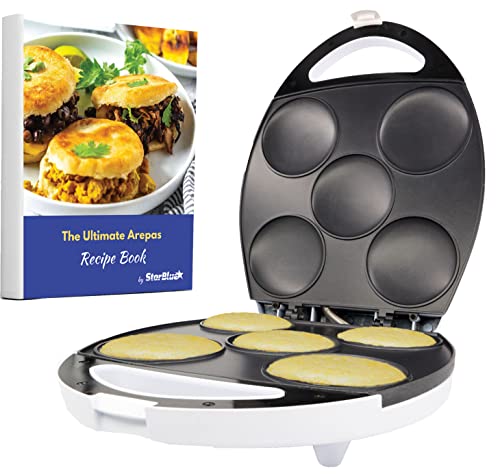


As an Amazon Associate we earn from qualifying purchases at no extra cost to you. Ratings are shown as listed on Amazon.
Best arepa makers for Venezuelan cooking
Best overall: IMUSA Arepa Maker
The IMUSA Arepa Maker is the most practical choice for regular Venezuelan-style cooking because its multi-cavity layout is designed around arepa portions rather than waffles or panini. Typical versions cook six individual arepas at once, with cavities close to 4 inches across. That is a useful size for stuffed arepas: large enough to split and fill, but not so large that the center stays doughy while the outside over-browns.
Its main advantage is consistency. A hinged lid applies similar pressure to every portion, while upper and lower heating elements brown both faces. The non-stick plates make it easier to release arepas made with precooked corn flour, water, and salt, although a very light film of oil is still useful during the first few uses and when making especially lean dough.
Expect to pay roughly $35 to $60, depending on the version and retailer. The trade-offs are a relatively bulky footprint, a fixed plate design that is less convenient to wash, and limited control over browning. It is a good fit if you cook arepas several times a month or want several portions ready together.
Best for a lower-cost trial: Compact two-plate arepa maker
A compact two- or four-cavity arepa maker is a sensible starting point for one or two people. These machines generally occupy less counter space and cost about $25 to $45. Their smaller batch size lets you prepare fresh arepas without storing leftovers, and the shorter heating surface can warm quickly.
Look for cavities at least 4 inches wide and approximately 0.5 to 0.75 inch deep. Very shallow cavities may produce thin discs that are difficult to split, while very deep cavities can leave the middle undercooked if the dough is packed too firmly. Budget machines commonly have a 600- to 800-watt heating element, which is adequate for small batches but may recover slowly after cold dough is added.
This category is best for occasional cooking, limited storage, or a first purchase. The compromise is lower throughput and often less even heat near the hinge or outer edge.
Best multifunction alternative: Dash Mini Maker or similar four-inch press
A four-inch Dash Mini Maker is not an arepa-specific appliance, but it can work when versatility matters more than batch size. It has a small cooking surface, typically about 4 inches across, and is widely sold in different plate configurations. A flat or griddle-style version can cook shaped arepas, while a sandwich-style version may compress them more than desired.
Use this option when you also want a compact appliance for pancakes, hash browns, or small sandwiches. Shape the dough by hand first instead of relying on the lid to flatten a thick ball. Because the cavities are not necessarily designed for arepa thickness, the result can be flatter and less suitable for stuffing than one made in an IMUSA-style six-cavity machine.
Typical pricing is about $20 to $40. Its small size is a benefit in an apartment, but it is slow for families: if one batch takes approximately 8 minutes, six arepas made in pairs can require about 24 minutes of cooking time, excluding preheating.
Head-to-head comparison
| Type or example | Typical capacity | Approximate plate size | Power range | Best use | Typical price range |
|---|---|---|---|---|---|
| IMUSA Arepa Maker | 6 arepas | About 4 inches each | 900–1,200 watts | Frequent family cooking | $35–$60 |
| Compact 2–4 cavity arepa maker | 2–4 arepas | About 4–4.5 inches each | 600–900 watts | Small households and beginners | $25–$45 |
| Dash Mini Maker, flat or griddle style | 1–2 small portions | About 4 inches | 350–550 watts | Small spaces and multipurpose use | $20–$40 |
| Stovetop cast-iron arepa press or griddle | 1–4, depending on surface | Hand-shaped; usually 4–5 inches | No electrical rating | Maximum control and durability | $30–$90 |
Specifications vary by production run, so check the rating label and plate dimensions before buying. The most important numbers are cavity diameter, cavity depth, wattage, and whether the plates are removable. A higher wattage does not automatically mean better arepas; even heat and adequate contact are more valuable than raw power.
What to look for before buying
Plate size and depth
For Venezuelan arepas intended for stuffing, target a finished diameter of 4 to 4.5 inches and a thickness of roughly 0.5 to 0.75 inch. A six-cavity machine with 4-inch wells is generally more useful than a large waffle maker because it creates a manageable serving size and leaves enough interior space for fillings.
Check the spacing between cavities as well as the individual diameter. A compact appliance may advertise six portions but still require a 12- to 14-inch-wide storage footprint. Measure the counter and cabinet before buying.
Non-stick coating
A good coating should release cooked corn dough without aggressive scraping. It also reduces the amount of oil needed, but it is not indestructible. Use silicone, wood, or nylon utensils; never cut an arepa inside the appliance with a knife. Avoid aerosol cooking sprays, which can leave a sticky residue that becomes difficult to remove around the hinge.
Coating wear usually appears first at the edges of the cavities, where dough is pressed against the plate or where utensils are used. If the surface begins flaking, sticking badly, or exposing the base metal, replace the appliance rather than trying to sand or reseason it.
Heat distribution
Even heating is essential because corn dough is thicker than a crepe. Look for upper and lower heating elements, a hinged lid that closes levelly, and an indicator light that shows when the plates are hot. Machines with only a small central heating zone may brown the middle while leaving the outer rim pale.
For a six-arepa batch, approximately 900 watts or more usually gives better recovery after the dough is added, though household voltage and design affect performance. A temperature dial is helpful but not essential. A fixed thermostat can work well if the plate temperature is balanced and the dough portions are uniform.
Decision matrix: which type fits your kitchen?
| Your situation | Best choice | Why |
|---|---|---|
| Cooking for 3–6 people | Six-cavity IMUSA-style maker | One batch produces enough portions with consistent thickness. |
| Cooking once a month | Compact 2–4 cavity model | Lower cost and smaller storage footprint. |
| Limited counter space | Four-inch multifunction press | Useful for other foods and easier to store vertically. |
| Experienced cook wanting crust control | Stovetop cast-iron griddle or press | Allows separate browning and finishing in the oven or pan. |
| Concerned about cleanup | Removable-plate model | Plates can be washed more thoroughly than fixed plates. |
How to use an arepa maker without a doughy center
- Preheat fully. Wait for the ready indicator rather than adding dough to a cold plate. Preheating helps form a crust quickly and reduces sticking.
- Keep portions consistent. For a 4-inch cavity, start with approximately 70–90 grams of dough. Adjust for the cavity depth, but avoid filling beyond the well.
- Moisten your hands. Smooth cracks before cooking. Cracks allow steam and filling juices to escape later and can make the arepa break when sliced.
- Use moderate pressure. Close the lid without forcing it. Excess pressure produces thin arepas with less room for filling.
- Cook until the surface is firm and lightly browned. Many machines take about 8–12 minutes, but thickness and wattage matter more than the clock. If the outside colors quickly while the center remains soft, use smaller portions or finish the arepas in a 350°F oven for several minutes.
- Rest briefly before cutting. A two- to five-minute rest lets steam settle and reduces tearing when you open the arepa.
Cleaning and ownership realities
Unplug the appliance and let it cool before wiping the plates with a damp, soft cloth. For stuck dough, place a damp cloth over the closed, unplugged plates for a few minutes to soften the residue. Do not immerse a fixed-plate appliance, pour water into the hinge, or use abrasive powder.
In normal home use, the coating is usually the first component to limit the appliance’s useful life. The hinge, cord, latch, and thermostat are the next areas to inspect. Store the maker upright only if the manufacturer allows it, and keep the cord loose rather than tightly wrapped around the body. A six-cavity machine may cost more initially, but if it replaces two smaller batches each week, it can save substantial cooking time over a year.
Final recommendation
Choose the IMUSA Arepa Maker or a comparable six-cavity model if authentic Venezuelan arepas are a regular part of your cooking. Prioritize 4- to 4.5-inch cavities, even upper-and-lower heating, and a durable non-stick surface over decorative features. Choose a compact two- or four-cavity machine for occasional use, and select a Dash Mini Maker-style press only when small size and multipurpose cooking are more important than traditional arepa capacity.



Write Your Review
No reviews yet. Be the first to share your experience!