

Key takeaways
- Under 10 pounds: a strong picture hook or two screws in drywall anchors.
- 10 to 25 pounds: two hooks or D-rings into studs, or heavy-duty toggle anchors rated at least double the weight.
- Over 25 pounds: screw into studs or use a French cleat. Never rely on adhesive strips alone for glass.
The best decorative mirror for most rooms in 2026 is a round or arched wall mirror between 30 and 36 inches wide with a slim metal or wood frame, because it reflects light well, suits both modern and traditional decor, and hangs easily. Sunburst mirrors are the choice for a focal point over a console or mantel, while oversized arched mirrors make small rooms feel bigger. Use the guide below to match shape, size, frame and mounting to the wall you are decorating.
Our top picks


As an Amazon Associate we earn from qualifying purchases at no extra cost to you.
Quick comparison of decorative mirror styles
| Style | Best for | Common sizes | Frame material | Typical weight | Price tier |
|---|---|---|---|---|---|
| Round metal-frame mirror | Entryways, bedrooms, above consoles | 24, 30, 32 and 36 in diameter | Aluminum, iron or brass finish | 8 to 18 lb | Budget to mid |
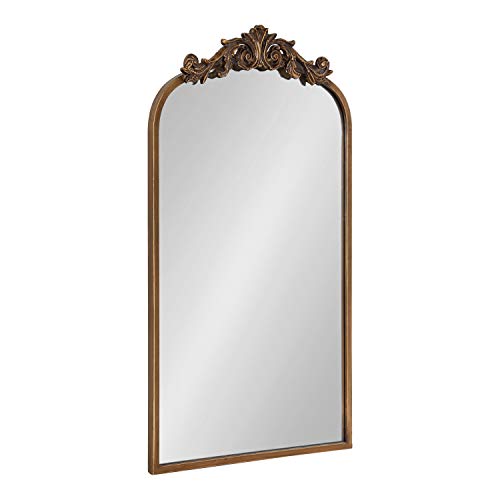
| Arched wall mirror | Making small rooms feel larger | 24 x 36 in to 30 x 60 in | Metal, wood or frameless | 10 to 30 lb | Mid-range |
| Sunburst mirror | Focal point over fireplace or sofa | 27 to 40 in diameter | Gilded wood, iron or resin rays | 8 to 25 lb | Mid to upper-mid |
| Rectangular framed mirror | Vanities, hallways, traditional rooms | 24 x 36 in to 36 x 48 in | Wood or composite | 12 to 35 lb | Budget to mid |
| Beveled frameless mirror | Bathrooms and minimalist rooms | 24 x 36 in to 30 x 40 in | Glass with polished bevel | 10 to 25 lb | Budget |
| Scalloped or organic-shaped mirror | Trendy accents and nurseries | 18 to 30 in | Wood, acrylic or metal | 3 to 12 lb | Budget to mid |
| Antiqued or vintage-look mirror | Traditional and eclectic spaces | 20 to 40 in | Distressed glass, ornate frame | 10 to 30 lb | Mid to premium |
Sizes and weights are typical ranges from manufacturer listings by brands such as Uttermost, Kate and Laurel and Howard Elliott. Check the exact specification and the mounting hardware before you buy.
Best overall: the round mirror with a slim frame
A round mirror in the 30 to 36 inch range is the easiest to place. The curved shape softens a room full of straight lines, and a thin black, brass or bronze frame suits both contemporary and traditional furniture. Hung over a console in an entry, it doubles as a last-look check before leaving.
Main trade-off: reflective area is smaller than a rectangle of the same width, and cheap versions use thin, easily bent frames. Look for a backing that supports the glass and a hanger rated above the weight.
Best for small rooms: arched mirrors
Tall arched mirrors, typically 24 to 30 inches wide and 48 to 60 inches high, draw the eye upward and bounce light around dark corners. Place them opposite a window to double the daylight in the room.
Main trade-off: they are heavy for their price, and a leaning mirror needs a wall anchor. Plan for secure fixing in homes with children and pets.
Best focal point: sunburst mirrors
Sunburst designs radiate rays from a center disc and look best above a fireplace, a sideboard or a bed. They work in mid-century, glam and boho rooms, and a gold or brass finish adds warmth.
Main trade-off: the mirror portion is small compared with the overall size, and the rays collect dust. They are art first, mirror second.
Best for traditional rooms: rectangular framed mirrors
A rectangular wood-framed mirror is the classic for hallways, dining rooms and over vanities. A horizontal orientation suits above a dresser, and vertical works in a narrow wall.
Main trade-off: they can look dated if the frame is overly ornate. Choose clean lines for a timeless result.
Best budget: beveled frameless mirrors
Frameless mirrors with a polished bevel catch light at the edges and fit minimalist bathrooms or dressing areas. They are usually the cheapest per square foot.
Main trade-off: edges are exposed, so moisture over time can cause black spots at the silvering. Use mirrors with sealed edges in humid rooms.
Where to hang a mirror for the best effect
- Opposite or beside a window, not directly facing it, to bounce daylight inward without glare.
- At eye level. The center should sit about 57 to 60 inches from the floor, unless it is a full-length leaner.
- Above furniture, 4 to 8 inches over a console, sideboard or vanity, and at about two-thirds of the furniture’s width.
- Away from clutter. A mirror doubles what it faces, so reflect a plant or art piece, not a messy corner.
- Check the view in the evening. Mirrors near lamps spread warm light, but reflect harsh bulbs too.
Worked example: sizing a mirror over a console
You have a 48-inch-wide console and want a round mirror above it. Two-thirds of 48 inches is 32 inches, so a 30 to 36 inch round mirror fits. If the console is 32 inches tall and the center of the mirror should be about 58 inches from the floor, a 32-inch mirror would have its bottom edge at 58 – 16 = 42 inches. That leaves 10 inches above the console, a little more than the 4 to 8 inch ideal, so lower the center to about 54 inches, which puts the bottom edge at 38 inches (6 inches above the console).
Weight and mounting
- Under 10 pounds: a strong picture hook or two screws in drywall anchors.
- 10 to 25 pounds: two hooks or D-rings into studs, or heavy-duty toggle anchors rated at least double the weight.
- Over 25 pounds: screw into studs or use a French cleat. Never rely on adhesive strips alone for glass.
Ownership and care realities
- Clean without soaking. Spray cleaner onto a microfiber cloth, not onto the mirror, so liquid does not seep behind the frame edge.
- Humidity damages silvering. Bathrooms need sealed-edge mirrors and good ventilation.
- Metal finishes can tarnish or scratch. Use a soft cloth, not abrasive pads.
- Shipping damage is common. Inspect the mirror on delivery and photograph any damage before disposing of packaging.
- Safety backing helps. Look for a safety film or backing that holds glass together if the mirror breaks.
Decision matrix
| Your situation | Choose |
|---|---|
| Entryway or console | Round slim-frame mirror, 30 to 36 in |
| Small or dark room | Tall arched mirror opposite a window |
| Fireplace or statement wall | Sunburst mirror |
| Traditional hallway or dining room | Rectangular wood-framed mirror |
| Bathroom on a budget | Beveled frameless mirror with sealed edges |
| Nursery or playful space | Lightweight scalloped or acrylic mirror |
Frequently Asked Questions
What size decorative mirror should I choose?
Pick a mirror about two-thirds the width of the furniture beneath it. For most consoles and sofas this means 30 to 36 inches for round mirrors or 24 to 30 inches wide for tall arched ones.
Do decorative mirrors make a room look bigger?
Yes. A mirror that reflects a window or a bright wall spreads light and adds visual depth. The effect is strongest with larger mirrors hung at eye level.
Can I hang a heavy mirror on drywall?
Only with proper hardware. Use studs for mirrors over 25 pounds, and toggle anchors rated for double the weight for lighter pieces. Avoid adhesive hooks for glass.
Where should I avoid hanging a mirror?
Avoid directly facing a window that creates glare, or a messy area you do not want doubled. Also avoid damp locations unless the mirror has sealed edges.
How do I clean a framed decorative mirror?
Dampen a microfiber cloth with glass cleaner and wipe the glass, then use a dry cloth for the frame. Keep liquids away from the edges so they do not seep behind the mirror.


Write Your Review
No reviews yet. Be the first to share your experience!