

Key takeaways
- 1/16 to 1/8 inch: best for small shrimp, peas, corn kernels, chopped garlic, and flaky fish pieces. The trade-off is slower browning and more residue.
- 1/8 to 1/4 inch: the most versatile range for sliced peppers, onions, mushrooms, asparagus, shrimp, and diced chicken.
- 1/4 to 3/8 inch: suitable for potato chunks, zucchini, broccoli, larger seafood, and substantial vegetable pieces.
- 3/8 to 1/2 inch: useful for thick-cut food when you want strong smoke exposure, but unsuitable for small or fragile ingredients.
Best Grill Baskets for Vegetables, Seafood, and More
The best grill basket for most cooks is a stainless-steel, flat-bottom basket with 1/8- to 1/4-inch perforations, a removable handle, and enough surface area to hold food in one layer without crowding.
That recommendation changes with the food and grill. Delicate fish needs smaller openings and a rigid, shallow basket; vegetables benefit from larger perforations and deeper sides; a compact portable grill needs a basket that fits the grate rather than the largest capacity available. The right choice is less about finding one “best” shape and more about matching the basket to heat, food size, and how often you grill.
Our top picks


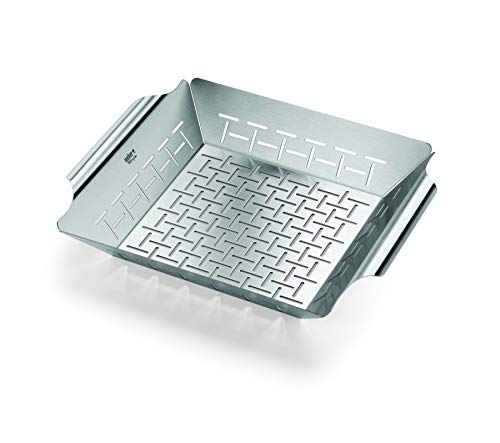

As an Amazon Associate we earn from qualifying purchases at no extra cost to you. Ratings are shown as listed on Amazon.
Quick comparison: which basket fits your cooking?
| Basket type | Best for | Typical dimensions | Perforation size | Approximate capacity | Main compromise |
|---|---|---|---|---|---|
| Shallow stainless-steel tray | Vegetables, shrimp, sliced meat | 12 x 9 x 1.5 inches | 1/8-1/4 inch | 3-5 servings | Can spill when shaken |
| Deep perforated basket | Large vegetable pieces, wings, potatoes | 13 x 10 x 3 inches | 1/4-3/8 inch | 4-6 servings | Requires more stirring for even browning |
| Fine-hole seafood basket | Small shrimp, scallops, flaky fish | 11 x 8 x 1.5 inches | 1/16-1/8 inch | 2-4 servings | May restrict smoke and airflow |
| Wok-style grill basket | Stir-fry vegetables and high-volume batches | 13-14 inches wide, 3-4 inches deep | 1/4-1/2 inch | 5-8 servings | Needs a wide grill and frequent tossing |
| Foldable wire basket | Portable grills, camping, small portions | 10-12 x 7-9 inches | 1/4-1/2 inch | 2-4 servings | Often less rigid and harder to clean |
These are useful buying targets rather than universal specifications. Actual capacity depends on whether food is spread in a single layer. For browning, plan on roughly 2 to 2.5 square inches of basket surface per serving of chopped vegetables or seafood.
Material: stainless steel is the safest all-purpose choice
Stainless steel
Stainless steel is the best default for frequent grilling because it tolerates high heat, does not require seasoning, and resists rust when washed and dried properly. Look for a rigid frame, welded seams, and metal that does not flex noticeably when lifted. A basket made from 18/8 or 18/10 stainless steel is generally a sound choice, although the construction matters as much as the alloy label.
Stainless steel will discolor, develop baked-on oil, and show heat marks. Those changes are cosmetic. The parts more likely to fail are thin welded joints, sharp unfinished edges, and handles that loosen after repeated heating.
Nonstick-coated metal
Nonstick baskets release marinated food more easily and can be simpler to wipe clean. They are useful for low-to-moderate heat cooking and delicate foods, but the coating is the ownership risk. Metal utensils, abrasive scouring pads, grill brushes, and direct contact with very hot burners can shorten its life.
If you choose a coated basket, use silicone or wooden tools, avoid preheating it empty for long periods, and follow the manufacturer’s maximum-temperature instructions. Replace it if the surface is flaking or badly scratched rather than treating the coating as permanent.
Cast iron
Cast iron holds heat better than thin sheet metal and can give vegetables more powerful browning. It is also heavy, slower to cool, and dependent on seasoning. Cast-iron grill baskets make sense for a fixed outdoor grill and cooks who do not mind drying and lightly oiling the surface after washing. They are less practical for portable grills or anyone who wants quick cleanup.
Perforation size determines what stays in the basket
Large holes improve airflow and let more smoke reach the food, but small ingredients can fall through. Use this guide:
- 1/16 to 1/8 inch: best for small shrimp, peas, corn kernels, chopped garlic, and flaky fish pieces. The trade-off is slower browning and more residue.
- 1/8 to 1/4 inch: the most versatile range for sliced peppers, onions, mushrooms, asparagus, shrimp, and diced chicken.
- 1/4 to 3/8 inch: suitable for potato chunks, zucchini, broccoli, larger seafood, and substantial vegetable pieces.
- 3/8 to 1/2 inch: useful for thick-cut food when you want strong smoke exposure, but unsuitable for small or fragile ingredients.
Perforation pattern matters too. Round holes are easy to manufacture and clean, while elongated slots can provide generous airflow but may allow narrow pieces to escape. A basket with a solid rim is helpful because it contains oil and makes tossing safer.
Handle design matters more than it appears
A fixed handle gives the best control when you are tossing food, but it can consume valuable grate space and may extend toward the grill lid. A removable handle allows the basket to sit flat and makes storage easier. The disadvantage is that a detachable connection can become hot, awkward, or loose if it is poorly designed.
For a lidded gas or charcoal grill, measure the distance from the cooking grate to the closed lid. A basket that is 3 inches deep may fit on the grate but prevent the lid from closing once food is added. For a portable grill, check both the grate width and the handle clearance; a basket that is 12 inches wide may leave too little room for indirect heat.
Prefer a handle with a positive locking mechanism rather than a friction-fit loop. Keep an insulated glove nearby even when the handle is advertised as heat resistant: metal transfers heat quickly, and removable handles can become hot while sitting over the fire.
Best choices by grilling situation
- For a first basket: choose a 12 x 9-inch stainless-steel tray, 1/8- to 1/4-inch holes, a rolled rim, and a removable locking handle.
- For vegetables: choose a 2- to 3-inch-deep basket if you want to toss food, but do not fill it more than halfway. A shallow tray browns more evenly.
- For seafood: choose a shallow basket with fine perforations and a smooth, rigid base. Smaller holes help retain shrimp and protect delicate pieces as they are turned.
- For charcoal cooking: choose stainless steel with a sturdy frame and moderate holes. The basket should tolerate vigorous shaking and direct radiant heat.
- For a gas grill: choose a basket that leaves room for a separate burner zone. Avoid covering the entire grate, since you may need a cooler area to finish food.
- For a small or portable grill: prioritize exterior dimensions and a folding or removable handle over capacity. A 10- to 11-inch basket is usually easier to position than a full-size wok basket.
- For frequent use: buy the thickest rigid stainless-steel construction that fits your grill. Spending roughly $20-$50 for a well-built basket is often more sensible than replacing a thin one every season.
How much food should a basket hold?
Do not size a basket by its maximum volume alone. A deep 4-quart basket may technically hold a large batch, but crowded food steams instead of browning. For a practical calculation, a 12 x 9-inch tray provides 108 square inches. At approximately 2.25 square inches per serving, it has enough surface area for about 4 servings when food is distributed in one layer.
If you are cooking for six people, use a larger 14 x 10-inch basket, which provides 140 square inches, or cook in two batches. The second option often produces better results because vegetables remain exposed to hot air rather than sitting in their own moisture.
Cleaning and durability: what ownership is really like
Clean the basket while residue is still warm, but let it cool enough to handle safely. Scrape away softened food with a wooden or plastic tool, soak stainless steel in hot water with dish soap, and use a nylon pad for stubborn areas. Dry it completely before storage, especially around spot-welded seams and folded edges.
For stainless steel, a paste of baking soda and water can loosen carbonized oil. Avoid chlorine bleach and harsh oven-cleaner chemicals unless the manufacturer specifically permits them. A dishwasher may be convenient, but repeated cycles can dull finishes, leave food trapped in seams, and accelerate corrosion in lower-quality metal.
Inspect the basket before each season. Stop using it if the frame is cracked, the base has warped enough to tip, or a coating is peeling. Do not rely on a basket with a loose handle over an open flame. These failures are more important than surface discoloration.
Common buying mistakes
- Choosing holes that are too large for shrimp, sliced mushrooms, or small vegetables.
- Buying a deep basket and filling it to the rim, which prevents browning.
- Ignoring lid clearance on a kettle, kamado, or compact gas grill.
- Selecting a permanently attached handle that blocks neighboring cooking space.
- Assuming “dishwasher safe” means baked-on oil will remove itself.
- Using cooking spray directly over an active flame, where aerosol can ignite.
For the broadest range of foods, select a rigid stainless-steel basket around 12 x 9 inches with medium-size perforations and a removable locking handle. Add a fine-hole seafood basket if you regularly cook small or delicate ingredients, or choose a deeper wok-style model only when your grill has the width and lid clearance to use it safely.





Write Your Review
No reviews yet. Be the first to share your experience!