

Key takeaways
- Choose wood for: dining rooms, breakfast areas, kitchens, and tables where the caddy stays in one location.
- Prioritize: sealed joints, stainless-steel or coated hardware, a removable bottom insert, and non-slip feet.
- Avoid: raw wood, deeply grooved dividers, and permanently attached fabric liners that retain sauce.
Best Condiment Caddy for Table: Wood, Metal & Ceramic
The best condiment caddy for table use is a powder-coated metal caddy for outdoor entertaining, a sealed wood caddy for everyday indoor meals, or a ceramic caddy when appearance and easy washing matter more than portability.
The right choice depends less on the number of sauce bottles you own than on four practical details: how many containers must fit, whether the caddy needs to travel, how easily its finish can be cleaned, and whether it will live on a dining table or outside. A compact two-compartment holder is enough for salt and pepper, while a family barbecue usually needs four to six compartments and a strong handle.
Our top picks


As an Amazon Associate we earn from qualifying purchases at no extra cost to you. Ratings are shown as listed on Amazon.
Quick comparison: wood, metal, and ceramic
The figures below describe typical dimensions and capacities for tabletop condiment caddies available in 2026. Actual measurements vary by design, so measure your largest bottle before buying.
| Material | Typical capacity | Typical size | Approx. weight | Best use | Main drawback |
|---|---|---|---|---|---|
| Sealed wood | 4 compartments; 250–400 ml each | 25 × 16 × 20 cm | 0.7–1.2 kg | Indoor dining and rustic tables | Needs prompt drying; finish can wear |
| Powder-coated metal | 4–6 compartments; 300–600 ml each | 28 × 18 × 22 cm | 0.8–1.6 kg | Patios, picnics, and frequent carrying | Can dent or develop rust at damaged edges |
| Ceramic | 2–4 compartments; 150–350 ml each | 24 × 14 × 17 cm | 1.5–2.8 kg | Decorative indoor serving | Heavy and vulnerable to chips or breaks |
| Plastic or resin | 4–6 compartments; 250–600 ml each | 27 × 17 × 21 cm | 0.4–0.9 kg | Low-cost outdoor use | May stain, fade, or feel less substantial |
Best choice by dining situation
| Your situation | Recommended type | Why it fits | Look for |
|---|---|---|---|
| Two to four people indoors | Sealed wood | Warm appearance and moderate capacity without visual clutter | Removable liner, 10–12 cm handle clearance, water-resistant finish |
| Large family meals | Metal, four to six compartments | Holds more bottles and tolerates repeated handling | Wide base, reinforced handle, compartments at least 8 cm wide |
| Patio or picnic service | Powder-coated metal or resin | Less worrying around spills and easier to carry in one trip | Rust-resistant coating, drainage, non-slip feet |
| Formal or decorative table | Ceramic | Looks like part of the table setting rather than storage | Glazed interior, broad base, dishwasher-safe labeling |
| Limited table space | Vertical two- or three-compartment caddy | Uses less surface area than a wide tray | Footprint under 25 × 15 cm and a low center of gravity |
What capacity do you actually need?
Count containers, not ingredients. A household might use salt, pepper, ketchup, mustard, hot sauce, and napkins, but those items may have very different shapes. A caddy with six narrow compartments is not necessarily more useful than one with four roomy compartments.
As a sizing rule, allow about 8–10 cm of width per standard squeeze bottle and 6–7 cm per shaker. For six mixed containers, a practical internal capacity is approximately 2,000–2,500 cubic centimeters. For example, four compartments measuring 9 cm wide, 10 cm deep, and 12 cm high provide:
4 × 9 × 10 × 12 = 4,320 cubic centimeters of nominal space.
That does not mean the caddy will hold 4.32 liters of usable contents. Dividers, rounded corners, and the need to lift bottles out reduce practical capacity. A better expectation is roughly half to two-thirds of the calculated volume, or about 2.2–2.9 liters in this example. Leave clearance above each bottle so you can grip it without removing neighboring items.
Wood caddies: the best indoor balance
Wood is usually the strongest choice for an everyday dining table because it combines a stable base with a softer visual presence than metal. Bamboo, beech, acacia, and rubberwood are common choices. The species matters less than the finish: a sealed surface with rounded corners is easier to wipe than unfinished wood with visible open grain.
- Choose wood for: dining rooms, breakfast areas, kitchens, and tables where the caddy stays in one location.
- Prioritize: sealed joints, stainless-steel or coated hardware, a removable bottom insert, and non-slip feet.
- Avoid: raw wood, deeply grooved dividers, and permanently attached fabric liners that retain sauce.
The first parts to wear are usually the bottom edges and the finish around the handle, where greasy hands repeatedly touch the surface. Wipe spills promptly with a damp cloth, then dry the caddy rather than soaking it. Do not assume a wood caddy is dishwasher-safe; prolonged heat and water can swell joints or dull the sealant.
Metal caddies: the portable outdoor winner
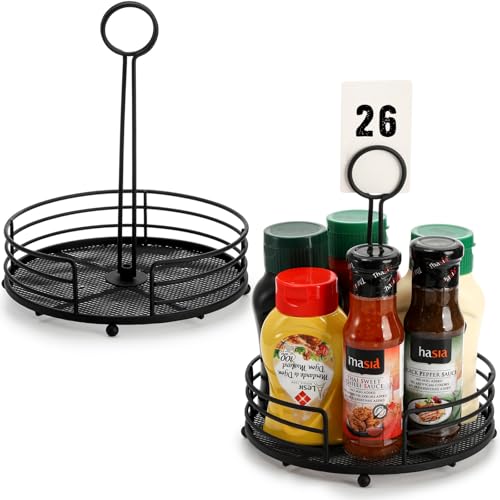
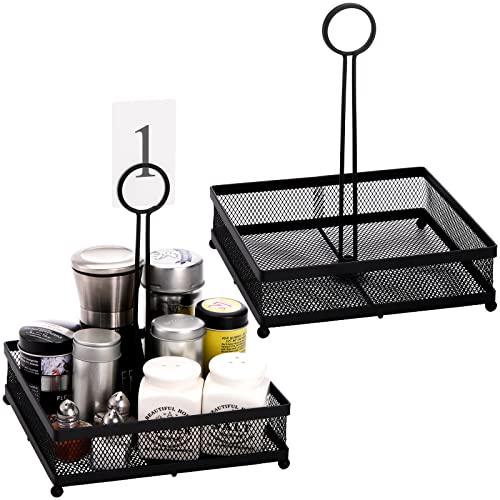
Metal is the most practical option when the caddy must move from kitchen to patio, buffet, or picnic table. Steel provides a heavier, more stable feel, while aluminum is lighter and easier to carry. A powder-coated finish hides fingerprints and protects the base metal, but it is not invulnerable.
Inspect the handle attachment before buying. A handle fixed with two sturdy fasteners on each side is preferable to a thin handle spot-welded at one point. The handle should remain comfortable when the caddy is loaded with 2–4 kg of bottles. A wide base and rubber feet also reduce sliding when a table is bumped.
For outdoor use, drainage is more important than many listings suggest. Small drainage holes prevent rainwater or spilled drinks from pooling, but they should be positioned where liquid will not run onto the table. After outdoor use, empty the caddy, rinse away salt or sugary residue, and dry the underside. Scratches through the coating are the most likely starting point for rust.
Ceramic caddies: attractive, washable, and heavy
Ceramic works well when the caddy is part of a coordinated place setting. Glazed ceramic resists sauce stains and generally wipes clean with little effort. Some pieces are dishwasher-safe, but check the manufacturer’s care instructions because metallic decoration and hairline cracks may make machine washing unsuitable.
The trade-off is weight. A ceramic caddy that weighs 2 kg empty can become awkward or unsafe when filled with glass jars. It is best kept in one place, especially on glass or delicate tables. Look for a broad footprint, smooth underside, and a handle integrated into the body rather than a narrow attached loop.
Features that make a caddy easier to live with
Compartment shape
Square compartments use space efficiently, but rounded or tapered compartments are easier to wipe. Removable dividers are useful if you alternate between shakers and tall bottles. Fixed dividers are sturdier, though they restrict future arrangements.
Handle clearance
A handle is useful only if your fingers fit under it while the caddy is loaded. Aim for at least 8 cm of clearance and about 2.5–4 cm of grip width. Handles that fold flat save storage space, but check that the hinge does not pinch fingers or rattle.
Feet and table protection
Silicone or rubber feet prevent sliding and protect polished surfaces. Felt can work indoors but absorbs spills and is less suitable for patios. A continuous non-slip base is more stable than four tiny pads, although it can trap moisture underneath if the caddy is not dried.
Finish and cleaning
For the easiest maintenance, choose glazed ceramic, powder-coated metal, or sealed wood with a smooth interior. Avoid porous stone, unfinished timber, and woven fabric pockets if the caddy will hold ketchup, oil, or barbecue sauce. A removable tray or liner can reduce cleaning time, provided it has no deep seams.
Common buying mistakes
- Measuring the caddy externally: exterior dimensions include walls and dividers. Compare the internal compartment width with your largest bottle.
- Choosing maximum capacity over stability: a tall, narrow caddy may hold more but can tip when one side is emptied.
- Ignoring loaded weight: six glass bottles can make a lightweight holder uncomfortable to carry.
- Using indoor wood outdoors: moisture and direct sun can discolor or warp an untreated finish.
- Assuming “easy clean” means dishwasher-safe: confirm care instructions for the exact material and construction.
Bottom line
For most indoor dining tables, choose a sealed wood caddy with four compartments and a stable handle. For outdoor entertaining or frequent movement, choose a powder-coated metal model with four to six compartments, drainage, and non-slip feet. Select ceramic when presentation and wipe-clean glazing matter more than weight. Whichever material you choose, prioritize usable compartment width, a secure handle, and a finish that matches the mess and moisture your table actually encounters.



Write Your Review
No reviews yet. Be the first to share your experience!