

Key takeaways
- Buy a 9-inch rattan basket if you want one versatile, traditional option and your dough is moderately hydrated. Choose silicone when easy release and washing matter more than a patterned crust. Choose wood pulp when you want a subtle finish, dependable flour adhesion, and a…
Best Bread Proofing Baskets for Bakery-Perfect Loaves
The best bread proofing baskets for most home bakers are 9-inch rattan baskets for round loaves, while silicone is the easiest option for very sticky dough and wood pulp is the best compromise between a smooth finish and traditional basket handling.
Quick comparison: rattan vs silicone vs wood pulp
| Basket type | Typical weight | Pattern transfer | Sticky-dough performance | Care | Best for |
|---|---|---|---|---|---|
| Rattan | 250–450 g | Distinct rings or ridges | Good with flour; poor if heavily wet | Dry brush and air-dry only | Traditional sourdough and decorative loaves |
| Silicone | 300–650 g | Minimal; usually smooth | Very good, especially at 75–85% hydration | Washable with mild soap; dry thoroughly | Beginners and high-hydration dough |
| Wood pulp | 350–700 g | Fine, shallow texture | Better than rattan because dough releases from a smoother surface | Brush clean; occasional careful hand-washing | Clean scoring and lower-maintenance shaping |
These weights and performance differences vary with basket shape, liner, rim thickness, and manufacturer. The material matters, but the interior dimensions and your dough formula matter more than the label.
Our top picks


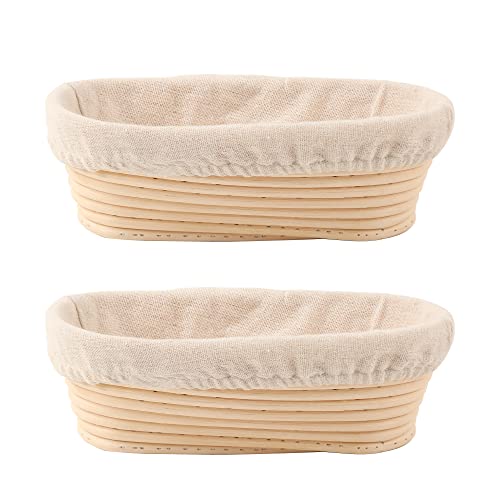
As an Amazon Associate we earn from qualifying purchases at no extra cost to you. Ratings are shown as listed on Amazon.
Choose the right size: 8, 9, or 10 inches
Basket diameter describes the opening, not the finished loaf. A round loaf expands outward and upward during proofing, so the same basket can produce very different results depending on dough weight and hydration.
| Basket size | Useful dough weight | Approximate flour amount | Best use | Main risk |
|---|---|---|---|---|
| 8 inch | 500–700 g | 350–500 g | Small boules and compact refrigerators | Overfilling can cause a tall, mushroom-shaped loaf |
| 9 inch | 700–950 g | 500–675 g | Everyday one-loaf baking | Underfilled dough can spread and bake low |
| 10 inch | 950–1,300 g | 675–900 g | Large loaves or generous family portions | Requires a large Dutch oven and more refrigerator space |
A practical sizing calculation is to multiply your total dough weight by about 1.15 to 1.30 when comparing it with a basket’s nominal capacity. For example, a 900 g dough containing 600 g flour is usually a comfortable fit for a 9-inch basket, but the same dough may be too large for an 8-inch basket. Very wet dough needs the smaller end of each weight range because it spreads more easily.
When an 8-inch basket is the better choice
Choose 8 inches for smaller formulas, single servings, or a compact refrigerator. It is also useful when you prefer a higher, narrower loaf. Do not force a 750–800 g dough into it simply because the dough fits before proofing; expansion can make unmolding difficult and leave the loaf pressed tightly against the basket walls.
Why 9 inches is the safest default
A 9-inch basket suits many standard formulas using 500–650 g of flour. It gives enough room for overnight proofing without requiring an unusually large baking vessel. If you are buying only one basket, this is generally the most versatile size for round sourdough and yeasted hearth loaves.
Who needs a 10-inch basket
A 10-inch basket is worthwhile for large loaves, high-volume baking, or doughs made with substantial whole-grain additions. Check the basket’s base diameter as well as its top diameter: a wide opening with a narrow base can create a taller loaf than expected.
Head-to-head: which material handles your dough?
Rattan: best for a traditional ridged finish
Rattan baskets leave the strongest visual pattern. Their coils encourage the dough to support itself, and the ridges can produce the classic spiral or ringed surface associated with artisan bread. They are light, stackable, and usually available at moderate market prices, commonly around $15–$35 for a single basket depending on size and accessories.
The drawback is that wet dough can press into the gaps between coils. Excessive flour may hide the pattern but still fail to prevent sticking, particularly when the dough contains little wheat gluten or has been proofed too long. Rattan is also less forgiving of careless cleaning. Soaking can swell the fibers, loosen the weave, and extend drying time.
Silicone: the practical choice for sticky dough
Silicone baskets or silicone-lined proofing bowls release wet dough more reliably than exposed woven baskets. They are especially useful for dough above roughly 75% hydration, dough enriched with oils or syrups, and formulas that are difficult to shape tightly. Most have a smooth interior, so the baked loaf receives little or no basket pattern.
Silicone is easier to wash, but “washable” does not mean “maintenance-free.” Fat can leave a film, and trapped moisture around a rigid rim or seam can create odors. Use mild dish soap, rinse completely, and dry the basket open rather than storing it folded while damp. Avoid sharp tools, abrasive scouring pads, and direct contact with a hot oven.
Wood pulp: best for a smooth, flour-friendly release
Wood pulp baskets have a compressed, porous surface that absorbs a small amount of surface moisture while remaining smoother than coarse rattan. They typically transfer a subtle texture rather than deep rings. This makes them attractive when you want a clean canvas for scoring, flour stenciling, or a simple rustic finish.
They are not waterproof. Treat them more like a wooden utensil than a plastic bowl: brush off dried flour, remove dough with a soft scraper, and let the basket dry fully. Occasional hand-washing may be acceptable if the manufacturer allows it, but repeated soaking can warp the form and shorten its life. Typical market pricing is around $20–$45, with larger or bundled sets costing more.
Decision matrix for common baking situations
| Your situation | Recommended choice | Why |
|---|---|---|
| First basket, one loaf at a time | 9-inch rattan | Broad compatibility, low cost, and useful pattern transfer |
| Very sticky or high-hydration dough | 9-inch silicone | Most forgiving release and simplest cleanup |
| Frequent baker using a well-developed dough | 9-inch or 10-inch rattan | Good support, airflow, and repeatable decorative ridges |
| Small kitchen or small loaves | 8-inch wood pulp or rattan | Uses less storage space and suits 500–700 g doughs |
| Clean scoring and subtle texture | Wood pulp | Less pronounced pattern than woven rattan |
| Several loaves each week | Two matching 9-inch baskets | Lets you proof a second loaf while the first bakes |
How to prevent sticking with any basket
-
Match the flour to the dough. Rice flour or a rice-and-wheat-flour blend generally remains more resistant to moisture than wheat flour alone. Use a light, even coating rather than a thick layer that can cake onto the crust.
-
Dust the basket just before shaping. A basket left coated for days can absorb humidity, reducing the benefit of the flour.
-
Build surface tension. Proper shaping keeps the dough from spreading into every groove. A slack dough will challenge even a well-dusted basket.
-
Watch proofing time. Overproofed dough becomes fragile and sticky. If the indentation from a gentle fingertip press remains and the dough feels very soft, bake promptly rather than waiting for more volume.
-
Invert decisively. Place parchment or a peel over the basket, turn it over in one controlled motion, and lift the basket vertically. Repeated shaking can tear the dough skin.
Care and durability: what wears out first?
For rattan, the first problems are usually broken coils, a distorted rim, or flour and dough accumulating in the weave. For silicone, scratches, persistent greasy residue, and stretched edges are the common failure points. For wood pulp, warping and softened corners indicate too much water exposure. None of these baskets should go in a dishwasher unless the specific product instructions explicitly permit it.
After each use, remove loose flour with a dry brush. Let any remaining dough dry completely before brushing again; trying to scrub wet dough deeper into a rattan or wood-pulp surface makes the problem worse. Store baskets where air can circulate. If you bake several times weekly, owning two baskets is often more useful than buying one premium basket: at a $25 basket used twice weekly for two years, the cost is about $0.24 per use.
Bottom line
Buy a 9-inch rattan basket if you want one versatile, traditional option and your dough is moderately hydrated. Choose silicone when easy release and washing matter more than a patterned crust. Choose wood pulp when you want a subtle finish, dependable flour adhesion, and a smoother interior than woven rattan. Move to 8 inches for smaller loaves and limited storage, or 10 inches for large formulas—but confirm both dough weight and baking-vessel capacity before ordering.



Write Your Review
No reviews yet. Be the first to share your experience!