

Key takeaways
- The best low profile jack for most home garages is the Sunex 6602LP if you need a genuinely low 2.75-inch entry height and a long 24-inch maximum lift; choose a compact aluminum racing jack for portability, or a 3-ton steel…
The best low profile jack for most home garages is the Sunex 6602LP if you need a genuinely low 2.75-inch entry height and a long 24-inch maximum lift; choose a compact aluminum racing jack for portability, or a 3-ton steel model when vehicle weight and stability matter more than carrying weight.
Our top picks

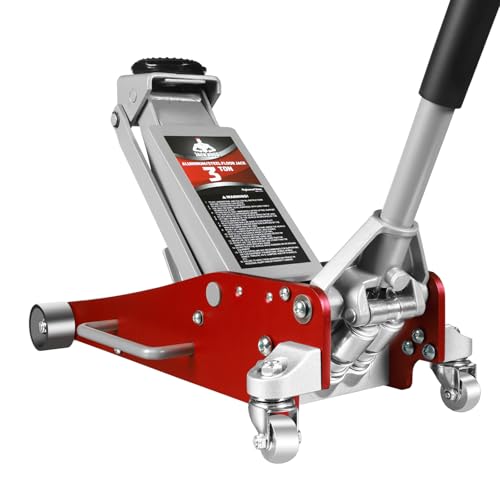


As an Amazon Associate we earn from qualifying purchases at no extra cost to you. Ratings are shown as listed on Amazon.
Best low profile jacks at a glance
| Jack | Capacity | Minimum lift | Maximum lift | Approx. weight | Best use |
|---|---|---|---|---|---|
| Sunex 6602LP | 2 tons | 2.75 in | 24 in | 103 lb | Low cars and maximum working height |
| Daytona 1.5 Ton Professional Racing Jack | 1.5 tons | 2.75 in | 15.875 in | 34 lb | Portable track or home use |
| Daytona 3 Ton Long-Reach Low-Profile Jack | 3 tons | 3.125 in | 24 in | 95 lb | Heavy vehicles and deep-set lift points |
| Torin Blackjack T83006 | 3 tons | 3.125 in | 19.75 in | 58 lb | Lower-cost general garage work |
Published dimensions can change with production revisions, and some sellers round measurements differently. Treat these figures as a comparison starting point, then confirm the specification label or manual before buying.
How the leading choices compare
Sunex 6602LP: best overall reach for tight clearances
The Sunex 6602LP combines a 2.75-inch minimum saddle height with a 24-inch maximum lift. That range is unusually useful: it can slide under many lowered cars while still reaching chassis lift points on crossovers and taller vehicles. Its 2-ton rating is suitable for lifting one end of many passenger vehicles, but it is not a reason to lift the entire vehicle at once.
Its trade-off is portability. At roughly 103 pounds, this is a shop-style steel jack rather than something most people want to load into a small car. The long frame improves reach and access, but it also needs more clear floor space and may be awkward in a narrow garage.
Daytona 1.5 Ton Professional Racing Jack: best portable option
A lightweight aluminum racing jack is the better choice when the jack must move frequently. The Daytona 1.5-ton model weighs about 34 pounds and reaches a 2.75-inch minimum height, making it easy to carry to track events or reposition around a crowded garage.
The limitation is its 15.875-inch maximum lift. That is enough for many brake, wheel, and suspension jobs, but it may not provide as much working room as a long-reach 3-ton jack. Its 1.5-ton capacity also demands more careful vehicle selection. Check the vehicle’s curb weight and lift only the end required for the job.
Daytona 3 Ton Long-Reach Low-Profile Jack: best for heavy vehicles
The 3-ton long-reach model is a strong fit for full-size cars, light trucks, and SUVs when a compact racing jack feels marginal. Its approximately 3.125-inch minimum height is still low enough for many standard vehicles, while the 24-inch maximum lift gives substantial access.
The extra capacity does not make unsafe lifting acceptable. A jack rating applies to the load it is designed to lift under specified conditions, not to a complete vehicle suspended indefinitely. Use correctly rated jack stands on solid, level ground after lifting.
Torin Blackjack T83006: best lower-cost general-purpose choice
The Torin Blackjack T83006 offers a 3-ton rating, a 3.125-inch minimum height, and approximately 19.75 inches of maximum lift. Its roughly 58-pound weight makes it easier to handle than the heaviest long-reach models.
It is a sensible compromise for routine tire, brake, and maintenance work, especially when the vehicle is not extremely low. However, its minimum height is about three-eighths of an inch higher than the lowest options. That difference can determine whether the saddle clears a low pinch weld or front subframe.
Decision matrix: choose by situation
| Your situation | What matters most | Best fit | Why |
|---|---|---|---|
| Lowered car under 3 inches of clearance | Minimum lift and saddle access | 2.75-inch racing or low-profile jack | Every fraction of an inch helps; measure the actual lift point |
| One jack for cars and SUVs | Capacity and maximum lift | 3-ton long-reach model | More working range and a larger safety margin for heavier vehicles |
| Track days or frequent transport | Weight and portability | 1.5-ton aluminum racing jack | About one-third the weight of a heavy steel shop jack |
| Occasional brake work on a normal car | Price, stability, and adequate lift | 3-ton general-purpose low-profile jack | Good capacity without paying for extreme low clearance |
| Narrow garage | Chassis width and turning room | Shorter, lighter floor jack | Long-reach frames can be difficult to position and store |
What the specifications really mean
Minimum lift height
Measure from the floor to the lowest point of the vehicle’s intended lift location, not to the lowest point of the bumper or rocker panel. A low bumper may clear the jack while the actual subframe does not. Leave practical room for uneven concrete, a rubber saddle pad, and the jack’s approach angle.
For example, if the lift point measures 3.2 inches from the floor, a jack advertised at 3.125 inches may technically fit but leave almost no margin. A 2.75-inch jack provides 0.45 inches of nominal clearance before adding a pad. That is a much more usable fit.
Maximum lift height
Maximum height determines whether you can remove a wheel, place a stand correctly, or create enough suspension droop for a repair. A high maximum lift is not automatically better: it often comes with a longer frame, greater weight, and a larger storage footprint.
Capacity
For a vehicle weighing 4,000 pounds, lifting one end theoretically places about 2,000 pounds on the jack if the weight distribution is perfectly even. Real vehicles are not perfectly balanced, and the load shifts as a wheel leaves the ground. Capacity should therefore exceed the expected end load by a comfortable margin.
Never use a floor jack as the only support while working underneath a vehicle. Chock the wheels that remain on the ground, lift from the manufacturer’s approved point, and lower the vehicle onto properly rated stands.
Saddle size and chassis clearance
A larger saddle spreads force more effectively but can be harder to place on a narrow reinforced pad. A small saddle may fit between exhaust components or under a designated notch, but it concentrates force and may damage a thin seam if positioned incorrectly. A removable rubber pad is useful, provided it does not make the jack too tall or conceal the approved contact point.
Pump speed
Two-stage pumps raise the saddle quickly through the empty space, then switch to shorter strokes under load. This matters during repeated wheel changes, but pump speed should not outweigh fit, stability, and serviceability. A fast jack that cannot reach the lift point is the wrong jack.
Portability, chassis design, and ownership costs
Aluminum racing jacks are easier to carry, but many use smaller wheels and a shorter frame than heavy steel shop jacks. Steel models usually feel more planted and tolerate routine garage abuse better, at the cost of lifting effort and storage space. Low-profile jacks with long noses can reach recessed chassis points, although they require a clear path under the vehicle.
Expect wear first at the caster wheels, front rollers, saddle pad, release-valve seals, and hydraulic seals. Dirt on the wheels increases rolling resistance, while a damaged saddle pad can scratch or slip against a lift point. Replacement seals and wheels may be available for established brands, but check parts support before buying an inexpensive unbranded jack.
Setup and maintenance that prevent common failures
-
Inspect before each use. Look for hydraulic leaks, bent arms, cracked welds, loose wheel hardware, and a missing saddle-retaining clip.
-
Use a clean, level surface. Soft asphalt, gravel, sloped driveways, and broken concrete can let the wheels shift or sink.
-
Test the fit unloaded. Roll the jack into position before pumping. Confirm that the saddle contacts the reinforced lift point rather than a thin floor panel.
-
Keep the chassis clean. Wipe the ram and pivot points, and lubricate manufacturer-designated joints. Do not coat the hydraulic piston with abrasive grease that attracts grit.
-
Lower slowly and store correctly. Fully retract the ram when stored, unless the manual specifies otherwise. Keep the handle and release mechanism protected from impact.
For most home users, the buying decision comes down to one measurement: the height of the actual lift point. If it is comfortably above 3.125 inches, a 3-ton general-purpose jack is often the most balanced purchase. If it is near or below that threshold, select a 2.75-inch model and verify the saddle shape. Choose the lightweight 1.5-ton racing jack when portability is central, and choose the Sunex 6602LP or a comparable long-reach model when maximum lift and chassis access matter more than easy storage.





Write Your Review
No reviews yet. Be the first to share your experience!