

Key takeaways
- Handling: dragging a branch across flooring or repeatedly bending the same tip removes more flocking than careful shaping.
- Storage pressure: compressing branches tightly in a small box creates friction and flattened patches.
- Moisture: damp storage can stain the coating, weaken cardboard packaging, and encourage musty odors.
The best flocked Christmas trees for cozy rooms are usually 6.5- to 7.5-foot models with hinged branches, moderate-to-heavy flocking, and a narrow or pencil profile that gives you snowy character without overwhelming the room.
Choosing well is less about finding the whitest tree and more about matching height, branch density, shedding tolerance, setup time, and storage space to the way you use your room. A dense 9-foot tree may look impressive in a large open-plan space, while a slim 6.5-foot tree can create the same festive effect in a bedroom, apartment, or small living room.
Our top picks
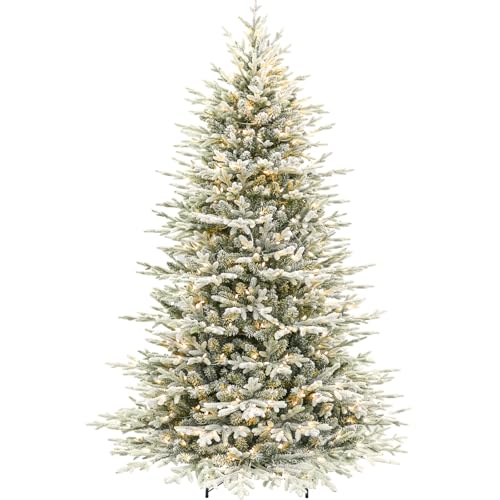


As an Amazon Associate we earn from qualifying purchases at no extra cost to you. Ratings are shown as listed on Amazon.
Best flocked Christmas trees by situation
| Room or priority | Best choice | Recommended size | Why it works | Main compromise |
|---|---|---|---|---|
| Small apartment or bedroom | Slim or pencil flocked tree | 5–6.5 ft; 24–34 in wide | Uses little floor space and needs less decoration | Less visual fullness from the side |
| Typical living room | Full-profile hinged tree | 6.5–7.5 ft; 40–55 in wide | Balances presence, stability, and manageable storage | Requires a clear area of roughly 4–5 ft diameter |
| Large room with high ceilings | Dense full-profile tree | 8–9 ft; 50–65 in wide | Fills vertical space and supports heavier ornaments | More expensive, heavier, and harder to store |
| Frequent setup and takedown | Pre-lit hinged artificial tree | 6.5–7.5 ft | Fewer loose parts and faster annual assembly | Integrated lights can be difficult to repair if sections fail |
| Minimal shedding | Lightly flocked molded-tip tree | Any height | Usually leaves less loose powder than heavily flocked PVC foliage | Snow effect is subtler and less rustic |
Our top picks by tree design
Best overall: a 7-foot, full-profile hinged flocked tree
For most homes, a 7-foot tree with a 45- to 55-inch maximum diameter is the safest choice. It looks substantial beside a sofa without demanding the clearance of a larger model, and its height works beneath the common 8-foot ceiling once you allow room for a stand and topper.
Look for a mix of hinged branches and sturdy metal center poles. Hinged construction keeps branches attached to the correct section, reducing assembly errors. A good branch structure should include dense interior tips for hiding the trunk, plus flexible outer tips that can be shaped around ornaments. National Tree Company and King of Christmas both offer flocked artificial tree ranges in this general format, although exact branch construction and lighting options vary by model.
Best for small rooms: a slim flocked tree
A slim tree is the better buy when the available floor area is more important than maximum fullness. A 6.5-foot model that is 28 to 36 inches wide can fit beside a media console or in a narrow corner where a conventional tree would obstruct walking space.
The trade-off is decoration depth. Slim trees have fewer long branches, so large ornaments can look crowded and the tree may appear sparse if it is decorated only around the front. Use smaller ornaments, concentrate heavier pieces near the trunk, and rotate the tree so its best side faces the room. A slim profile also tends to use less flocking material, making it a practical choice for anyone concerned about initial shedding.
Best for a traditional snowy look: a heavily flocked, dense tree
Choose heavy flocking when the snow effect is the main reason you are buying artificial rather than green foliage. Dense white coating gives the most convincing winter appearance from across the room and can make simple warm-white lights look brighter.
Heavy flocking does not automatically mean better quality. It can conceal the branch tips, reduce available ornament-hanging space, and shed more during the first setup. Examine close-up photographs for visible green gaps, especially near the lower branches. A dense tree with varied tip lengths generally looks more natural than a uniformly white tree with flat, fan-shaped branches.
Best for convenient setup: a pre-lit flocked tree
Pre-lit branches save time, particularly on a 7.5-foot or taller tree where string lights are difficult to distribute evenly. Section-to-section connectors should be clearly labeled, and the wiring should be routed close to the trunk rather than left exposed at branch joints.
The ownership drawback is electrical dependence. If a light section stops working, troubleshooting can take longer than replacing a removable string. For a pre-lit tree, confirm whether replacement bulbs, fuses, or light sections are available and whether the lighting is warm white, multicolor, or switchable. If you already own favorite lights, an unlit tree is more flexible and often easier to maintain for many seasons.
Flocking durability: what actually wears first?
Flocking is a paper- or fiber-based snow coating bonded to artificial needles. It is not paint, and some loose material is normal even on a well-made tree. The coating usually loses the most material at branch hinges, outer tips, and points where sections rub together during storage.
Durability depends on three practical factors:
- Handling: dragging a branch across flooring or repeatedly bending the same tip removes more flocking than careful shaping.
- Storage pressure: compressing branches tightly in a small box creates friction and flattened patches.
- Moisture: damp storage can stain the coating, weaken cardboard packaging, and encourage musty odors.
Expect the first setup to produce the most visible shedding. Wear a long-sleeved top, place a sheet beneath the tree, and shape branches before adding ornaments. Vacuum loose material with a soft brush attachment rather than wiping branches with a wet cloth. Water can dissolve or clump parts of the flocking and may damage lighting connections.
Height and room fit: measure before buying
Do not match tree height to ceiling height alone. Add the stand and topper to the advertised tree height, then leave several inches for a comfortable visual gap. A 7.5-foot tree can be too tall for an 8-foot room once a 10-inch topper and stand are included.
Use this simple calculation:
Available tree height = ceiling height − stand height − topper height − clearance.
For an 8-foot ceiling, a 4-inch stand, an 8-inch topper, and 6 inches of clearance, the available tree height is 78 inches, or 6.5 feet. In that room, a 6.5-foot tree is safer than a nominal 7.5-foot model.
Also measure the walking path. A 50-inch-wide tree needs about 25 inches of radius from its center, but furniture, curtains, and doors require additional clearance. If the tree will sit beside a sofa, a 36-inch slim model may preserve circulation while a 50-inch full tree makes the room feel blocked.
Assembly and storage comparison
| Tree format | Typical sections | Initial setup time | Approximate packed volume | Shedding expectation |
|---|---|---|---|---|
| 5–6.5 ft slim, unlit | 2–3 | 20–35 minutes | 3–5 cubic feet | Low to moderate |
| 6.5–7.5 ft full, unlit | 3–4 | 30–50 minutes | 5–8 cubic feet | Moderate |
| 7.5–9 ft dense, pre-lit | 3–4 | 35–60 minutes | 7–11 cubic feet | Moderate to high |
These are useful planning ranges rather than guarantees: branch count, stand design, lighting, and the compression of the storage carton can change the result. Before ordering, check whether the original box is intended for reuse. Many flocked trees are difficult to force back into their factory packaging after the branches have been fully shaped.
Common mistakes that reduce a tree’s lifespan
- Opening branches too aggressively: bend branch hinges gradually and shape individual tips with light pressure.
- Storing ornaments inside the tree: ornaments add pressure and can tear flocking or distort branches.
- Using a damp garage or attic: heat swings and humidity are harder on flocking and wiring than a dry indoor closet.
- Overloading outer tips: heavy glass ornaments pull down flexible tips and expose bare interior areas.
- Ignoring the stand: an undersized or uneven stand makes a tall, top-heavy tree less stable.
For storage, remove decorations first, then collapse branches in the reverse order of setup. Wrap each section loosely in an old sheet or breathable tree bag. Avoid airtight plastic if the tree may not be completely dry, and label the sections so next year’s assembly does not involve unnecessary handling.
Final buying recommendation
For the widest range of cozy rooms, choose a 6.5- to 7-foot full or slim flocked tree with hinged branches, a metal stand, and either unlit construction or replaceable light sections. Choose heavy flocking for a dramatic snowy style, but choose light or medium flocking if low shedding and easier maintenance matter more. Measure both ceiling height and floor diameter before purchasing; those two numbers will affect daily enjoyment more than an extra layer of artificial snow.





Write Your Review
No reviews yet. Be the first to share your experience!