

Key takeaways
- Plastic: Easy to wipe and usually affordable, but thin shelves can bow under a dense collection. Look for a reinforced underside and non-slip feet.
- Powder-coated steel: Strong and suitable for heavier jars. Inspect the coating for chips, especially around screw holes, where rust can begin.
- Bamboo or wood: Attractive and stable when sealed, but it should not be soaked. Wipe spills promptly and avoid storing it beside a steamy kettle.
- Acrylic: Keeps small jars visible and suits open shelving. It can scratch and may slide unless the base has rubber feet.
- Adhesive mounts: The adhesive is usually the first component to fail, particularly on dusty, textured, humid, or freshly painted surfaces.
The best tiered spice rack organizers for small kitchens are narrow, three-tier countertop risers for open storage, shallow pull-out shelves for cabinets, and adjustable or wall-mounted systems when your collection does not fit a fixed layout.
For most tight kitchens, choose a rack with 3.5–4.5 inch tiers, shelves at least 3.25 inches deep, and a total width that leaves roughly 1 inch of clearance inside the cabinet. A three-tier rack usually holds 18–24 standard spice jars without wasting vertical space.
Our top picks
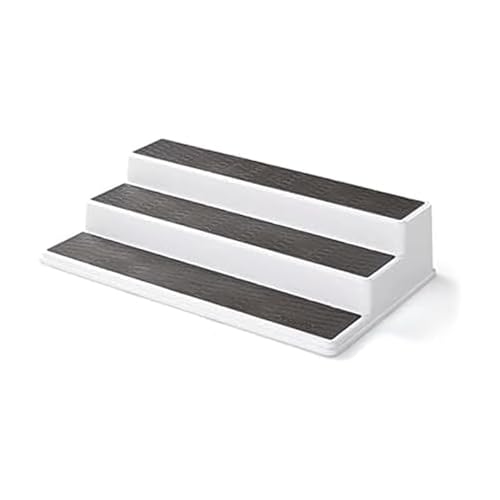
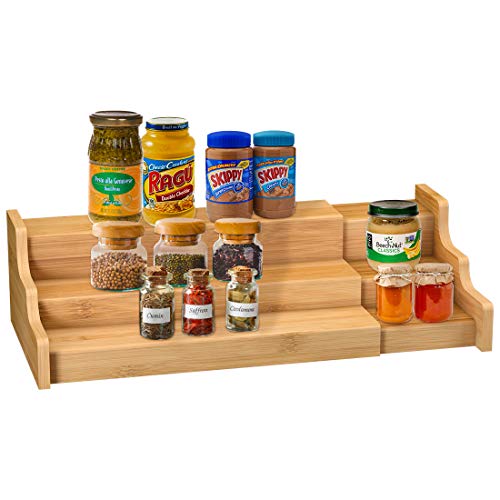


As an Amazon Associate we earn from qualifying purchases at no extra cost to you. Ratings are shown as listed on Amazon.
Quick Picks by Kitchen Situation
| Kitchen situation | Best rack type | Useful target specification | Why it works |
|---|---|---|---|
| Shallow cabinet or narrow pantry | Three-tier cabinet riser | 12–18 inches wide, 9–11 inches deep, 3.5–4.5 inch tier height | Uses vertical space while keeping labels visible |
| Deep cabinet with jars at the back | Pull-out spice shelf or drawer insert | 10–15 inches wide, 16–20 inches deep, 20–30 jar capacity | Brings rear jars forward instead of creating hidden rows |
| Mixed jar sizes and frequent reorganization | Adjustable modular rack | Movable shelves or dividers, 2–4 inch height adjustment | Accommodates short seasoning tins and tall refill containers |
| No usable cabinet shelf | Wall-mounted stepped rack | Two or three levels, 3–5 inch depth, rated for at least 10 pounds | Converts unused wall space into accessible storage |
| Small collection and limited budget | Single-piece countertop riser | 9–12 inches wide, 6–10 inches deep, 12–18 jar capacity | Low cost and no installation |
What Makes a Tiered Spice Rack Good in a Small Kitchen?
Tier height
Tier height determines whether labels remain readable and whether tall jars collide with the shelf above. A 3.5-inch step is usually enough for standard cylindrical spice jars and common square seasoning bottles. A 4.5–5-inch step is safer for taller jars, but it reduces the number of levels that fit inside a cabinet.
Measure the jar, not just its advertised volume. A typical 2-ounce spice jar may be 3–4 inches tall, while a larger pepper grinder, smoked paprika container, or refill bottle can exceed 5 inches. Leave at least 0.5 inch of vertical clearance above the tallest container so it can be lifted out without scraping the shelf.
Shelf depth
A deep shelf does not automatically provide more useful storage. If the rack is deeper than the cabinet shelf, it may prevent the door from closing. If it is too deep for the jars, the rear of each level becomes wasted space.
For standard jars, look for a usable shelf depth of 3.25–4 inches. This supports most containers while keeping labels near the front edge. A 5–6-inch-deep rack is better for larger seasoning bottles but may make small jars harder to see. For a cabinet with an interior depth of 11 inches, an organizer measuring 9.5–10 inches deep gives room for the door, hinges, and hand clearance.
Capacity without overcrowding
Manufacturers often count every possible jar position, but practical capacity is lower. A three-tier rack that claims 24 jars may hold only 18–20 comfortably if your containers vary in diameter or if you need space to grip the front row.
Use this estimate before buying:
Usable capacity = number of tiers × usable width ÷ average jar diameter.
For example, a 12-inch-wide rack with 0.25 inch of clearance at each side has 11.5 inches of usable width. With jars averaging 2 inches in diameter, each tier holds about five jars. Three tiers provide approximately 15 jars, not 18 or 24. A rack designed for narrow 1.5-inch jars can hold more, but only if your collection uses that jar format consistently.
Head-to-Head: The Main Rack Designs
Fixed three-tier risers: best all-purpose choice
Fixed risers are the simplest solution for a cabinet, pantry shelf, or countertop. Their stepped shape makes rear labels visible, and there are no rails or moving parts to maintain. Plastic versions are usually the least expensive, while powder-coated steel or bamboo versions tend to feel more stable.
Choose a fixed riser when most of your jars are similar in height and you want 12–24 containers accessible at once. Avoid one if your cabinet shelf is unusually low or if you store tall bottles alongside standard jars. The fixed steps cannot be repositioned around obstructions.
Adjustable modular racks: best for mixed containers
Adjustable organizers use movable shelves, removable dividers, or interlocking sections. They are useful when your collection includes standard jars, shallow tins, tall extracts, and larger refill containers. Their flexibility also helps when a cabinet has a hinge or a shelf support in an inconvenient position.
The trade-off is reduced rigidity. A modular rack can shift when a jar is removed unless it has non-slip feet or a locking connection. Select a system with adjustment increments of roughly 1–2 inches rather than a design that relies only on friction. This makes it easier to create a stable layout instead of forcing every shelf to the same height.
Pull-out organizers: best for deep cabinets
A pull-out spice shelf solves the common deep-cabinet problem: jars disappear behind the front row. Look for full-extension runners, a front stop, and a load rating of at least 15 pounds. A narrow pull-out between 5 and 9 inches wide can be particularly useful beside a refrigerator or range cabinet.
Pull-outs cost more and require accurate installation. Measure the cabinet opening, not the outside frame, and check for hinges, plumbing, and internal shelf supports. A product that fits the shelf depth may still fail if the door opening is narrower than the interior.
Wall-mounted racks: best when cabinets are full
Wall-mounted stepped racks preserve cabinet space, but they need a suitable mounting surface. Adhesive mounting is appropriate only for lightweight collections and smooth, clean surfaces within the mounting hardware’s stated limit. For a heavily used rack, screw-mounted brackets into a stud or suitable wall anchor are more dependable.
Keep wall racks away from direct steam and splashes. Moisture can soften bamboo, corrode untreated metal, and cause labels to peel. A three-tier wall rack with 3–5-inch-deep shelves is generally more useful than a very deep basket, because jars remain visible and do not form a second hidden row.
Materials and Durability: What Wears First?
- Plastic: Easy to wipe and usually affordable, but thin shelves can bow under a dense collection. Look for a reinforced underside and non-slip feet.
- Powder-coated steel: Strong and suitable for heavier jars. Inspect the coating for chips, especially around screw holes, where rust can begin.
- Bamboo or wood: Attractive and stable when sealed, but it should not be soaked. Wipe spills promptly and avoid storing it beside a steamy kettle.
- Acrylic: Keeps small jars visible and suits open shelving. It can scratch and may slide unless the base has rubber feet.
- Adhesive mounts: The adhesive is usually the first component to fail, particularly on dusty, textured, humid, or freshly painted surfaces.
The most common ownership mistake is overloading the front edge. A rack may support a substantial total weight, but repeated pulling on one jar can flex a lightweight shelf. Keep heavier salt, peppercorn, and refill containers on the lowest tier.
How to Choose the Correct Size
- Measure the cabinet opening at its narrowest point, including the door frame.
- Measure usable depth from the front edge to the nearest hinge, wall, or obstruction.
- Measure vertical clearance from the shelf surface to the shelf above.
- Measure three representative jars: your shortest, tallest, and widest.
- Subtract at least 1 inch from width and depth measurements for operating clearance.
- Choose capacity based on the jars you use, leaving one empty position per tier for easier removal.
For example, if a cabinet opening is 14 inches wide, a 12-inch rack is a safer choice than a 14-inch rack. If the usable depth is 11 inches, select a rack no deeper than 10 inches. If the vertical opening is 13 inches, a three-tier organizer with 3.75-inch steps may fit, while a four-tier model may make the top row unreachable.
Setup and Maintenance Tips
Group spices by frequency of use rather than alphabetically alone. Put everyday seasonings such as salt, pepper, garlic powder, and chili flakes on the front or lowest accessible tier. Place occasional baking spices and specialty blends higher or farther back.
Before loading the rack, wipe the cabinet and add thin non-slip shelf liner if the organizer moves when jars are lifted. Do not use liner to compensate for a rack that is fundamentally too narrow or unstable. Clean spills with a barely damp cloth, then dry the rack completely. Avoid putting spice jars away with damp bottoms, since moisture and residue can cause sticking and staining.
Every few months, check screw-mounted racks, pull-out runners, and adhesive corners. Replace cracked shelves or loose mounts rather than continuing to add weight. Label refill containers with both the spice name and the refill date; this prevents old contents from remaining hidden behind the visible front row.
Final Buying Recommendation
For the majority of small kitchens, a fixed three-tier rack about 12 inches wide, 9–10 inches deep, and 3.5–4.5 inches high per level offers the best balance of visibility, capacity, and simplicity. Choose an adjustable model when jar sizes vary, a pull-out shelf when the cabinet is deep, and a wall-mounted rack only when the mounting surface and location can safely handle repeated use. The right organizer is not the one with the largest claimed capacity—it is the one that fits with clearance, keeps labels visible, and lets you remove one jar without moving five others.



Write Your Review
No reviews yet. Be the first to share your experience!