

Key takeaways
- Worn seals: Dispensing valves and silicone gaskets usually show wear before the motor or cooling system. Check whether replacement parts are available before purchasing.
- Overfilling: Expansion during churning can block the dasher and create inconsistent dispensing. Follow the fill line rather than the maximum volume printed in marketing material.
- Warm mix: Starting with room-temperature liquid lengthens freezing time and can produce a weak, collapsing swirl.
- Improper cleaning: Leaving dairy mix in the chute is more damaging to hygiene and seals than a slightly longer cleanup after each use.
- Using the wrong base: Very low-sugar, alcohol-heavy, or chunky mixes may not freeze or dispense correctly.
- Poor ventilation: Compressor units need clearance around their vents. Do not operate one inside a cabinet or directly beside a heat-producing appliance.
The best soft serve machines for home depend on how often you will use one: choose a freezer-bowl countertop machine such as the Cuisinart ICE-45 or ICE-48 for the lowest upfront cost, and choose a self-freezing compressor model such as the Whynter ICM-201SB or ICM-202SB for faster repeat batches, firmer texture, and less advance planning.
These machines are not interchangeable. Freezer-bowl models are compact and relatively inexpensive, but the bowl must be frozen for many hours before every batch. Compressor machines contain their own refrigeration system, so they cost more, weigh more, and occupy more counter space in exchange for convenience and more consistent freezing.
Our top picks
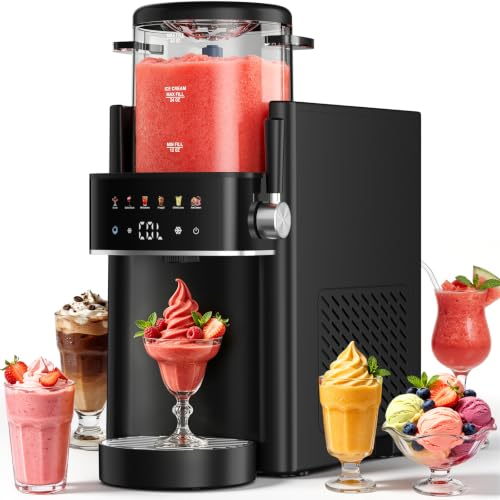


As an Amazon Associate we earn from qualifying purchases at no extra cost to you. Ratings are shown as listed on Amazon.
Quick comparison: freezer bowl versus compressor
| Characteristic | Freezer-bowl countertop model | Compressor model |
|---|---|---|
| Typical examples | Cuisinart ICE-45, Cuisinart ICE-48 | Whynter ICM-201SB, Whynter ICM-202SB |
| Practical batch size | About 1 to 1.5 quarts | About 1.5 to 2.1 quarts |
| Freezing method | Pre-frozen insulated bowl | Built-in compressor |
| Freezing preparation | Freeze bowl for roughly 12–24 hours | No bowl pre-freezing |
| Typical freezing time | Approximately 15–30 minutes after setup | Approximately 25–45 minutes, depending on mix and room temperature |
| Repeat batches | Usually requires another frozen bowl | Usually possible after a short cleaning and reset |
| Approximate machine weight | Roughly 10–15 pounds | Roughly 25–35 pounds |
| Counter footprint | About 8–11 inches wide and 10–13 inches deep | About 10–12 inches wide and 15–18 inches deep |
| General market price | About $100–$180 | About $300–$700 |
| Best fit | Occasional treats, small kitchens, lower budgets | Frequent use, parties, planned entertaining, repeat batches |
Capacity figures are nominal bowl or hopper capacities, not always the amount that can be dispensed cleanly. Leave room for expansion and air incorporation; overfilling can produce a thin, uneven stream or cause the dasher to struggle.
Best for occasional use: Cuisinart ICE-45 or ICE-48
A Cuisinart freezer-bowl machine is the sensible choice when you want soft serve a few times per month without dedicating substantial counter space or budget to the appliance. The ICE-45 is designed specifically around soft-serve dispensing, while the ICE-48 adds a more elaborate sundae-station format with topping containers and dispensing features.
The main compromise is scheduling. The bowl has to be completely frozen before churning. A freezer that is too warm, crowded, or frequently opened may not freeze the liquid-filled bowl hard enough. Store the bowl upright or in the position recommended by the manufacturer, and keep it in the freezer between uses if there is room.
These machines generally produce a lighter, softer result soon after churning than a compressor machine. That is useful for cones and cups, but the mixture can become too loose if the base starts warm or the room is hot. They are also better suited to one modest batch than to a birthday party requiring continuous service.
Best for frequent batches: Whynter compressor models
A compressor machine is the stronger choice for households that make frozen desserts weekly, entertain often, or dislike remembering to freeze a bowl. The Whynter ICM-201SB is a compact self-freezing soft-serve model with a built-in cooling system, while the larger ICM-202SB is aimed at higher-volume home use.
The compressor maintains cold conditions while the dasher works, which helps the mixture reach a more stable serving texture. It does not eliminate preparation: the mix should still be chilled, the hopper should not be overfilled, and the machine needs time to cool before dispensing. Compressor units also make more noise, draw more power, and are awkward to move once placed.
Their advantage becomes clearer with two batches. With a freezer-bowl model, the first batch may use the only frozen bowl, leaving you unable to make another batch immediately. With a compressor model, you can often wash the removable parts, chill the next mix, and continue, subject to the manual’s operating and rest instructions.
How the important criteria affect your choice
Batch capacity
For two to four servings, a 1-quart batch is usually sufficient. A 1.5-quart machine is more practical for a family, but remember that cones, toppings, and melting reduce the number of generous servings. A 2-quart compressor unit makes more sense for gatherings, although a larger batch also takes longer to chill and clean.
Freezing time and consistency
Freezing time depends on the starting temperature, sugar content, fat level, batch volume, and room temperature. A refrigerated base freezes more efficiently than one mixed on the counter. Bases with too much sugar or alcohol may remain soupy; bases with too little sugar can freeze hard and grainy.
Compressor machines usually deliver more repeatable results because they do not depend on a bowl that may have warmed in the freezer. However, consistency also depends on the recipe. No machine can compensate for a warm, unbalanced mix.
Cleaning effort
The removable chute, dasher, mixing chamber, drip tray, and dispensing handle are the parts that matter most. A simple freezer-bowl machine often has fewer cooling components to clean, but its narrow dispensing path can still hold dairy residue. Compressor machines add more parts, seals, and crevices, so cleanup takes longer and must be done immediately.
Do not immerse the motor housing or compressor body. Wash food-contact components according to the manual, inspect silicone seals for stretching, and allow parts to dry fully before reassembly. A small bottle brush is useful for narrow channels that a sponge cannot reach.
Footprint and storage
Measure both the counter and the vertical clearance before buying. Leave space around compressor ventilation openings, and check whether the lid or hopper needs to open upward. A unit that fits only when pushed against a wall may overheat or become inconvenient enough that it stays unused.
Mix requirements
Most home soft-serve machines work best with a smooth, fully dissolved, refrigerated liquid base. Commercial soft-serve mixes are convenient because they are formulated for freezing and dispensing, but they can be expensive per serving. Homemade bases need careful attention to sugar, dairy solids, and stabilizers.
A practical starting point is to chill the mix to about 40°F (4°C) or below before churning. Strain it if it contains fruit purée, cocoa, or undissolved ingredients. Avoid large pieces of chocolate, nuts, or fruit in the hopper; add them as toppings or fold-ins after dispensing unless the manufacturer specifically permits inclusions.
Decision matrix: which type fits your situation?
| Your situation | Better choice | Why |
|---|---|---|
| Budget under about $200 | Freezer-bowl model | Lower purchase cost and adequate capacity for occasional treats |
| Small kitchen or limited storage | Freezer-bowl model | Lighter body and smaller footprint |
| First soft-serve machine | Freezer-bowl model | Lower financial risk while you learn mix and serving habits |
| Weekly use | Compressor model | No overnight bowl-freezing routine |
| Two or more batches at a party | Compressor model | Better suited to repeat batches and sustained cooling |
| Maximum texture consistency | Compressor model | Active refrigeration is less dependent on freezer conditions |
| Minimal cleaning and maintenance | Smaller freezer-bowl model | Typically fewer components and no compressor ventilation system |
A simple ownership calculation
Suppose a $140 freezer-bowl machine is used twice monthly for three years. That is 72 uses, or about $1.95 per use before ingredients. A $450 compressor machine used weekly for three years equals 156 uses, or about $2.88 per use before ingredients. The compressor costs more per use in this example, but it may be the better value if its convenience is what makes you use it four times as often.
For a less frequent household, the calculation reverses. A compressor that sits unused still occupies space and contains seals, switches, and refrigeration components that eventually need care. Buy the expensive type for a clear usage pattern, not simply because its specifications are higher.
Durability and common mistakes
- Worn seals: Dispensing valves and silicone gaskets usually show wear before the motor or cooling system. Check whether replacement parts are available before purchasing.
- Overfilling: Expansion during churning can block the dasher and create inconsistent dispensing. Follow the fill line rather than the maximum volume printed in marketing material.
- Warm mix: Starting with room-temperature liquid lengthens freezing time and can produce a weak, collapsing swirl.
- Improper cleaning: Leaving dairy mix in the chute is more damaging to hygiene and seals than a slightly longer cleanup after each use.
- Using the wrong base: Very low-sugar, alcohol-heavy, or chunky mixes may not freeze or dispense correctly.
- Poor ventilation: Compressor units need clearance around their vents. Do not operate one inside a cabinet or directly beside a heat-producing appliance.
Bottom line
Choose the Cuisinart ICE-45 or ICE-48 if you want an affordable, compact machine for occasional single-batch soft serve and can plan ahead for bowl freezing. Choose a Whynter ICM-201SB or ICM-202SB if you make frozen desserts frequently, need repeat batches, or care more about consistent cooling than weight, noise, and price. Whichever type you buy, the best results come from a well-chilled, properly balanced mix and immediate cleaning after every session.



Write Your Review
No reviews yet. Be the first to share your experience!