

Key takeaways
- People who want back and leg support without a pillow surrounding both sides.
- Couples sharing a queen or king bed who need to preserve some space.
- Sleepers who alternate positions and are willing to reposition one large pillow.
- Anyone who wants a pillow that can also work as a lounging or reading support.
The best pregnancy pillows depend on where you need support: choose a U-shaped pillow for full-body coverage, a C-shaped pillow for flexible back-and-belly support, or a wedge for compact, targeted support.
Pregnancy pillows are not interchangeable. Their shape affects how much bed space they use, how easily you can turn over, how much filling they contain, and whether the cover can be removed for washing. The right choice is less about finding the largest pillow and more about matching support to your sleeping position, mattress size, and willingness to reposition it during the night.
Our top picks


As an Amazon Associate we earn from qualifying purchases at no extra cost to you. Ratings are shown as listed on Amazon.
Quick decision guide
| Your situation | Best starting choice | Why | Main compromise |
|---|---|---|---|
| You want support on both sides | U-shaped pillow | Surrounds the head, back, abdomen, and legs | Uses the most bed width and can be difficult to move |
| You change sides often | C-shaped pillow | Offers a supported opening and can be turned with you | One side may need repositioning when you switch sides |
| You have a small bed or limited budget | Wedge pillow | Compact, lightweight, and usually less expensive | Supports one area rather than the whole body |
| You dislike firm or highly structured pillows | Adjustable-fill U or C pillow | Some filling can be removed to change the loft | More expensive and bulkier to store |
| You want a pillow for pregnancy and later use | Wedge or flexible C-shaped pillow | Can support the back, knees, reading posture, or feeding position | May not provide the wraparound support of a U shape |
U-shaped pregnancy pillows: maximum coverage
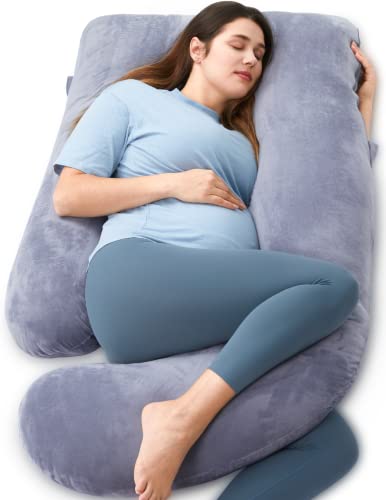
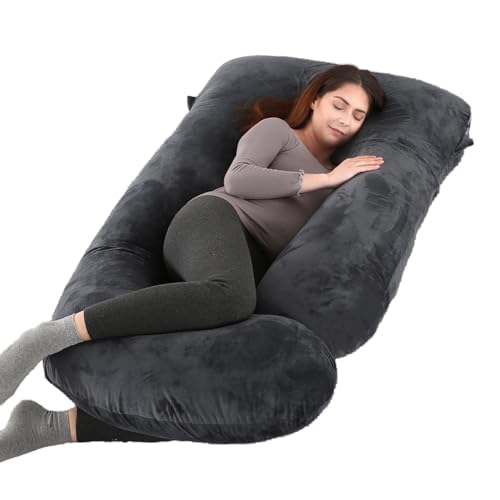
A U-shaped pillow runs along both sides of the body and connects around the head or feet. It is the strongest option for people who want to lie between two cushioned sides without placing a separate pillow behind the back.
Support and repositioning
The two arms can support the abdomen, back, hips, and knees at the same time. This is useful if you tend to roll backward or if a single pillow behind your back constantly falls away. The drawback is turning: you may need to climb over one side of the U or rotate the entire pillow, rather than simply rolling onto the other side.
Filling and size
Common fills include polyester fiber, shredded foam, and solid foam. Polyester fiber feels softer and is usually lighter; shredded foam offers a denser, more moldable feel but may be heavier; solid foam generally holds its shape best but has less of a “sink-in” feel. Typical full-length U pillows measure about 55 to 65 inches long and 30 to 40 inches wide, with weights around 6 to 12 pounds.
On a queen bed, a 35-inch-wide U pillow can occupy nearly half of the 60-inch mattress width before your body is added. That leaves roughly 25 inches for you and a partner on the remaining side. On a full bed, which is about 54 inches wide, the same pillow can make the sleeping surface feel especially crowded.
C-shaped pillows: the balanced all-rounder
A C-shaped pillow curves around the head, back, hips, and legs, leaving an open side. It usually gives more directional support than a wedge while remaining easier to move than a full U shape.
Support and ease of use
The upper curve can cushion the head and neck, the lower curve can sit between the thighs, and the long section can support the back or abdomen. To change sides, you can either turn the entire C or place the open side toward the new sleeping direction. This is less cumbersome than stepping over a U-shaped pillow but still requires occasional adjustment.
C-shaped pillows commonly measure about 55 to 65 inches long and 25 to 35 inches wide. Their typical weight is 4 to 9 pounds. A medium-density polyester-fill version is often a practical compromise: substantial enough to stay in place, but not so dense that it becomes difficult to lift.
Who should choose a C shape?
- People who want back and leg support without a pillow surrounding both sides.
- Couples sharing a queen or king bed who need to preserve some space.
- Sleepers who alternate positions and are willing to reposition one large pillow.
- Anyone who wants a pillow that can also work as a lounging or reading support.
Wedge pillows: small, targeted, and easy to keep
A wedge pillow is the simplest option. It can sit under the abdomen, behind the back, between the knees, or beneath the upper body, depending on its angle and size. It does not replace a full-body pillow, but it can solve one specific support problem without taking over the bed.
Filling, firmness, and dimensions
Most wedges use solid polyurethane foam, memory foam, or a foam core with a softer top layer. A compact wedge may measure approximately 12 by 14 by 4 inches; a larger wedge may be 20 by 20 by 8 inches. Firmness matters more than height: a very soft wedge can flatten under body weight, while an overly firm one may feel unstable or create pressure at the hip.
Wedges are usually light enough to move with one hand and may weigh 1 to 4 pounds. That makes them the easiest option for travel, daytime use, and frequent repositioning. They are also commonly the least expensive category, with broad market pricing of about $20 to $60, compared with approximately $35 to $90 for many C-shaped pillows and $45 to $120 or more for large U-shaped designs.
Head-to-head comparison: what matters after the first night
| Feature | U-shaped | C-shaped | Wedge |
|---|---|---|---|
| Typical dimensions | 55–65 × 30–40 in | 55–65 × 25–35 in | 12–20 × 14–20 in |
| Typical weight | 6–12 lb | 4–9 lb | 1–4 lb |
| Body coverage | Head, back, abdomen, hips, knees | Head, back or abdomen, hips, knees | One targeted area |
| Turning in bed | Most difficult | Moderate | Easy |
| Recommended bed space | Queen or larger | Full, queen, or larger | Any bed size |
| Typical market range | $45–$120+ | $35–$90 | $20–$60 |
Cover and cleaning details worth checking
The cover often determines whether a pillow remains pleasant to own. Look for a removable, machine-washable cover with a full-length zipper rather than a small opening. Cotton or cotton-blend covers tend to feel breathable; polyester and velour covers may feel softer but can retain more warmth. A spare cover is useful because large pillows can take a long time to dry.
- Wash the cover according to its care label, usually on a cool or warm gentle cycle.
- Do not assume the insert is machine washable. Many fiber-filled inserts should only be spot-cleaned.
- Dry the cover completely before putting it back on to prevent trapped moisture.
- Fluff fiber-filled pillows regularly so one section does not become permanently compressed.
- Do not use high heat on foam, which can damage or distort the material.
A practical ownership calculation illustrates why a washable cover matters. If a pillow is used for six months, or about 180 nights, and its cover can be washed weekly, it will receive roughly 26 wash cycles during that period. A delicate, removable cover is therefore more important than decorative piping or an unusually plush outer fabric.
Common buying mistakes
Choosing by length alone
A longer pillow is not automatically more supportive. Check the width, loft, and fill density as well as the total length. A pillow that is long but thin may leave the knees or abdomen unsupported.
Ignoring the mattress size
Measure the available mattress width before buying. If two people share a queen bed, a full U-shaped pillow may leave too little room for comfortable movement. A C-shaped pillow or two compact wedges may provide similar targeted support with less crowding.
Buying a cover that cannot be replaced
Spills, sweat, and skin oils eventually affect any fabric. If replacement covers are unavailable, choose a pillow with a standard enough shape that a loose protective cover can fit over it.
Expecting one pillow to solve every discomfort
Sleep comfort can also depend on mattress firmness, room temperature, clothing, and positioning. A pillow should not cause numbness, sharp pain, or persistent discomfort. Stop using it and seek advice from a qualified healthcare professional if symptoms are concerning or do not improve.
Our practical picks by situation
- Best for maximum support: a medium- or firm-fill U-shaped pillow with a washable cotton-blend cover.
- Best for shared queen beds: a C-shaped pillow around 25 to 30 inches wide.
- Best for small spaces and travel: a compact foam wedge with a removable cover.
- Best for adjustable comfort: a fiber-filled C or U pillow with a zippered inner chamber that allows filling to be removed.
- Best value for occasional use: a wedge, especially if you already own a supportive head pillow and knee pillow.
When comparing the best pregnancy pillows, prioritize the support pattern you need, then check bed width, fill behavior, cover construction, and cleaning instructions. A U shape offers the broadest coverage, a C shape provides the most balanced compromise, and a wedge is the easiest to reposition and maintain.





Write Your Review
No reviews yet. Be the first to share your experience!