

Key takeaways
- Best for prescribed post-surgery protocols: Game Ready GRPro 2.1 or a similar clinic-grade system, because it combines circulating cold water with adjustable pneumatic compression. It is expensive and bulky, so it makes less sense for casual use.
- Best simple knee-and-shoulder option: DonJoy IceMan CLEAR3, a compact cold-water circulator with dedicated anatomical pads and straightforward controls.
- Best for a low-complexity setup: Aircast Cryo Cuff IC, which uses a gravity-assisted cooler and intermittent compression rather than a highly configurable electronic control panel.
- Best for people who want a relatively quiet basic pump: Ossur Cold Rush, provided its pad shape and hose arrangement fit your joint comfortably.
- Best for occasional daily recovery: a basic non-compression circulating-water unit with a 3–4-liter tank. You avoid paying for pressure settings you may never use.
The best cold therapy machines for most post-surgery users are circulating-water systems with a contoured knee or shoulder pad, a timer, and a reservoir of roughly 3–5 liters; choose a pressure-capable system such as Game Ready when compression is specifically part of your prescribed recovery routine.
Cold therapy machines differ less in their basic purpose than in how evenly they cool, how much area the pad covers, how often you must refill the tank, and how tolerable the pump is beside a bed or sofa. The right choice for occasional soreness is not necessarily the right choice for several daily recovery sessions after surgery.
Our top picks
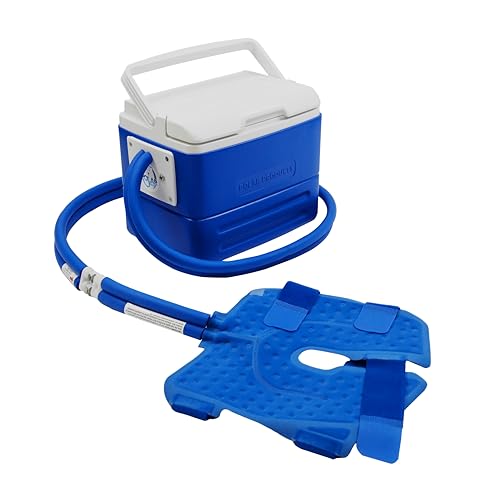


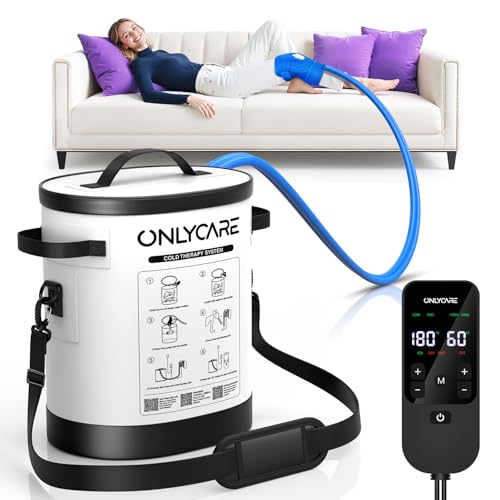
As an Amazon Associate we earn from qualifying purchases at no extra cost to you. Ratings are shown as listed on Amazon.
Quick picks by recovery situation
- Best for prescribed post-surgery protocols: Game Ready GRPro 2.1 or a similar clinic-grade system, because it combines circulating cold water with adjustable pneumatic compression. It is expensive and bulky, so it makes less sense for casual use.
- Best simple knee-and-shoulder option: DonJoy IceMan CLEAR3, a compact cold-water circulator with dedicated anatomical pads and straightforward controls.
- Best for a low-complexity setup: Aircast Cryo Cuff IC, which uses a gravity-assisted cooler and intermittent compression rather than a highly configurable electronic control panel.
- Best for people who want a relatively quiet basic pump: Ossur Cold Rush, provided its pad shape and hose arrangement fit your joint comfortably.
- Best for occasional daily recovery: a basic non-compression circulating-water unit with a 3–4-liter tank. You avoid paying for pressure settings you may never use.
What matters most when comparing cold therapy machines
Flow rate and cooling consistency
Flow rate is the volume of chilled water moving through the pad per minute. Faster circulation can reduce warm spots and shorten the time needed to feel cooling, but a high flow rate is not automatically better: it can raise pump noise, use more power, and make a small pad feel uncomfortably cold.
Many manufacturers do not publish a pump rate in liters per minute. Treat that omission as a comparison limitation rather than assuming two machines perform identically. Look for a pad that fills evenly, a hose with secure quick-connect fittings, and a pump designed to circulate continuously rather than merely hold ice against the joint. Systems with compression, including Game Ready equipment and Aircast Cryo Cuff IC, add another variable: pressure can change the sensation and should be used only as directed by a clinician or the manufacturer.
Pad coverage and fit
A knee pad should cover the front and sides of the knee without pressing sharply into the kneecap or incision. A shoulder pad should wrap around the shoulder and upper arm; a small rectangular pad may leave the back or side of the joint warm. Measure the joint area and check whether the manufacturer offers separate knee, shoulder, universal, or post-operative wraps.
Coverage is especially important after surgery, when a loose pad can cool poorly and an overly tight strap can be uncomfortable around swelling or dressings. Adjustable straps are useful, but they should hold the pad in place—not compress the limb unless the system is specifically designed and prescribed for that purpose.
Tank capacity and session length
A larger tank reduces refills but adds weight and takes longer to chill. For a typical 20–30-minute session, a 3–4-liter reservoir is usually a practical compromise. A 5-liter-plus system is more convenient for repeated sessions, but it is less portable and may require more ice or chilled water.
Do not fill a reservoir completely with ice. Most systems need room for water circulation, and excessive ice can obstruct the intake or create uneven cooling. Follow the fill line and water-to-ice instructions supplied with the specific machine.
Timer settings
A timer is more than a convenience: it helps prevent falling asleep with a cold pad attached. Basic units may provide a fixed 20- or 30-minute cycle. More configurable systems may offer timed cooling, compression intervals, or separate on/off periods. For post-surgery use, choose a machine whose controls are easy to operate while seated and whose timer can be set without repeatedly disconnecting the pad.
Noise levels
Cold therapy pumps are rarely silent. A small circulator typically produces a low electrical hum, while compressor-assisted or compression-capable systems may add clicking, pulsing, or vibration. Published decibel figures are uncommon, so consider the machine’s placement: a unit on a hard bedside table sounds louder than one on a folded towel on the floor, although ventilation openings must remain clear.
| System or type | Typical tank capacity | Flow-rate information | Pad coverage | Timer and pressure | Noise and portability |
|---|---|---|---|---|---|
| Game Ready GRPro 2.1 | About 5.5 L | Circulating-water system; pump rate is not usually the main published buying specification | Interchangeable knee, shoulder, ankle, hip and other wraps | Programmable cold and pneumatic compression; use pressure as prescribed | Clinic-grade, heavier and generally louder than basic home units |
| DonJoy IceMan CLEAR3 | About 3.8 L | Continuous circulation; published flow figures may vary by market | Dedicated knee and shoulder pads, with other pad shapes available | Simple timed operation; generally no advanced pneumatic compression | Compact pump; low mechanical hum with periodic water movement |
| Aircast Cryo Cuff IC | About 3–4 L, depending on version | Gravity-assisted and intermittent circulation design | Joint-specific cuffs, including knee and shoulder options | Intermittent compression function; limited compared with clinic-grade systems | Portable cooler; audible pump cycling rather than a constant high-speed fan |
| Ossur Cold Rush | About 3.8 L | Water circulation is the core feature; exact pump rate is not typically emphasized | Cold-compression pads in several anatomical shapes | Basic cooling control; check the pad and controller package for included features | Relatively compact; expect a noticeable but generally modest pump hum |
| Basic non-compression circulator | 2.5–4 L | Often undisclosed; prioritize even pad filling and reliable circulation | Usually one universal pad plus optional joint pads | Fixed or adjustable 20–60-minute timer | Usually the lightest and least expensive category |
Capacity and feature availability can vary by regional package and pad bundle. Confirm the current manual before purchase, especially if you need both knee and shoulder pads.
Decision matrix: which specification fits your routine?
| Your situation | Prioritize | Most suitable choice | Trade-off |
|---|---|---|---|
| Several sessions daily after surgery | 3.8–5.5 L tank, dependable circulation, easy timer, replaceable pads | DonJoy IceMan CLEAR3, Game Ready, or equivalent circulating system | More cleaning, hose handling, and floor space |
| Compression was specifically recommended | Adjustable pressure and a correctly sized joint wrap | Game Ready or Aircast Cryo Cuff IC | More cost, bulk, and setup complexity |
| Occasional exercise recovery | Compact size, simple controls, 2.5–4 L capacity | Basic circulator or Ossur Cold Rush | Fewer pressure and programming options |
| Small bedroom or shared living space | Low vibration, modest footprint, manageable hose length | Compact non-compression unit or DonJoy IceMan CLEAR3 | Smaller tank may require more frequent refilling |
| Budget-conscious buyer | One useful pad, fixed timer, standard replacement parts | Basic circulating-water machine | Flow rate, noise, and pad ergonomics may be less refined |
How to set one up safely and efficiently
- Inspect the pad and hose. Check the connector, strap, and seams for damage before adding water. A small leak becomes a large problem near electronics.
- Fill to the marked line. Use the specified water and ice mixture. Leave expansion space and keep the pump intake unobstructed.
- Position the machine below or beside the joint if instructed. Avoid sharp bends in the hose, which can restrict circulation and make the pump work harder.
- Place a thin fabric layer between the pad and skin. This can improve comfort and helps protect skin, but do not use a thick towel that prevents useful contact.
- Set the timer before settling in. Start with the duration recommended in the device instructions or by your healthcare professional. Check the skin during and after use, particularly around numb areas or incisions.
- Drain and dry after use. Empty residual water from the pad and reservoir, leave openings uncapped until dry, and store the hose without tight kinks.
Ownership costs and what wears out first
The machine itself is only part of the ownership cost. Replacement pads, hoses, connectors, seals, and straps typically wear before the motor. Straps lose elasticity, hook-and-loop closures collect lint, and repeated bending can stress the hose near its connector. A machine with inexpensive, readily available replacement pads may be a better long-term value than a cheaper unit with proprietary accessories.
A simple cost-per-use calculation can clarify the choice. Suppose a $250 machine is used twice daily for 90 days: that is 180 sessions, or about $1.39 per session before replacement parts and electricity. A $1,500 clinic-grade system used twice daily for the same period costs about $8.33 per session. If it remains useful for a year of regular use—730 sessions—the equivalent falls to about $2.05 per session. The expensive option only makes financial sense if you will use its larger pad selection, compression, durability, or prescribed settings often enough.
Clean water reduces residue, but it does not eliminate maintenance. Follow the manual for cleaning agents; do not add disinfectant, salt, or essential oils unless the manufacturer explicitly permits it. Never operate a water-circulating unit with an empty reservoir.
Questions to ask before buying
Is a higher flow rate always better?
No. Even circulation and a comfortable pad fit matter more than an isolated flow number. If a manufacturer does not publish flow rate, compare the return policy, pad design, hose quality, and replacement-part availability instead.
Can one machine treat both a knee and a shoulder?
Often yes, but usually by purchasing or selecting separate pads. Confirm that the shoulder pad covers the upper arm and that the knee pad accommodates your leg size and any permitted dressing.
How cold should the water be?
Use the temperature and ice instructions supplied with the machine. Colder is not automatically safer or more effective, and skin sensation may be altered after surgery. Stop if you notice excessive pain, skin discoloration, blistering, or persistent numbness and contact a healthcare professional.
Should I buy compression?
Only if it suits your care plan and you understand the controls. Compression-capable systems offer more adjustability but cost more, make more noise, and require more careful pad fitting. Ask your surgeon, physiotherapist, or other qualified clinician if compression is appropriate for your specific condition.



Write Your Review
No reviews yet. Be the first to share your experience!