

Key takeaways
- Socket: E26 is the common full-size screw base in North America; other regions may use different standards.
- Bulb shape: A globe or A-shaped bulb may not fit through a narrow bowl opening.
- Dimming: The bulb must be labeled dimmable, and the lamp’s control must be compatible with its electronics.
- Heat and enclosure rating: Never exceed the stated wattage or use a bulb that contacts the shade.
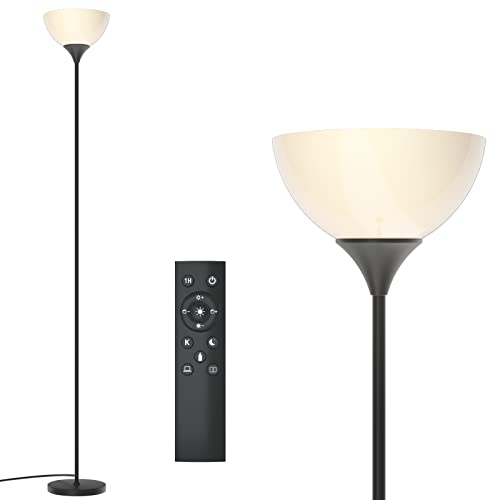
The best torchiere floor lamps for bright rooms are high-output LED uplighters with at least 2,000 lumens, a wide frosted bowl or shade, reliable dimming, and a weighted base that will not wobble when placed near a walkway.
A torchiere sends most of its light toward the ceiling, where it reflects back into the room as softer, more even illumination than a bare downward bulb. That makes it useful in living rooms, open-plan spaces, bedrooms, and rooms with limited overhead lighting—but the right model depends on ceiling height, bulb format, control type, and how much stability you need.
Our top picks



As an Amazon Associate we earn from qualifying purchases at no extra cost to you. Ratings are shown as listed on Amazon.
Quick picks by room and priority
| Situation | Best torchiere type | Useful target specifications | Why it fits |
|---|---|---|---|
| Large room or dark-painted ceiling | High-output integrated LED uplighter | 2,500–3,500 lumens; 20–30 watts; 3-way or continuous dimming | Provides enough upward light to spread across a broad ceiling |
| Rental or low replacement cost | Standard-socket torchiere | One E26 socket; LED bulb up to 1,600–2,000 lumens; 9–15 watts | You can replace or change the bulb without replacing the whole lamp |
| Home with children, pets, or busy walkways | Heavy-base LED torchiere | Base at least 10 inches wide; 6–12 pounds; metal pole and shade | More resistant to tipping and accidental bumps |
| Low ceiling, approximately 7–8 feet | Short or adjustable uplighter | 52–60 inches tall; 1,500–2,500 lumens; wide shade opening | Leaves visual clearance and reduces a concentrated bright spot overhead |
| High ceiling, approximately 10 feet or more | Tall, high-output torchiere | 65–72 inches tall; 3,000 lumens or more; broad diffuser | Gets light closer to the ceiling while retaining useful room coverage |
Best overall: high-output integrated LED torchiere
For a large living room or a room that feels dim despite having several lamps, an integrated LED torchiere is usually the strongest choice. Look for 2,500 to 3,500 lumens, a frosted diffuser, and a dimmer that operates smoothly rather than switching between only two brightness levels.
Its main advantage is upward light coverage. A broad bowl—roughly 12 to 16 inches across—spreads light over more of the ceiling than a narrow shade. That reduces the sharp pool of brightness found with inexpensive uplighters. A color temperature around 2700K to 3000K feels warm and comfortable; 3500K to 4000K appears crisper and can suit a workroom or contemporary interior.
The trade-off is ownership. Integrated LEDs are not normally user-replaceable. A reputable model may last for many years, but the lamp’s electronics and LED board eventually determine its lifespan. Choose this format when maximum brightness and a clean appearance matter more than future bulb swaps.
Best for replaceability: E26-socket torchiere
A socketed torchiere is the safer long-term choice if you want control over brightness, color, and replacement cost. An E26 socket accepts common LED bulbs, including warm decorative bulbs and high-lumen daylight options. Use an LED bulb rated for enclosed fixtures if the shade traps heat, and confirm the lamp’s maximum wattage before installing it.
For bright-room performance, a single bulb should produce around 1,200 to 1,600 lumens. If the lamp accepts two bulbs, the combined output can reach 2,000 to 3,000 lumens, but check whether the upward shade has enough space to prevent bulbs from touching the diffuser.
Bulb compatibility is the point that listing photos often conceal. Check four details:
- Socket: E26 is the common full-size screw base in North America; other regions may use different standards.
- Bulb shape: A globe or A-shaped bulb may not fit through a narrow bowl opening.
- Dimming: The bulb must be labeled dimmable, and the lamp’s control must be compatible with its electronics.
- Heat and enclosure rating: Never exceed the stated wattage or use a bulb that contacts the shade.
Best for precise control: torchiere with a foot dimmer
A foot-operated dimmer is convenient when the lamp stands behind a sofa or beside a reading chair. Continuous dimming is preferable to a simple high-low switch because upward light changes the mood of the whole room. A lamp that dims from 100% to about 10% can serve as both general lighting and evening accent lighting.
Touch controls are convenient, but they can be triggered accidentally and may behave unpredictably with some LED bulbs. A rotary control or a clearly marked foot slider is easier to operate consistently. Remote controls can be useful for inaccessible corners, although losing the remote or replacing its batteries adds a minor ownership inconvenience.
For a genuinely bright room, do not judge dimming range by itself. A 1,500-lumen lamp at full power may dim beautifully but still be inadequate for a large space. Prioritize maximum output first, then control quality.
Base stability matters more than decorative styling
Torchiere lamps are tall and top-heavy, so the base deserves as much attention as the shade. A narrow base can look elegant in a photograph but become unstable on thick carpet or beside a frequently used path. For a lamp around 65 to 72 inches tall, a base approximately 10 to 12 inches wide and weighing 6 pounds or more is a sensible target.
Metal bases generally resist cracking better than thin plastic, while a felt or rubber underside protects hard flooring and prevents sliding. A weighted base is not automatically stable: a tall pole with a loose threaded joint can still wobble. Before buying, look for a pole assembled in multiple sections with firm connections and a shade that does not spin freely.
Place the lamp where the base is fully supported. Avoid putting one foot on a rug edge, directly behind a door, or where a vacuum cleaner cord will catch the pole. If the lamp rocks after assembly, tighten every joint before adding floor pads; pads can reduce sliding but cannot correct a loose connection.
Choosing the right height for your ceiling
Ceiling height changes how effectively an uplighter works. The reflected light becomes less concentrated as the distance increases, but a very tall ceiling can swallow the output of a low-lumen lamp.
- 7–8-foot ceiling: Choose a 52–60-inch lamp. A wide shade and 1,500–2,500 lumens usually work better than an extremely tall, narrow design.
- 8–10-foot ceiling: A 60–68-inch lamp with 2,000–3,000 lumens is a versatile range for living rooms and bedrooms.
- 10-foot-plus ceiling: Choose 65–72 inches and at least 2,500 lumens. Consider two lamps if the room is long or the ceiling is dark.
As a rough coverage calculation, assume a bright uplighter provides useful ambient illumination over approximately 100 to 150 square feet in a room with a light-colored, 8-foot ceiling. A 240-square-foot living room may therefore need two lamps, not one exceptionally bright lamp. Dark ceilings absorb more light, so plan for the lower end of that coverage estimate.
Integrated LED versus replaceable bulb: the head-to-head
| Feature | Integrated LED | Replaceable-bulb socket |
|---|---|---|
| Typical output | 2,000–3,500 lumens | 800–3,000 lumens, depending on bulb count |
| Brightness control | Often smoother; may include color adjustment | Depends on bulb and lamp switch |
| Future bulb replacement | Usually not possible | Simple and inexpensive |
| Appearance | Usually slimmer and more modern | May have a larger shade to conceal the bulb |
| Best ownership advantage | High output from a relatively compact lamp | Easy upgrades, repairs, and color-temperature changes |
Maintenance and common mistakes
Dust on an upward-facing bowl can noticeably reduce brightness because the shade is aimed at the ceiling rather than the room. Unplug the lamp, let it cool, and wipe the diffuser and pole with a soft, dry or slightly damp cloth. Do not spray cleaner into the socket, dimmer, or LED housing.
The most common mistakes are choosing a lamp by height alone, using a non-dimmable bulb with a dimmer, overlooking the base diameter, and installing a cool-white bulb in a warm-toned room. Another mistake is placing the torchiere in a corner with a dark ceiling and expecting one lamp to illuminate an entire open-plan area. Light-colored walls and ceilings return more of the lamp’s output; dark finishes may require a second source.
Final buying recommendation
Choose a 2,500–3,500-lumen integrated LED torchiere with a wide diffuser and continuous dimming for the brightest, cleanest result in a large room. Choose an E26-socket model if replaceability and bulb experimentation matter more. Whichever format you select, match the lamp’s height to the ceiling, insist on a broad weighted base, and treat the stated lumens—not the number of bulbs—as the key measure of upward light coverage.




Write Your Review
No reviews yet. Be the first to share your experience!