

Key takeaways
- Up to 250 square feet: approximately 7,000–8,000 BTU SACC.
- 250–400 square feet: approximately 8,000–10,000 BTU SACC.
- 400–550 square feet: approximately 10,000–12,000 BTU SACC.
- Open-plan or heavily sun-exposed spaces: consider a larger rated unit or cooling only the occupied zone.
The best dual hose portable air conditioners for most homes are the Midea Duo MAP14S1BWT for quieter, more efficient whole-room cooling, the Whynter ARC-14S for a proven, sturdy design, and a lower-cost dual-hose model in the 10,000–12,000 BTU class for bedrooms or smaller living spaces.
Dual-hose units are usually a better choice than single-hose portables when you plan to cool a room for many hours. One hose draws outdoor air across the condenser, while the other expels hot air outside. That reduces the negative pressure, warm-air leakage, and “fighting the room” effect common with single-hose designs.
Our top picks

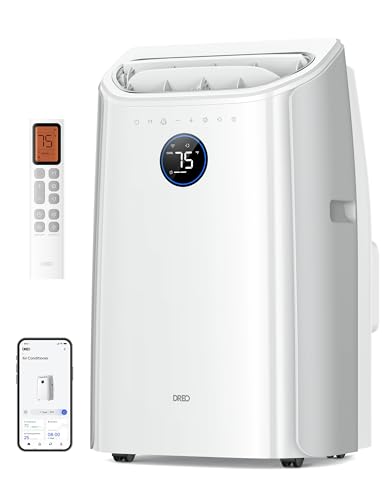


As an Amazon Associate we earn from qualifying purchases at no extra cost to you. Ratings are shown as listed on Amazon.
Best dual hose portable air conditioners at a glance
| Model | Published cooling rating | Suggested room size | Approx. weight | Notable advantage |
|---|---|---|---|---|
| Midea Duo MAP14S1BWT | 14,000 BTU ASHRAE; about 10,000 BTU SACC | Up to about 550 sq. ft. | About 77 lb | Quiet operation and integrated hose design |
| Whynter ARC-14S | 14,000 BTU ASHRAE; about 9,500 BTU SACC | Up to about 500 sq. ft. | About 64 lb | Durable, conventional dual-hose layout |
| 10,000–12,000 BTU dual-hose portable unit | Roughly 7,000–8,000 BTU SACC, depending on model | About 250–400 sq. ft. | Typically 55–70 lb | Lower purchase cost and easier room placement |
BTU figures are not directly interchangeable. Older advertising often uses the larger ASHRAE number, while the Department of Energy’s SACC rating is a more realistic measure of portable-air-conditioner output. Compare SACC ratings when available, and treat room-size claims as starting points rather than guarantees.
Our top picks by situation
Best overall: Midea Duo MAP14S1BWT
The Midea Duo is the strongest choice when quiet operation, efficient cooling, and frequent use matter more than low weight. Its hose arrangement is integrated into the unit rather than using two visibly separate tubes, which creates a cleaner installation and reduces the amount of hose to manage behind the machine. It is rated for rooms around 550 square feet, although a sunny top-floor room may need a smaller effective coverage target.
Its main drawback is weight. At roughly 77 pounds, it is not a practical appliance to carry up stairs repeatedly. The casters help on hard floors, but moving any portable air conditioner over thresholds, rugs, or narrow doorways still takes effort.
Best for a sturdy, conventional design: Whynter ARC-14S
The Whynter ARC-14S remains a sensible pick for a large bedroom, home office, or living room of approximately 350–500 square feet. Its dual-hose system uses a separate intake and exhaust hose, making the airflow arrangement easy to understand and service. The unit also includes a window kit and supports cooling, fan, and dehumidifying modes.
Choose it when reliability of the basic layout and a somewhat lighter chassis are more important than the lowest noise level. Its approximately 55 dBA operating noise is audible in a quiet bedroom, especially when the compressor starts. The hoses also need more careful positioning than Midea’s integrated design.
Best for a smaller room or tighter budget: a 10,000–12,000 BTU dual-hose model
A smaller dual-hose portable air conditioner makes more sense for a 200–350-square-foot bedroom or office than an oversized 14,000 BTU machine. It generally costs less, occupies less floor area, and may be easier to roll between rooms. Look for a published SACC rating, washable filters, a supplied window panel, and a hose length of at least 4–5 feet.
Do not buy this size solely because the package says “12,000 BTU.” If the room has large west-facing windows, poor insulation, high ceilings, or several computers, the effective cooling area may be closer to 200–250 square feet.
Cooling capacity: choose for the room you actually have
Start with floor area, then adjust for heat entering the room. A shaded, reasonably insulated 300-square-foot bedroom may work well with a unit near 8,000 BTU SACC. A sunny room with old windows can require substantially more capacity.
- Up to 250 square feet: approximately 7,000–8,000 BTU SACC.
- 250–400 square feet: approximately 8,000–10,000 BTU SACC.
- 400–550 square feet: approximately 10,000–12,000 BTU SACC.
- Open-plan or heavily sun-exposed spaces: consider a larger rated unit or cooling only the occupied zone.
Oversizing is not automatically better. A unit that cools the air very quickly may cycle off before removing enough humidity, leaving the room cool but clammy. Portable units also have limited airflow compared with central systems, so a 14,000 BTU model will not reliably cool several closed-off rooms.
Head-to-head: Midea Duo versus Whynter ARC-14S
| Decision factor | Midea Duo | Whynter ARC-14S |
|---|---|---|
| Cooling output | About 10,000 BTU SACC | About 9,500 BTU SACC |
| Noise | Often listed around the low-40 dBA range, depending on mode | About 55 dBA listed operating noise |
| Hose setup | Integrated dual-hose arrangement | Two separate hoses |
| Mobility | Good casters, but heavy | Lighter, though still bulky |
| Best fit | Frequent use, bedrooms, living rooms, noise-sensitive users | Large rooms, straightforward installation, conventional maintenance |
Noise specifications are measured under particular conditions and should not be treated as a guarantee. Compressor cycling, hard floors, wall reflections, and hose vibration all affect perceived sound. Place the unit on a firm, level surface and avoid letting the exhaust assembly touch the window frame.
Window-kit setup: the details that affect performance
The window panel is not merely an accessory. Gaps around it allow outdoor heat and humid air back into the room, reducing the benefit of the dual-hose design.
- Measure the opening first. Confirm the panel’s minimum and maximum width before buying. Many kits fit common sliding windows, but casement, crank, and unusually tall windows may require an aftermarket panel.
- Install the panel tightly. Use the supplied foam seals, then add removable weatherstripping around persistent gaps.
- Keep hoses short and gently curved. Do not crush, sharply bend, or extend them with improvised ducting. Restriction makes the compressor work harder and can reduce cooling.
- Keep the intake and exhaust unobstructed. Leave the clearance specified in the manual, commonly several inches on the sides and rear.
- Check drainage instructions. In humid conditions, the water tank may fill even if the unit normally evaporates condensation. Route a drain hose to a suitable container or drain when the manual permits.
Energy use and a realistic operating-cost calculation
Portable air conditioners often draw roughly 1,000–1,400 watts while the compressor is running, although the exact figure varies by model and mode. A 1,200-watt unit used for six hours consumes:
1.2 kilowatts × 6 hours = 7.2 kilowatt-hours.
At an electricity rate of $0.20 per kilowatt-hour, that is about $1.44 for six hours. If the compressor runs only 70% of the time after the room reaches its set temperature, the comparable energy use is closer to 5.0 kilowatt-hours, or about $1.00. Your local rate, insulation, outdoor temperature, thermostat setting, and humidity will change the result.
A dual-hose unit may use more electricity than a small window air conditioner of similar output, but it avoids permanent installation and can be moved seasonally. Compared with a single-hose portable unit, its advantage is often better real-world performance rather than dramatically lower wattage.
Ease of moving between rooms
Portable air conditioners are movable, but they are not truly grab-and-go appliances. The machine may weigh 60–80 pounds, and the window kit must be reinstalled whenever the destination room has a different window.
For occasional room changes, choose a model with large casters, recessed handles, a manageable hose connection, and a short minimum hose length. Clear the route before moving: lift over door thresholds rather than dragging the unit, and keep it upright. If it has been tilted substantially, allow the period specified by the manufacturer before restarting so the compressor oil can settle.
If you expect to move the air conditioner every day, a smaller unit or two fixed window units may be more convenient. The best dual-hose portable air conditioner is not the highest-capacity model if its weight means it stays in the wrong room.
Ownership realities: filters, water, and parts that wear first
- Filters collect dust quickly. Inspect them weekly during heavy use and wash or vacuum them according to the manual. A clogged filter reduces airflow and can cause icing.
- Foam window seals flatten. Replace compressed or torn foam when air leakage becomes visible.
- Casters and hose collars receive mechanical stress. Avoid pulling the unit by the hose or forcing it over thick carpet.
- Condensation is normal. High humidity increases drainage frequency, particularly in dehumidify mode.
- Store it clean and upright. Drain it, run the fan briefly to dry internal moisture, clean the filters, and cover the unit before seasonal storage.
Bottom line
Choose the Midea Duo MAP14S1BWT when quiet operation and frequent cooling are the priority. Choose the Whynter ARC-14S when you want a well-established dual-hose layout for a large room and can accept more audible operation. For a bedroom or office under about 350 square feet, a 10,000–12,000 BTU dual-hose model is usually the more balanced purchase.
Whichever model you select, prioritize the SACC rating, a properly sealed window kit, washable filters, and a route that lets you move the machine safely. Those practical details often matter more than the largest BTU number printed on the box.



Write Your Review
No reviews yet. Be the first to share your experience!