

Key takeaways
- Wood: Adds warmth and suits natural or traditional rooms. Check whether the frame is solid wood or a wood-based material, and keep it away from persistent moisture unless the maker specifies bathroom suitability.
- Metal: Works well with clean-lined or industrial interiors. Inspect the finish description and edges; coatings can scuff if frames knock together during installation or cleaning.
- Resin or plastic: Often allows ornate shapes at a lighter weight. Look closely at close-up images and dimensions, since a molded finish may read differently from wood or metal in person.
- Frameless glass: Creates a quieter, less visually heavy display. Confirm how each piece is secured and whether the edges are finished; frameless pieces still require careful handling.
Best Mirror Sets for Stylish Wall Displays
The best mirror sets are the ones that fit your wall as a complete arrangement—not just the ones whose individual mirrors look right in a product photo. Before choosing, compare each mirror’s dimensions, the assembled display’s overall footprint, frame material, hanging method, and total weight. For a dependable starting point, consider a set of three or five lightweight mirrors with included templates, then check the measurements against your wall and the type of fastener it can support.
Choose by room and display size
A coordinated set can make a narrow wall feel finished or bring shape to a large, plain surface. The right arrangement depends on viewing distance, nearby furniture, and whether the mirrors need to function as useful reflections or mainly as decorative accents.
Our top picks

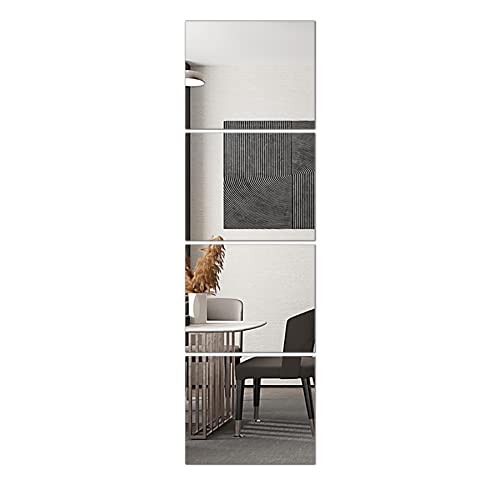
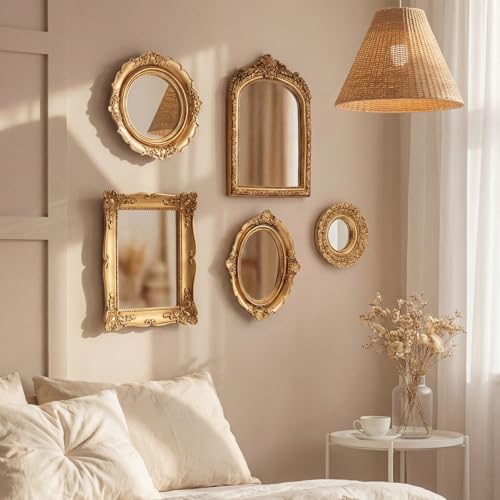

As an Amazon Associate we earn from qualifying purchases at no extra cost to you. Ratings are shown as listed on Amazon.
| Situation | Useful starting point | What to check |
|---|---|---|
| Small entry or powder room | Three mirrors, each about 8–12 inches across | Leave roughly 2–3 inches between frames; avoid crowding switches and trim. |
| Wall above a console or sofa | Three to five mirrors, each about 10–16 inches across | Keep the display narrower than the furniture where possible, and account for the full frame width. |
| Large dining or living-room wall | Five or more pieces, often 12–20 inches across | Sketch the entire arrangement first; several small mirrors can look scattered on a broad wall. |
| Rental or frequent rearranging | Small, light mirrors with a clearly stated mounting method | Confirm whether the hardware requires a screw, nail, adhesive, or a combination. |
These are planning ranges, not rules. A set of five 10-inch mirrors is not automatically a 50-inch-wide display: the final width depends on the layout and spacing. Measure the complete proposed arrangement, including gaps and frame edges, before ordering.
Calculate the arrangement before you buy
Use painter’s tape or paper cutouts to mark each mirror’s outside dimensions on the wall. This reveals whether the display fits above furniture and whether the spacing feels deliberate. For a single row, calculate the width as the sum of each mirror’s width plus the gaps between them.
Example: Three 12-inch-wide mirrors with two 3-inch gaps need 42 inches of wall width: (3 × 12) + (2 × 3) = 42 inches. If you center that row above a 60-inch console, it leaves 9 inches of console width on either side. Check the arrangement’s height as well, especially near a doorway, shelf, or ceiling slope.
For staggered or clustered layouts, measure the outermost edges instead of adding every mirror’s width. Save the paper template or a simple drawing with each piece labeled; it makes installation and future rehanging easier.
Compare materials, weight, and upkeep
Frame material affects the look, but also how much care the set may need. “Metal,” “wood,” and “resin” cover a wide range of finishes and construction, so read the product specifications rather than assuming a particular material is heavy or durable.
- Wood: Adds warmth and suits natural or traditional rooms. Check whether the frame is solid wood or a wood-based material, and keep it away from persistent moisture unless the maker specifies bathroom suitability.
- Metal: Works well with clean-lined or industrial interiors. Inspect the finish description and edges; coatings can scuff if frames knock together during installation or cleaning.
- Resin or plastic: Often allows ornate shapes at a lighter weight. Look closely at close-up images and dimensions, since a molded finish may read differently from wood or metal in person.
- Frameless glass: Creates a quieter, less visually heavy display. Confirm how each piece is secured and whether the edges are finished; frameless pieces still require careful handling.
For day-to-day care, use a soft microfiber cloth and a glass cleaner applied to the cloth rather than sprayed directly onto the mirror. Liquid can seep behind the glass and damage the backing over time. Avoid abrasive pads and harsh cleaners on both the mirror and frame finish. The most vulnerable points are often the corners, mounting hardware, and reflective backing—not the center of the glass.
Plan hanging around the total load
Do not judge wall safety by the weight of one mirror. Add the weights of every piece and consider how each one attaches. A five-piece set weighing 2 pounds per mirror has a combined mirror weight of 10 pounds, before accounting for hardware. That total does not mean one fastener can safely hold the set: each mirror’s own mounting point and the wall material matter.
Check the manufacturer’s stated weight for each mirror, not just the shipping weight of the box. Shipping weight includes packaging and is not a useful substitute for installation weight. Then identify the wall: drywall, plaster, masonry, and tile need different fasteners. Whenever possible, fasten into a stud or use an anchor rated for the wall type and load. Follow the fastener maker’s instructions, and do not assume a nail or adhesive strip is suitable because it worked for a lighter picture.
For a rental, an adhesive-mounted set may sound convenient, but wall texture, paint condition, humidity, and the mirror’s weight can affect adhesion. Confirm the product’s stated limits and removal guidance first. If any piece feels unstable or the wall surface is damaged, choose a safer mounting approach rather than relying on an uncertain hold.
Pick a hanging layout that suits the set
- Even row: Best for similar-sized mirrors above a console or headboard. Measure the gap between frame edges, not between hanging points.
- Symmetrical cluster: Useful for a balanced look over a central feature. Lay out the largest pieces first and fill the spaces with smaller ones.
- Loose gallery arrangement: Works with mixed shapes, but needs a clear visual boundary. Keep the outside edges within a planned rectangle so the display does not drift across the wall.
- Vertical stack: A practical choice for a narrow wall or beside a doorway. Check that the lowest mirror will not be blocked by furniture.
Sets with a hanging template or individually labeled pieces can reduce measuring mistakes. Still, verify that the template corresponds to the mirror’s actual outside dimensions and that the included hardware suits your wall. Some sets include hanging loops but no wall fasteners, so check the package details before installation.
What to prioritize at different budgets
At a lower price, prioritize accurate measurements, secure mounting points, and a finish that looks consistent across the set. A simple frame with reliable hardware is often a better buy than elaborate detailing paired with unclear weight information. At a mid-range price, look for better-finished frame joints, matching color across all pieces, and a useful layout guide. At the higher end, you may find heavier materials or distinctive shapes, but those features can increase both installation demands and shipping costs.
Before checkout, verify the dimensions of every mirror, the number of pieces, the assembled layout or spacing guidance, per-piece weight, frame material, and included hardware. If the listing omits weight or mounting details, ask the seller or choose a set with clearer specifications. A coordinated set earns its place when it fits the wall, suits the room, and can be hung securely—not simply because all its mirrors match.




Write Your Review
No reviews yet. Be the first to share your experience!